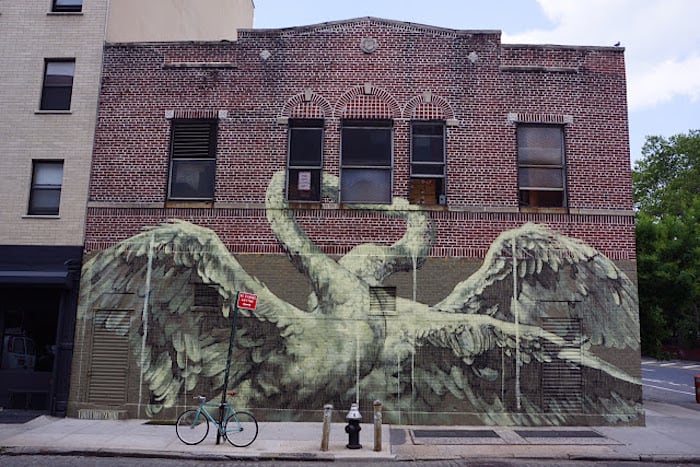
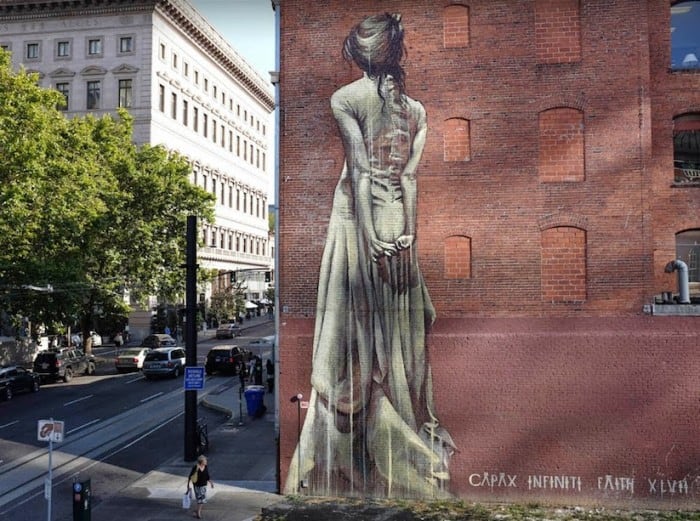
Faith47 is a South African visual artist known for large-scale murals, drawing, printmaking, video, and installation work that moves between the street and the gallery. Her practice uses the language of urban ruin, sacred objects, and human figures to explore memory, vulnerability, power, and spiritual searching.
- Faith47 works across mural painting, printmaking, projection mapping, video installation, drawings, and assemblage.
- Her imagery often comes from cities, derelict buildings, animals, and figures marked by erosion, tenderness, or ritual.
- She is associated with street art, but her work is not limited to walls; she also builds gallery pieces from found and rescued materials.
- Her art often treats decay as a site of attention rather than neglect, giving worn surfaces and abandoned spaces a new role.
- She is known for combining technical control with a quiet, reflective mood.
Where did Faith47 come from?
Faith47 emerged from South Africa’s urban art and mural scene and later developed into an international practice based in Los Angeles. Over roughly two decades, she built a reputation for making work in public space, where scale, architecture, and weather become part of the image. That background still shapes her art, even when it appears in museums or galleries.
Her name became attached to a body of work that travels easily between contexts: a painted wall in a city, a print on paper, a sculptural shrine, or a projected image inside a dark room. That mobility matters because it reflects one of the central concerns of her practice: how images carry meaning differently depending on the surface, the site, and the viewer’s distance.
What does her work look like in practice?
Faith47’s images often show solitary figures, animals, birds, hands, or symbolic fragments arranged with careful restraint. The palette tends toward muted tones, soot-like blacks, faded whites, rust, and weathered greys, though she also uses stronger color when the composition calls for it. Even when the work is highly controlled, it keeps a sense of abrasion, as if the image has emerged from a damaged wall or a remembered dream.
Materially, her practice is broad. She uses found and rescued objects, shrine-like constructions, painting, projection mapping, video installation, printmaking, and drawing. This range gives her work a tactile character: paper fibers, cracked paint, shadow, and object placement all help build atmosphere. The result is less like illustration and more like a set of visual propositions about presence, loss, and endurance.
Why do murals matter in her practice?
Murals are one of Faith47’s defining forms because they let her work at the scale of the city itself. A mural has to negotiate architecture, street life, and public visibility, so it turns the building into part of the composition. In her case, the wall is rarely just a support; it is also subject matter, especially when she paints over surfaces already marked by age, exposure, or neglect.
This matters because her murals often reclaim spaces that might otherwise be read as forgotten or worthless. Rather than polishing away damage, she treats wear as evidence of lived history. That approach gives her public work a strong emotional register without turning it into simple decoration. The wall becomes a site where beauty and ruin stay in tension.
What ideas shape Faith47’s imagery?
Faith47’s work returns again and again to duality: intimacy and distance, collapse and care, body and spirit, presence and disappearance. Her imagery often feels devotional without belonging to any single religion. Shrines, offerings, and still figures appear as ways of thinking about attention and reverence rather than doctrine.
She also draws on the psychological charge of animals and urban fragments. A bird, a skull, a hand, or a face may appear as a symbol, but the image usually remains open rather than fixed. That openness is important to her practice. It allows the work to hold private feeling and public history at the same time, without forcing one to explain the other.
Frequently Asked Questions
Is Faith47 a street artist or a gallery artist?
She is both. Her career began with mural and street-based work, but she has long made pieces for galleries and institutions as well. The split is less important than the continuity between them: she uses the same visual concerns across walls, prints, installations, and objects.
Why do ruined buildings appear so often in discussions of her work?
Ruined buildings matter to Faith47 because she reads them as records of use, abandonment, and social change. Instead of treating decay as failure, she often frames it as a surface with its own dignity. That gives her work a strong ethical edge, especially in cities where demolition and exclusion shape who gets seen.
What makes her work different from other muralists?
Her murals often feel quieter and more contemplative than the brightly graphic style associated with much street art. She leans toward atmosphere, symbolism, and material restraint rather than slogans or spectacle. That gives her work a more reflective, sometimes spiritual tone, even when it remains firmly rooted in public space.
Articles mentioning Faith47