
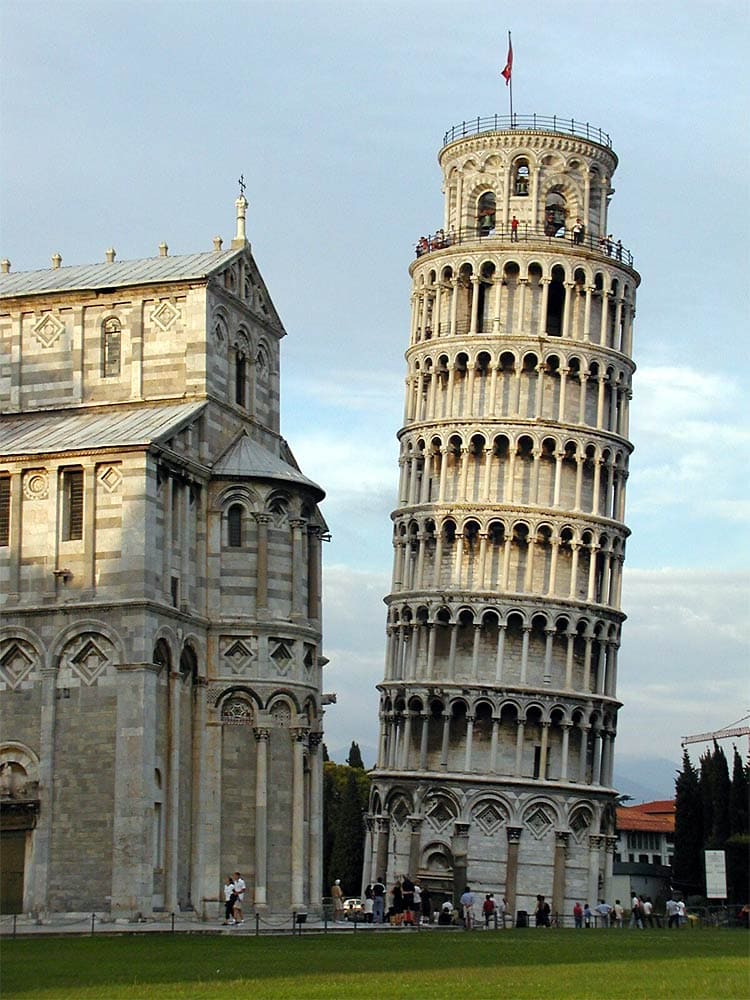
Pisa is a city in Tuscany, central Italy, on the lower River Arno near the Tyrrhenian Sea. It is the capital of the Province of Pisa and is best known internationally for its leaning tower, but the city’s historic fabric includes churches, palaces, bridges, and long stretches of riverfront that still shape daily life.
| Type | City and provincial capital |
|---|---|
| Region | Tuscany, Italy |
| River | Arno |
| Sea | Tyrrhenian Sea |
| Population | About 88,000 in the city, roughly 200,000 in the metropolitan area |
| Known for | Leaning Tower, Romanesque architecture, historic river crossings |
What makes Pisa distinct?
Pisa’s identity comes from the way its built environment and geography overlap. The city grew along the Arno, a route that supported trade, administration, and building activity, and its historic core still reflects that river-based urban pattern. The famous tower is only one part of a larger architectural landscape that includes the cathedral complex, medieval churches, civic palaces, and bridges that connect the two sides of the city.
That mix matters for visual culture because Pisa offers a compact example of how a city can become globally recognisable through a single structure while still remaining a dense historical place. The tower’s tilt has made it a symbol, but the surrounding stonework, marble facades, and river crossings give the city its actual character.
Why is Pisa famous?
Pisa became famous largely because of the bell tower of the cathedral, commonly called the Leaning Tower of Pisa. Its slant came from unstable ground and an early foundation problem, then became more pronounced over time. The tower’s unintended angle turned it into one of the most photographed buildings in the world and a shorthand for architectural eccentricity.
That fame can obscure the rest of the city, but Pisa was historically important long before it became a tourist icon. It was a maritime and commercial centre in the Middle Ages, and that older power is still visible in the scale of its churches, the ambition of its public buildings, and the survival of monuments made from stone and marble.
What does Pisa look like in practice?
Pisa is a city of measured streets, pale masonry, and river light. Its best-known monuments use Romanesque forms: rounded arches, striped marble, sculpted facades, and a restrained but precise decorative language. The cathedral complex, known as the Piazza dei Miracoli ensemble, shows how architecture, carving, and open space work together as a single visual composition.
Outside the famous square, the city is less monumental but still materially rich. Historic bridges cross the Arno, churches punctuate neighbourhoods, and palaces line older streets. For artists and photographers, Pisa offers both an iconic image and a wider urban texture of walls, courtyards, arcades, and river reflections.
How has Pisa been used in art and image-making?
Pisa appears often in drawing, print, photography, and travel imagery because it is instantly legible. The leaning tower functions as a ready-made motif: a building that can be framed quickly, understood quickly, and altered visually through perspective, scale, or collage. That makes the city useful to artists who want to test how far a recognisable landmark can be transformed before it stops being itself.
At the same time, Pisa rewards slower looking. Its buildings show the craft of stone cutting, masonry, and architectural composition, while the city’s river setting adds changing weather, shadow, and reflection. In practice, Pisa is less a single image than a set of materials and forms that can be isolated, repeated, or rearranged.
Frequently Asked Questions
Is Pisa only important because of the Leaning Tower?
No. The tower is the most famous part of the city, but Pisa has a broader historical and architectural importance. Its cathedral complex, churches, palaces, and bridges show the city’s earlier role as a significant Tuscan centre.
The tower dominates public memory because it is so visually unusual. The city itself is more complex, with a long urban history shaped by the Arno and by medieval building traditions.
What kind of architecture is Pisa known for?
Pisa is especially associated with Romanesque architecture, particularly the Pisan Romanesque style. This often includes white and grey marble, rounded arches, layered arcades, and carved ornament.
Those features are visible in the cathedral ensemble and in other historic buildings across the city. The style gives Pisa a clear visual identity even beyond its most famous monument.
Where is Pisa in Italy?
Pisa is in Tuscany, in central Italy, near the mouth of the River Arno on the Tyrrhenian Sea. That position helped make it an important port and trading city in earlier periods.
Today it remains a provincial capital and a major cultural destination. Its location still shapes the city’s light, landscape, and relationship to the river.
At a glance
- Address
- Province of Pisa, Italy
- Coordinates
- 43.716667, 10.4
Articles mentioning Pisa
