
Alexander Semenov is a Russian marine biologist and underwater photographer known for scientific macrophotography of small marine animals in their natural habitats. He works at Moscow State University’s White Sea Biological Station, where he heads a dive team that supports underwater research in harsh Arctic and sub-Arctic conditions. His photographs have helped bring obscure plankton, jellyfish, and other invertebrates into public view.
Alexander Semenov’s work on FreeYork
All 5 stories


About Alexander Semenov
- Marine biologist focused on invertebrate animals and underwater fieldwork
- Head of the Divers’ team at Moscow State University’s White Sea Biological Station
- Specialises in scientific macrophotography in natural environments
- Photographs organisms that are difficult to study in laboratories, including soft-bodied plankton and seafloor life
- Known for public-facing science communication through lectures, exhibitions, media, and social platforms
What does Alexander Semenov do?
Semenov combines field biology and photography. His scientific work centres on marine invertebrates, especially organisms that are fragile, transparent, tiny, or adapted to conditions that make standard lab observation difficult. As a photographer, he uses close-up imaging underwater to document the shapes, colours, movement, and textures of species that most people never see clearly.
That combination matters because many marine animals lose their form, colour, or behaviour when removed from the sea. By photographing them where they live, Semenov preserves visual evidence of how they actually look and move. His images are not just aesthetic objects; they are also field records.
Why is his underwater photography important?
Scientific macrophotography in the ocean requires more than a camera. It depends on diving skill, patience, fast handling, and an understanding of animal behaviour. Lighting has to be managed carefully, water movement can ruin focus, and the subject may be drifting, pulsing, or almost transparent. Semenov’s practice is demanding because he often works in cold, dark, and unstable conditions where equipment and timing both matter.
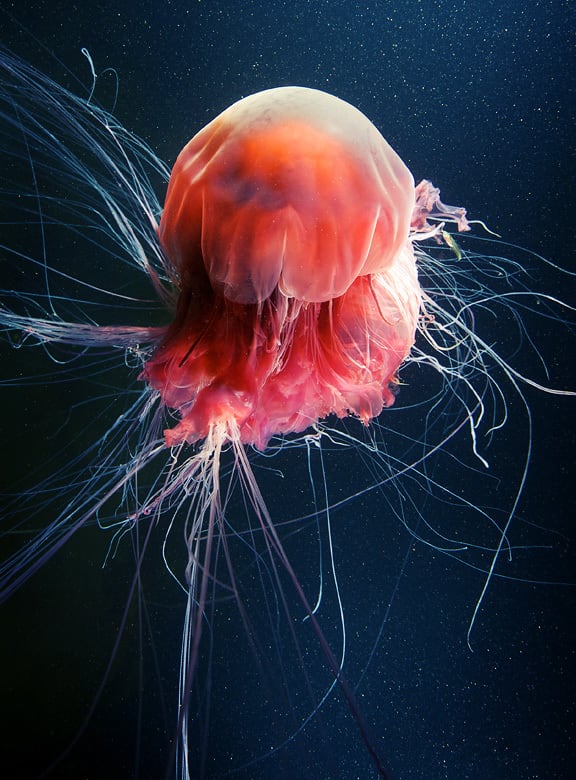
This approach expands what marine biology can show in public. Jellyfish bells, comb jellies, larval forms, and other small organisms often appear abstract or invisible in ordinary documentation. Semenov’s photographs make them legible. They also show that scientific imaging can be beautiful without giving up accuracy.
Where did his work come from?
Semenov’s career grew out of academic marine biology and station-based field research rather than studio photography. The White Sea Biological Station, part of Moscow State University, gives him direct access to seasonal marine environments and diving work that supports research projects. That setting shaped both his subject matter and his method: observe animals alive, underwater, and in context.
His public reputation developed through repeated publication and collaboration with major science and culture outlets, including National Geographic, BBC, Nature, Science, and the Smithsonian Institution. Those collaborations brought his images to wider audiences, but the core of the work remains the same: documenting marine life through sustained field observation.
How is his work used in practice?
In practice, Semenov’s work sits between science, documentation, and outreach. He uses photography to study animals, but he also uses it to communicate marine biology to non-specialists. Public lectures, exhibitions, films, and social media posts extend the life of the images beyond the field season and the research station.
The visual style usually emphasises a subject isolated against water or dark background, with crisp edges, luminous transparency, and vivid structural detail. The result is often striking, but the main purpose is descriptive: to reveal anatomy, motion, and behaviour that would otherwise remain hidden. That makes his work useful to researchers, educators, and publishers alike.
Questions
Is Alexander Semenov mainly a scientist or a photographer?
He is both, but the scientific side comes first. His photography grows out of marine biology and field research, rather than from commercial or purely artistic practice. The two roles support each other: biology gives the subject matter, and photography makes it visible.
What kinds of animals does he photograph?
He focuses on marine invertebrates, especially soft-bodied or delicate organisms. That includes planktonic life, jellyfish, and other seafloor or open-water species that are hard to study once removed from the ocean. Many of these animals are small, transparent, or easily damaged.
Why are his pictures often taken underwater instead of in a lab?
Many marine organisms change quickly when handled or placed in artificial conditions. Underwater photography lets Semenov capture their natural form, colour, and movement in place. That produces images that are both scientifically useful and visually precise.
