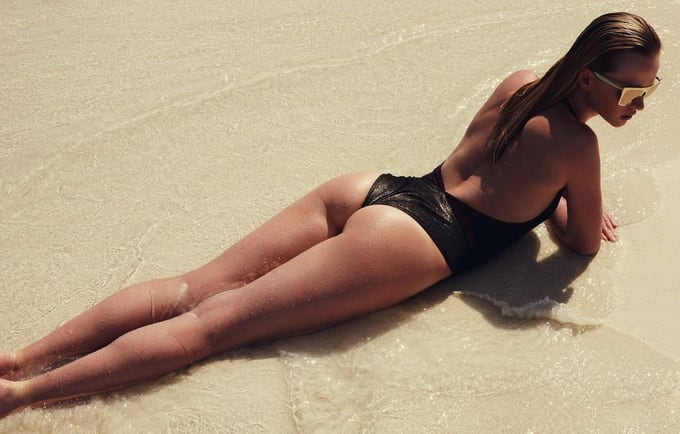
Anne Vyalitsyna is a Russian fashion and swimwear model known for a long run in the Sports Illustrated Swimsuit Issue and for editorials that rely on clear movement, athletic poise, and a polished, directional face. She built her career in the 2000s as one of the most visible models working between commercial campaigns, magazine fashion stories, and lingerie and swimwear photography.
| Born | 1986, Nizhny Novgorod, Russia |
|---|---|
| Also known as | Anne V |
| Field | Fashion, swimwear, and lingerie modelling |
| Known for | Nine consecutive appearances in the Sports Illustrated Swimsuit Issue, 2005–2013 |
| Work context | Editorials, advertising campaigns, runway, and commercial print |
How did Anne Vyalitsyna become widely known?
Vyalitsyna came up through the Russian modelling system and reached international visibility in the early 2000s, when fashion magazines and brand campaigns were still tightly tied to a small group of globally recognisable models. Her name became especially familiar in the United States because of Sports Illustrated, where she appeared year after year from 2005 to 2013. That repeated presence made her less of a one-off cover subject than a recurring figure in the magazine’s visual language.
She worked under the shortened professional name Anne V, a common move in modelling where a compact name reads better in castings, credits, and magazine layouts. That branding also suited her image: clean, concise, and easy to remember. Her career shows how a model can move between high-visibility commercial image-making and fashion editorial work without being fixed to one category.
What does her modelling look like in practice?
Vyalitsyna’s modelling style is built on motion and structure. She often reads as athletic rather than overly posed, with a direct gaze and a body line that suits swimwear, lingerie, and fitted fashion. In practice, that means photographs frequently rely on a sense of energy: a twist through the torso, an extended leg, a hand in motion, or a stance that keeps the frame from becoming static.
Editors and photographers have used that quality in different ways. In commercial work, it supports the persuasive clarity that swimwear and beauty campaigns need. In fashion editorials, it gives stylists room to place her in sharper tailoring, sheer fabrics, or minimal sets without losing visual momentum. Her face and body language work well in images that aim for accessible glamour rather than abstraction.
Why did the Sports Illustrated run matter?
Nine consecutive appearances in the Sports Illustrated Swimsuit Issue made Vyalitsyna unusual even in a field that rewards repeat exposure. The issue functions less like a normal fashion magazine and more like a media event, combining swimwear, celebrity culture, and mass-market advertising. Staying visible there across nearly a decade means remaining part of a very large and highly public image cycle.
That kind of run matters because it stabilises a model’s public identity. A single editorial can introduce a face, but repeated annual appearances make the face familiar. For Vyalitsyna, the Sports Illustrated association anchored her in popular culture while she continued to work in the fashion press, where photographers such as Ben Hassett and magazines such as Numéro and Elle France use a model’s recognisability as part of the image’s effect.
Where does she sit in fashion image-making?
Vyalitsyna belongs to a generation of models who bridged glossy commercial beauty work and more authored magazine fashion stories. That position matters because it reflects how fashion photography was organised in the 2000s and early 2010s: models were expected to carry campaigns, sell products, and still adapt to editorial narratives shaped by a photographer’s lighting, styling, and composition.
Her work in publications such as Elle France and Numéro shows that adaptability. In those settings, the image is not just about looking attractive; it has to respond to wardrobe, set design, and the photographer’s point of view. A successful model can make a fabric seem heavier, a silhouette sharper, or a scene more relaxed. Vyalitsyna’s career rests on that practical skill as much as on fame.
Frequently Asked Questions
Is Anne Vyalitsyna mainly a fashion model or a swimwear model?
She is both, though much of her public recognition comes from swimwear and lingerie imagery. The Sports Illustrated Swimsuit Issue made her especially visible, but her editorial work in fashion magazines shows a broader range. In practice, her career sits between commercial swimwear, beauty, and fashion editorial modelling.
Why is she sometimes called Anne V?
Anne V is a shortened professional name used in modelling and fashion media. Short names are easier to place in magazine credits, advertising, and casting lists, and they can also sharpen a public identity. In her case, the abbreviation became part of her brand without replacing her full name entirely.
What kind of photographers and magazines has she worked with?
She has appeared in glossy fashion publications and image-led editorials, including work credited in Elle France and Numéro. The relevant context is not only the publication name but the type of image-making: controlled lighting, styling-led shoots, and photographers who use pose and attitude as core visual tools. Her career is closely tied to that fashion-editorial system.
Articles mentioning Anne Vyalitsyna