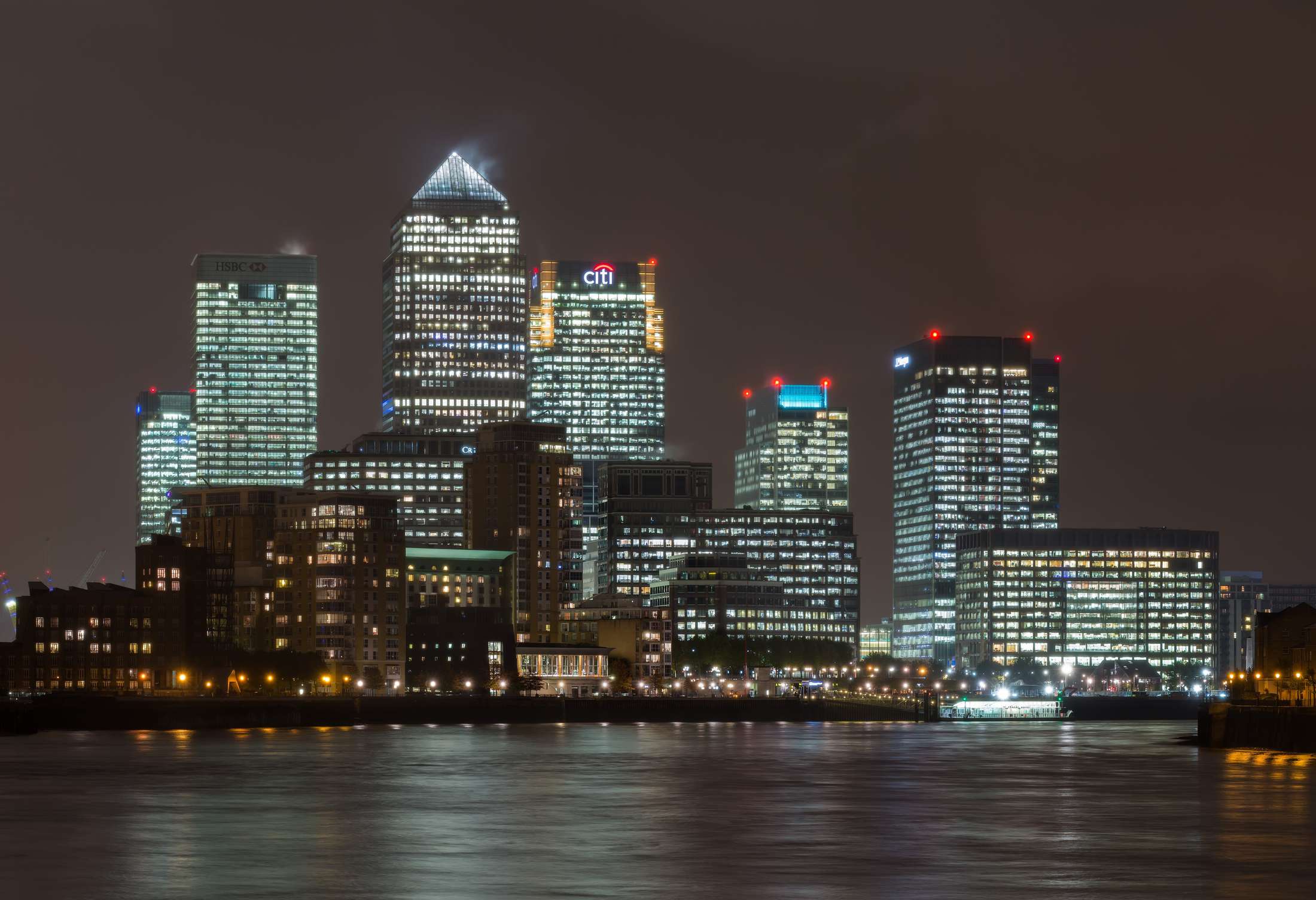
Canary Wharf

Canary Wharf is a business district in Tower Hamlets, east London, built on former docklands and now known for its cluster of office towers, retail concourses, and transport hubs. It is one of London’s two main financial centres, alongside the City of London, and it has become a familiar backdrop for corporate headquarters, media shoots, and contemporary fashion imagery.

  • Located on the Isle of Dogs in the London Borough of Tower Hamlets.
  • Developed from former West India Docks and surrounding dockland land.
  • Best known for its dense office estate, underground shopping arcades, and tall glass-and-steel towers.
  • Contains One Canada Square, long the signature tower of the district and still one of the tallest buildings in the UK.
  • Combines finance, retail, public art, and transport infrastructure in a tightly planned urban environment.

How did Canary Wharf get its modern form?

Canary Wharf’s present shape grew out of the collapse of London’s dock system and the later redevelopment of derelict docklands. The area once handled shipping connected to the West India trade; by the late twentieth century, containerisation and changing logistics had emptied the docks. That vacuum made space for one of the most ambitious regeneration projects in Britain.

Development accelerated in the 1980s and 1990s with a plan to create a new financial district from scratch. The result was a private, highly managed urban core: tall towers, polished public plazas, extensive underground circulation, and a direct link to global capital. The district’s architecture signals that purpose plainly, with reflective façades, hard edges, and a scale designed to project corporate power.

What does Canary Wharf look like in practice?

Canary Wharf is defined by height, glass, metal, and compression. Streets give way to elevated walkways, subterranean shopping levels, and broad paved spaces framed by tower blocks. Many buildings are wrapped in curtain wall systems that mirror the sky and neighbouring towers, giving the district a cool, uniform sheen. One Canada Square remains the most recognisable element, with its pyramid top and sharply vertical profile.

The district is not only an office zone. Its malls, station concourses, restaurants, and event spaces make it a daily destination for workers and visitors. Public art and seasonal installations soften the severity of the setting, but the overall feel remains controlled and commercial. In visual terms, Canary Wharf offers a shorthand for late-capitalist London: clean lines, dense finance, and an urban landscape built to serve circulation, consumption, and work.

Why does Canary Wharf matter in visual culture?

Canary Wharf matters because it helped redefine what central London could look like at the end of the twentieth century. Instead of spreading finance through older streets and masonry blocks, it concentrated it in a new built environment that embraced modern tower construction and privately managed public space. That shift influenced how architects, planners, photographers, and stylists thought about business districts.

For image-makers, the area provides a very specific set of surfaces and cues: mirrored façades, polished stone floors, geometric interiors, and a skyline dominated by corporate towers. Those features make it useful as a setting for editorials that need order, ambition, or metropolitan gloss. In fashion and art contexts, Canary Wharf often stands in for wealth, labour, aspiration, or the impersonality of global finance.

Who controls and uses it?

A large share of Canary Wharf is owned and managed by Canary Wharf Group, which has shaped the district’s development and maintenance over time. The company’s role matters because the place operates less like a traditional mixed street network and more like a coordinated estate. Planning, security, leasing, and public realm management all contribute to its unusually uniform character.

The area houses banks, law firms, insurers, media companies, and related service businesses. Its population changes through the day, with heavy commuter traffic and far fewer permanent residents than in surrounding neighbourhoods. That turnover affects how the district reads visually: busy at peak hours, sparse at others, and always marked by the rhythms of corporate work.

Frequently Asked Questions

Is Canary Wharf the same as the City of London?

No. The City of London is the older financial district, with its own long history, institutions, and street pattern. Canary Wharf is a later development in east London, created as a modern financial centre on former dockland. The two areas now function as London’s main finance hubs, but they have very different origins and urban forms.

Why is Canary Wharf full of tall buildings?

The district was planned to concentrate large numbers of offices on a redeveloped site with room for high-density construction. Tall towers made commercial sense because they maximised floor space and announced the area’s role as a global financial centre. Their glass-and-steel appearance also helped establish a recognisable image for the new business district.

Why does Canary Wharf appear in fashion and editorial photography?

Its surfaces and architecture create a strong visual language: polished, modern, controlled, and unmistakably urban. Those qualities suit images that want to suggest power, professionalism, affluence, or distance. The district’s plazas, towers, and underground retail spaces also offer varied backdrops without leaving the same tightly managed environment.