
Carlos Amorales is a Mexican contemporary artist known for building artworks from repeatable systems: drawing archives, silhouettes, print-based multiples, animation, performance, and installations that can spread across a room like a pattern or swarm. Born in 1970, he lives and works in Mexico City. His work often turns simple graphic forms into something unstable and theatrical, using repetition to suggest migration, crowding, disguise, and loss of control.
Carlos Amorales on FreeYork
What kind of artist is Carlos Amorales?
Amorales works across media, but his practice is recognisable for its use of a strict visual vocabulary. He often starts with a limited set of shapes, especially black silhouettes, then repeats and recombines them across paper, walls, screens, sound, and staged environments. This makes his work feel both controlled and unruly: the same form can read as decorative, political, comic, or threatening depending on how it is deployed.
That approach matters in visual culture because it treats images as systems rather than isolated objects. Instead of making a single painting or sculpture stand alone, Amorales often produces a structure that can multiply. The result is work that behaves like a score, an archive, or a graphic language put under pressure.
Where did his visual language come from?
Amorales emerged in the 1990s, when many artists were rethinking the image after the dominance of painting and the rise of installation, appropriation, and new media. His work draws on the traditions of printmaking, animation, and conceptual art, but it also has roots in children’s books, folklore, comics, and folk-like cut-paper imagery. The black silhouette is central because it is instantly legible and easy to reproduce, yet it removes detail and identity at the same time.
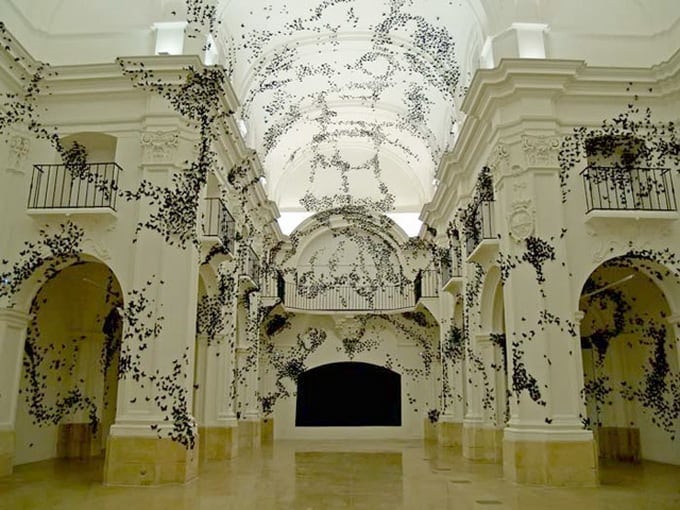
That reduction gives his work its tension. A shape can become a moth, a mask, a bird, a crowd, or a stain depending on context. In several projects he has used thousands of cut or printed units to build fields of forms that suggest movement and migration without illustrating a fixed story. The method is as important as the final image: copying, sorting, and installing become part of the meaning.
What does his work look like in practice?
In exhibitions, Amorales’ work often appears as walls covered in dark cut-outs, dense collages, projected animations, or sculptural arrangements that occupy the viewer’s space. The forms can be flat and graphic, but the installation gives them physical presence. A piece like Black Cloud uses thousands of black paper moths to transform a gallery wall into a swarm, turning a simple motif into an environment that feels mobile and unsettled.
He also extends these systems into performance and sound. In some works, performers activate graphic materials or musical scores, and in others animation gives life to figures that remain intentionally generic. The result is not illustration in the usual sense. It is closer to choreography for images, where repetition and variation generate emotion.
Why does Carlos Amorales matter?
Amorales matters because he shows how a restricted visual system can carry a wide range of ideas. His work links graphic design, installation art, and political unease without relying on narrative explanation. The black silhouette, repeated until it fills a room, can speak about anonymity, mass movement, imitation, or disappearance.
For designers and artists, his practice is a useful example of how form can produce meaning before content does. Materials are often plain and direct: paper, cut vinyl, projection, drawing, sound, simple theatrical staging. What gives the work force is the discipline of its rules and the way those rules are pushed until they start to break.
Questions
Is Carlos Amorales mainly a painter?
No. Painting is only one part of a broader practice that includes installation, animation, drawing, performance, and sound. He is better understood as a visual artist who builds temporary worlds from graphic elements and repeatable forms. That flexibility is central to his work.
Why does he use black silhouettes so often?
The silhouette is simple, portable, and easy to multiply, which makes it ideal for systems based on repetition. It also strips away detail, so the viewer sees shape before identity. That allows the same figure to shift between meanings: decorative, eerie, playful, or political.
What is the connection between his work and installation art?
Many of his works are not meant to be viewed as single framed images. They are installed across walls, floors, or rooms so that the viewer moves through them as an environment. This spatial format is essential, because repetition and scale are what turn his graphic language into something immersive.