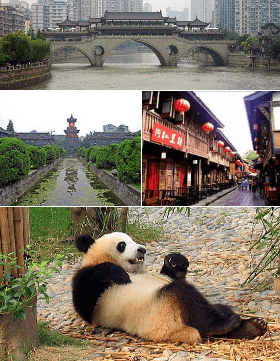
Chengdu is the capital of Sichuan province in Southwest China and one of the region’s main centres for government, transport, commerce, and culture. Formerly transliterated as Chengtu, it has sub-provincial administrative status and a large metropolitan population spread across the municipality and its surrounding districts and counties. Its size and long urban history have made it a practical base for makers, manufacturers, studios, and institutions working across western China.
- Capital of Sichuan province, in Southwest China
- Sub-provincial city with major administrative weight
- Large metropolitan area with more than 14 million inhabitants
- Important hub for transport, communication, and industry in western China
- Often appears in art and design as a place of production, circulation, and contemporary urban life
What is Chengdu known for?
Chengdu is best known as a major inland Chinese city with a strong regional identity. It anchors the Chengdu Plain, a fertile area that supported dense settlement for centuries, and it now functions as a gateway between eastern China and the southwest. That position matters in visual culture because cities with dense transport networks and large consumer markets tend to attract galleries, publishers, filmmakers, photographers, and design practices.
In everyday life, Chengdu is associated with a slower public rhythm than some of China’s faster-moving coastal cities, but that reputation sits alongside rapid urban growth. New districts, commercial centres, and infrastructure have expanded the city’s footprint, while older streets, teahouses, and neighbourhood markets continue to shape how the city looks and feels on the ground.
Why does Chengdu matter in art and design?
Chengdu matters because it is not only a provincial capital but also a production environment. It supports institutions, studios, printing, display, and distribution across a large catchment area. For artists and designers working in western China, the city can function as a local base that still connects to national and international circuits.
Its presence in contemporary visual work often comes through urban scenes, regional identity, and the tension between tradition and redevelopment. Photographers may use Chengdu to show changing city life; artists may treat it as a site where local customs, state planning, and modern consumption meet. That combination gives the city a clear visual character without reducing it to a single image.
What does Chengdu look like in practice?
Chengdu’s built environment mixes wide roads, high-rise commercial districts, ring roads, older residential blocks, and pockets of low-rise street life. Teahouses, food stalls, parks, and public squares still shape the social use of space, even as new transport links and business districts redefine the city’s centre of gravity. The result is a city that can feel both expansive and intimate.
For makers and cultural producers, that mix creates different kinds of working conditions. Large institutions and corporate clients sit alongside independent studios and local craftspeople. In visual terms, Chengdu often appears as a city of surfaces: glass towers, concrete infrastructure, steam, signage, tiled courtyards, and dense street activity.
How has Chengdu been represented in contemporary work?
Recent art and photography often use Chengdu as a lens on modern China beyond the coastal megacities. In that context, the city can stand for western urbanisation, regional memory, and the material changes brought by development. Works set in Chengdu may show construction sites, public life, domestic interiors, or local landmarks rather than landmark architecture alone.
The city also carries a strong sense of place in projects that value atmosphere and rhythm. Its food culture, public leisure spaces, and everyday street scenes provide a rich visual vocabulary. That makes Chengdu useful to artists who want to show how a city is lived in, not just how it is planned.
Frequently Asked Questions
Is Chengdu a city or a province?
Chengdu is a city and the capital of Sichuan province. It is governed as a sub-provincial city, which gives it more administrative weight than an ordinary prefecture-level city. In practical terms, it operates as the political and economic centre of the province.
Why do artists and photographers use Chengdu as a subject?
Artists and photographers use Chengdu because it offers a distinct urban setting with strong regional character. The city combines older neighbourhood life, public leisure culture, and rapid modern development, which creates useful contrasts in images. It is also an important base for people working across western China, so it appears both as subject matter and as a working location.
What is the difference between Chengdu and Chengtu?
Chengtu is an older transliteration of the city’s name in English-language sources. Chengdu is the standard modern form. Both refer to the same city in Sichuan province.