
French artist and designer Christophe Guinet works at the intersection of street culture, botany, and sculpture. Best known under the name “Monsieur Plant,” Guinet transforms everyday objects into living ecosystems, embedding sneakers, luxury accessories, musical instruments, and urban artifacts with moss, bark, flowers, fungi, and roots. His work sits somewhere between land art, design intervention, and ecological commentary.
Christophe Guinet on FreeYork
 Christophe Guinet Merges AI and Nature in His ‘Nature 2.0’ Robot Adorned with Living Plants
 From Streetwear to Garden: The Bonzai Sneaker Collection
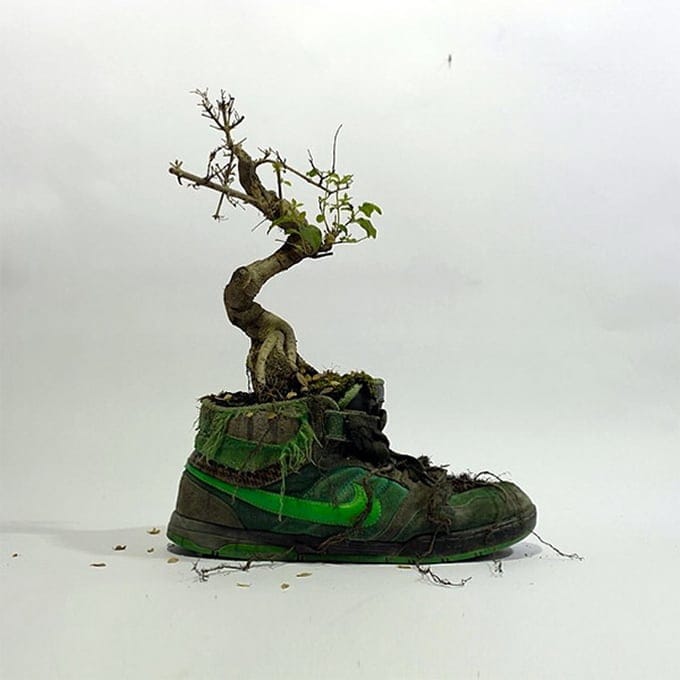 Just Grow It: French Artist Transforms Nike Sneakers Into Blooming Plant Gardens
 “Just Grow It ! – Les Sneakers Végétales” by French Artist Monsieur Plant
About Christophe Guinet
Rather than treating nature as decoration, Guinet uses it as an active force reclaiming manufactured objects. A pair of sneakers cracks open with tree bark. A Louis Vuitton bag erupts with mushrooms. Skateboards sprout moss and vines. The contrast is deliberate: industrial perfection versus organic unpredictability.
Guinet originally worked in advertising and visual communication before shifting fully into art. That commercial background still shapes his compositions. The pieces are photographed with the precision of luxury campaigns, but the message often critiques consumerism and disposability. Nature becomes both collaborator and disruptor.
One of his most recognized series reimagines iconic sneakers overtaken by plants and fungi. Instead of presenting footwear as pristine status symbols, the works suggest a future where nature inevitably outlives human branding. The same idea appears throughout his practice: no object remains untouched forever.
Guinet’s process combines real organic material with sculptural construction. Some works use preserved plants and fungi, while others are built through meticulous mixed-media fabrication. Texture plays a major role. Cracked leather, damp moss, rough bark, and polished surfaces coexist in ways that feel simultaneously luxurious and decayed.
His work has been exhibited internationally across galleries, fashion collaborations, and design festivals. Brands often approach him because his aesthetic naturally bridges contemporary art and high-end visual culture without feeling purely commercial.
What makes Guinet’s work resonate is the tension it creates. The objects feel familiar, but their transformation feels irreversible. The pieces are less about destruction and more about reminding viewers that nature is never fully controlled, no matter how engineered modern life becomes.