Daan Roosegaarde is a Dutch artist and designer known for large-scale interactive works that combine light, landscape, sensors, and public space. He trained in architecture at the Berlage Institute and built a practice that sits between art, design, and social experiment. His projects often use custom lighting, reflective materials, and digital control systems to make familiar environments behave in unexpected ways.
| Field | Art, design, architecture |
|---|---|
| Nationality | Dutch |
| Education | MA in Architecture, Berlage Institute |
| Studios | The Netherlands and Shanghai |
| Known for | Interactive installations, lighting systems, public-space projects |
What makes Roosegaarde’s work distinctive?
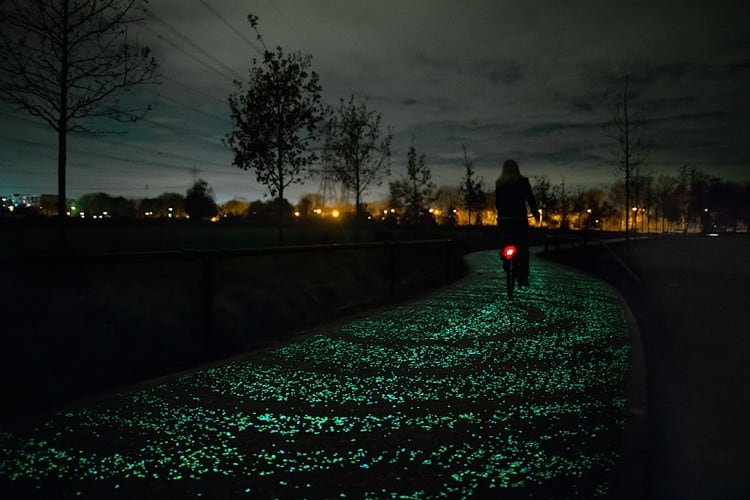
Roosegaarde’s work is usually built around a simple public experience that relies on a precise technical setup. A path glows when light charges a phosphorescent surface. A field of “dunes” responds to movement through hundreds of LEDs. A city edge becomes a canvas for environmental or sensory effects. The point is not spectacle alone; the work uses design to change how people move through a place and notice it.
That approach places him in a line of designers and artists who treat infrastructure as a medium. Materials matter in his projects: light-reactive coatings, steel structures, electronic controls, solar power, and interactive programming are all part of the final result. The work often reads as playful at first glance, but the underlying structure is usually serious engineering.
Where did he come from?
Roosegaarde studied architecture at the Berlage Institute, which helps explain the spatial ambition of his projects. Rather than making objects for galleries alone, he has often worked with public environments, from roads and landscapes to civic installations. His studio practice has expanded across the Netherlands and Shanghai, reflecting the international scale of commissions and collaborations around his work.
He also became visible through media appearances and lectures, which helped frame him as a public-facing designer rather than a studio-only maker. That visibility matters because his projects depend on public acceptance, municipal partners, and technical sponsors. Many of them are not isolated artworks; they are proposals for how shared space might function differently.
Why does Daan Roosegaarde matter?
Roosegaarde matters because he helped make interactive environmental design legible to a broad audience. His work shows that light, energy, and data can be used not only on screens but also in streets, fields, and buildings. He has been especially influential in showing how sustainability can be communicated through experience rather than through signage or statistics alone.
His work also sits inside a larger shift in contemporary design toward hybrid practice. The same project may involve digital design, material testing, engineering, and political messaging. That mix has made him a useful reference point for discussions about smart cities, public art, and design that is both technically complex and easy to understand at a glance.
What does his work look like in practice?
One of Roosegaarde’s best-known works, Dune, consists of an interactive landscape of hundreds of LEDs that flicker in response to movement. The piece turns a natural form into a responsive light field, making the landscape feel alive without hiding its artificial components. It is typical of his method: a familiar object or setting is altered with a minimal but carefully tuned system.
The same logic appears in projects such as solar-powered illuminated bike paths inspired by Vincent van Gogh’s brushwork. In that kind of work, the material base is practical and public-facing, while the surface effect is poetic. The result is not a static sculpture but an environment that changes with time, weather, and human presence.
Frequently Asked Questions
Is Daan Roosegaarde an artist or a designer?
He is both, and the distinction is part of his appeal. His projects use the methods of design—testing, prototyping, fabrication, and systems thinking—but they are often experienced as art because they shape perception and atmosphere. The work usually sits in public space rather than in a single category.
What materials and technologies does he use?
Roosegaarde often works with LEDs, solar power, reflective surfaces, sensors, and custom-built structures. These materials support installations that react to movement, change with light levels, or operate without much visible infrastructure. The material choice is usually inseparable from the concept.
Why is he associated with public space?
Many of his projects are made to be encountered outside museums, in places where people walk, cycle, or gather. That requires attention to durability, safety, maintenance, and the politics of shared environments. His work is designed to be used, not only viewed.
Articles mentioning Daan Roosegaarde