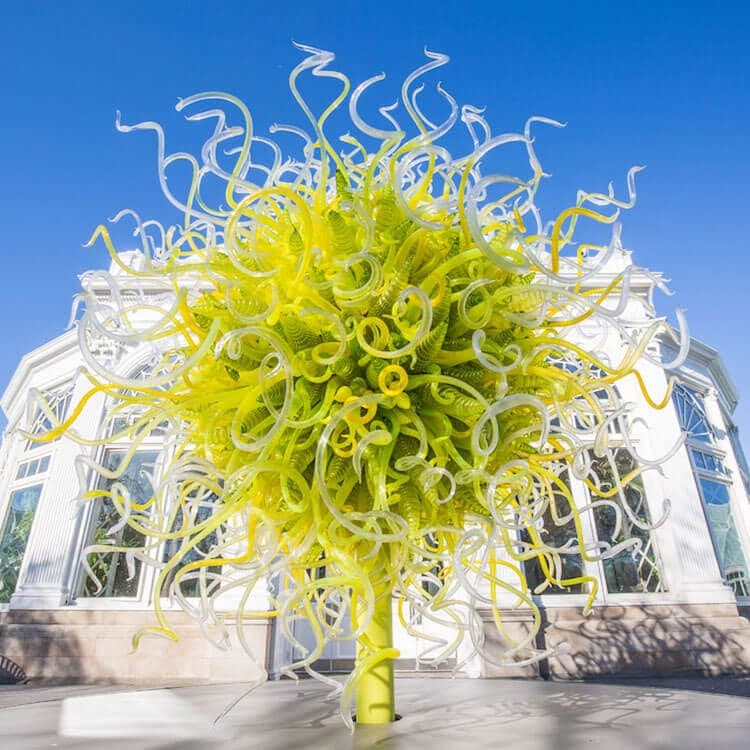
Dale Chihuly is an American artist known for large-scale glass installations and for helping turn studio glass into a museum and garden spectacle. His work combines blown glass, fabricated armatures, and teams of assistants to produce dense arrangements of color, light, and reflective surface. Born in 1941, he became one of the best-known figures in contemporary glass art and built a practice that operates as both art studio and production enterprise.
| Field | Glass sculpture, installation art |
|---|---|
| Born | 1941, Tacoma, Washington, United States |
| Known for | Monumental blown-glass installations, chandeliers, ceiling works, botanical displays |
| Materials | Hot-worked glass, steel support structures, wires, acrylic, installation hardware |
| Training | University of Washington; Rhode Island School of Design |
| Practice | Designs installed and fabricated with a workshop team rather than made entirely by hand alone |
How did Chihuly become important?
Chihuly trained first as a designer and then in glass at a moment when studio glass was still establishing itself as a serious art form. He studied with Harvey Littleton at the University of Wisconsin and later at the Rhode Island School of Design, where he helped build a program around glass blowing and experimentation. That period mattered because it shifted glass from a craft associated with vessels and decorative objects into an art medium capable of scale, abstraction, and installation.
His influence grew through teaching, exhibition-making, and a strong instinct for public spectacle. Chihuly did not simply present glass objects on pedestals; he treated glass as a spatial medium that could fill ceilings, gardens, atriums, and walls. That approach helped make glass art legible to larger audiences and changed how museums, collectors, and designers thought about the material.
What does a Chihuly work look like?
A typical Chihuly installation uses hundreds or thousands of individual glass forms in saturated colors. These may include thin-walled blown vessels, spiky botanical forms, curled reeds, or long trumpet-like elements grouped into masses that read as coral, flowers, sea life, or fire. The work often depends on contrast: opaque against translucent, smooth against jagged, clear glass against dark framing, and glossy surfaces catching daylight or artificial light.
Many works are built for a specific site and respond to architecture or landscape. In a garden, glass forms may rise out of planted beds or float over water, while indoor works can hang from ceilings in clustered chandeliers or spread across gallery floors like a field of color. The result is less about individual object-making than about orchestrating reflections, shadows, and the movement of a viewer through space.
How is the work made?
Chihuly’s studio practice depends on glassblowing, mold work, assembly, and installation engineering. Hot glass is gathered from the furnace, inflated, shaped with tools, and sometimes pushed into molds or manipulated into thin, organic forms. After cooling, pieces are selected, combined, and mounted on metal or wire armatures that support the final composition.
This method is important because the finished work is usually the product of many hands. Chihuly designs, directs, and edits the outcome, but assistants and fabricators carry out much of the physically demanding production. That division of labor has been central to both his scale and the criticism around his brand-like authorship, since the work behaves as a studio enterprise rather than the output of a lone maker at the bench.
Why does Chihuly matter in contemporary visual culture?
Chihuly helped make blown glass visible outside the studio glass world. His installations appear in botanic gardens, hotel lobbies, museums, and civic spaces, where they function as attraction, environment, and image all at once. That crossover into public-facing display made glass art commercially successful and widely recognizable, even among audiences with little prior knowledge of the medium.
He also shaped expectations for what glass could do in exhibition design. Instead of treating the material as fragile or secondary, he used it at architectural scale and with theatrical lighting. For curators, designers, and institutions, his work became a model for immersive display built from crafted material rather than digital spectacle or screen-based effects.
What controversies surround his practice?
Chihuly’s career has also drawn criticism over authorship, studio labor, and the commercial packaging of art. Because many works are made by teams and presented under his name, some critics question how closely the final form reflects individual artistic handwork. Others see that as part of the logic of contemporary large-scale production, where concept, direction, and fabrication are separated.
There has also been debate over repetition and branding. The recognizable visual language of his installations—bright color, organic abundance, and dramatic installation formats—has been praised as distinctive and criticized as formulaic. Both responses are tied to the same fact: Chihuly built a practice that is immediately identifiable, widely reproducible, and tightly connected to exhibition as experience.
Frequently Asked Questions
Is Dale Chihuly a glassblower or a sculptor?
He is both, although “glass sculptor” better describes the finished work than the studio process. He learned glassblowing and uses it as the core technique, but the results are installations and sculptural environments rather than functional vessels. His work sits between craft, sculpture, and exhibition design.
Why are Chihuly installations so often shown in gardens?
Gardens give his glass a direct relationship to natural light, plant forms, and open space. The reflective surfaces and bright colors gain intensity against leaves, water, and sky, and the scale of a garden allows the work to spread out rather than crowd a gallery wall. That setting suits his interest in immersive, site-specific display.
Does Chihuly make all of his work by himself?
No. Like many large contemporary studios, his practice relies on assistants, fabricators, and installers. Chihuly sets the direction and oversees the final appearance, but the physical production is collaborative and heavily organized around studio labor. That structure is part of how the work reaches its monumental scale.
Articles mentioning Dale Chihuly