
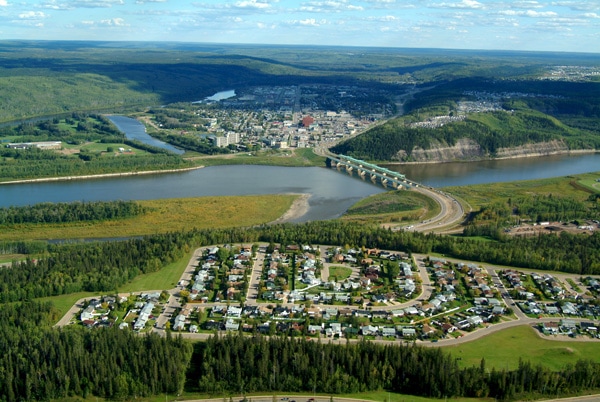
Fort McMurray is an urban service area in northern Alberta, Canada, and the administrative centre of the Regional Municipality of Wood Buffalo. It grew from a small trading settlement into a boomtown tied to the extraction and upgrading of the Athabasca oil sands, then lost its city status in 1995 when it merged into the new Municipality of Wood Buffalo. Today it is best known as a service hub for one of the largest industrial resource regions in the country.
- Located in northeastern Alberta, near the Athabasca River
- Originated as a frontier settlement and supply point
- Expanded rapidly with oil sands development in the late 20th century
- No longer an incorporated city; it is an urban service area
- Functions as a base for workers, logistics, and administration in the oil sands region
How did Fort McMurray grow?
Fort McMurray began as a fur-trade post and river settlement, where access to transport mattered more than formal planning. Its early importance came from geography: it sat at a practical crossing and supply point in a northern landscape that was otherwise hard to move through. For decades, the settlement remained small and remote, with its economy tied to trade, government services, and regional transport.
The decisive change came with the industrial exploitation of the Athabasca oil sands. As mining and upgrading expanded, Fort McMurray became the nearest major place for housing, retail, healthcare, and business services. The town’s built form reflects that role: a patchwork of subdivisions, industrial access routes, temporary accommodation, airports, camps, and commercial strips designed to support a fluctuating workforce.
Why does Fort McMurray matter in Canadian industry?
Fort McMurray matters because it sits at the human centre of the oil sands economy. The extraction sites themselves are spread across a much larger landscape, but the labour force, contractors, municipal services, and many support industries concentrate in and around the town. That makes Fort McMurray less a conventional city than a service platform for resource extraction.
This role has shaped its identity and its infrastructure. Roads, air travel, housing, emergency planning, and water systems all had to scale in response to industrial demand. The town became closely associated with boom-and-bust cycles, labour migration, and the environmental debates surrounding large-scale oil production.
What does the place look like on the ground?
Fort McMurray’s landscape combines suburban neighbourhoods with industrial edges and vast stretches of working country beyond town. The Athabasca River still provides a strong physical frame, but the surrounding area is also marked by haul roads, staging areas, camps, and access corridors linked to mining and upgrading facilities. Much of the everyday visual character comes from pragmatism rather than civic display.
In practice, the place feels shaped by movement: commuters, trucks, aircraft, and seasonal workers passing through in high volume. Commercial architecture tends to be utilitarian, while housing ranges from older low-rise neighbourhoods to newer subdivisions and temporary accommodations. The result is a settlement whose appearance makes its purpose plain: it exists to hold, move, and service a large industrial workforce.
What changed when it became an urban service area?
Fort McMurray was incorporated as a city in 1980, then folded into a larger municipal structure in 1995, when it amalgamated with Improvement District No. 143 to form the Municipality of Wood Buffalo. That change did not erase the name, but it altered its governance. The term “urban service area” signals that Fort McMurray remains the primary built-up settlement within a much larger municipality.
The administrative shift reflects the scale of the region around it. Governance had to cover not just a town, but a dispersed industrial territory with highways, work camps, remote facilities, and environmental responsibilities. Fort McMurray stayed central because it was already the place where those systems met.
Frequently Asked Questions
Is Fort McMurray a city?
No. It was incorporated as a city in 1980, but it lost that status in 1995 after amalgamation into the Municipality of Wood Buffalo, now the Regional Municipality of Wood Buffalo. It is currently classified as an urban service area. The name still refers to the main populated centre in the region.
Why is Fort McMurray associated with oil sands?
Because it became the nearest major settlement supporting the Athabasca oil sands. Workers, contractors, service businesses, and public services all clustered there as extraction expanded. Its economy and population growth were closely tied to that industrial development.
What kind of place is it visually?
It looks like a working northern service town rather than a planned civic centre. Housing, commercial strips, transport infrastructure, and industrial corridors dominate the built environment. The surrounding landscape reinforces that sense, with heavy industry and remote access routes extending far beyond the town itself.
At a glance
- Address
- Regional Municipality of Wood Buffalo, Canada
- Coordinates
- 56.726387, -111.38028
Articles mentioning Fort McMurray
