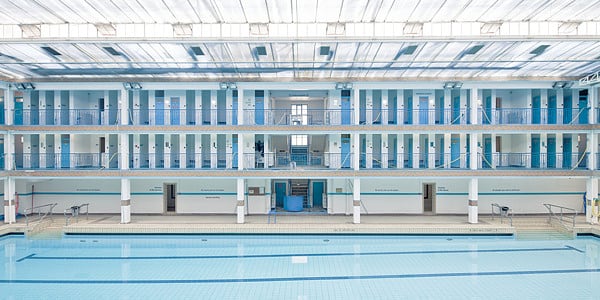
Franck Bohbot is a French photographer known for carefully composed images of interiors, city streets, storefronts, swimming pools, and other public spaces. His work turns ordinary urban places into scenes with a strong graphic order: deep color, clean symmetry, bright artificial light, and a quiet, cinematic mood.
- Born in France in 1980, he later moved to New York City and built a career photographing architecture and public life.
- He often works with saturated color, centered framing, and long perspectives that flatten space into pattern.
- His best-known series include Chinatown and photographs of swimming pools and nighttime city scenes.
- His images borrow from cinema as much as from documentary photography, especially noir and science-fiction lighting.
- He is associated with a polished, highly controlled style that makes familiar places feel slightly unreal.
What kind of photographer is Franck Bohbot?
Bohbot is a contemporary photographic artist whose subject is often the built environment rather than the portrait sitter or the event. He photographs lobbies, arcades, facades, cinemas, pools, and streets in a way that emphasizes geometry, color, and atmosphere. The people in his pictures, when they appear at all, usually serve the space rather than dominate it.
That focus gives his work a clear identity. Instead of chasing spontaneity, Bohbot looks for order: repeated lines, reflective surfaces, strong symmetry, and precise points of light. The result can feel theatrical, but it remains grounded in real places photographed with patience and control.
Where did his style come from?
Bohbot was born in a suburb of Paris and later settled in New York, a route that makes sense in the context of his work. Paris and New York both offer dense street life, old and new architecture, and a constant mix of public interiors and urban signage. His pictures often treat those spaces as stages, and his eye seems shaped by the visual languages of film, design, and street photography.
His palette and lighting frequently recall cinema, especially the glossy artificiality of modern noir and science-fiction imagery. Neon, fluorescent tubes, reflected highlights, and deep shadow appear often. Rather than recording a place in a neutral way, he uses these elements to give it a mood, sometimes making a real corner of the city look like a set built for a future that has not arrived yet.
What does his work look like in practice?
A typical Bohbot image is tightly organized. Lines of architecture pull toward the center, repeated objects create rhythm, and the frame is often balanced so exactly that the scene feels almost staged. This is especially visible in his series on Chinatown, where shopfronts, lanterns, signs, and alleyways become blocks of color and pattern.
He also pays close attention to materials and surfaces. Glass, polished tile, painted metal, water, and illuminated plastic all matter because they catch light differently. In his swimming pool pictures, for example, the water becomes a bright blue plane, while ladders, lane markers, and tiled edges produce crisp horizontal and vertical structure. The images are not busy, but they are dense with visual information.
Why does Franck Bohbot matter?
Bohbot matters because he shows how commercial, public, and everyday spaces can be photographed with the formal discipline usually reserved for architecture or fine art. His pictures do not rely on spectacle. They find drama in repetition, symmetry, and ambient light, which gives viewers a new way to look at places that might otherwise seem familiar or overlooked.
He also sits in a broader conversation about color photography and urban imagery. His work overlaps with documentary photography, yet it is more stylized than documentary in the strict sense. That tension between description and design is central to its appeal: the places remain recognizable, but they are edited by framing, timing, and light into something more composed than casual observation.
Frequently Asked Questions
Is Franck Bohbot a documentary photographer?
Only in a loose sense. He photographs real places, but his method is highly controlled and often more aesthetic than documentary. His images care as much about pattern, tone, and composition as they do about recording a subject faithfully.
Why do his photos feel cinematic?
He uses lighting, color, and symmetry the way a production designer or cinematographer might. Many scenes have a strong sense of artificial illumination, and his framing often makes the space feel like a set with a deliberate point of view. That is why critics often compare his work to film noir or science fiction.
What subjects does he return to most often?
He returns to urban interiors and exteriors: streets, shops, pools, transit spaces, and neighborhoods with distinctive visual systems. These subjects give him strong geometry and layered surfaces to work with. They also let him show how public space changes character under different light, weather, and time of day.
Articles mentioning Franck Bohbot