
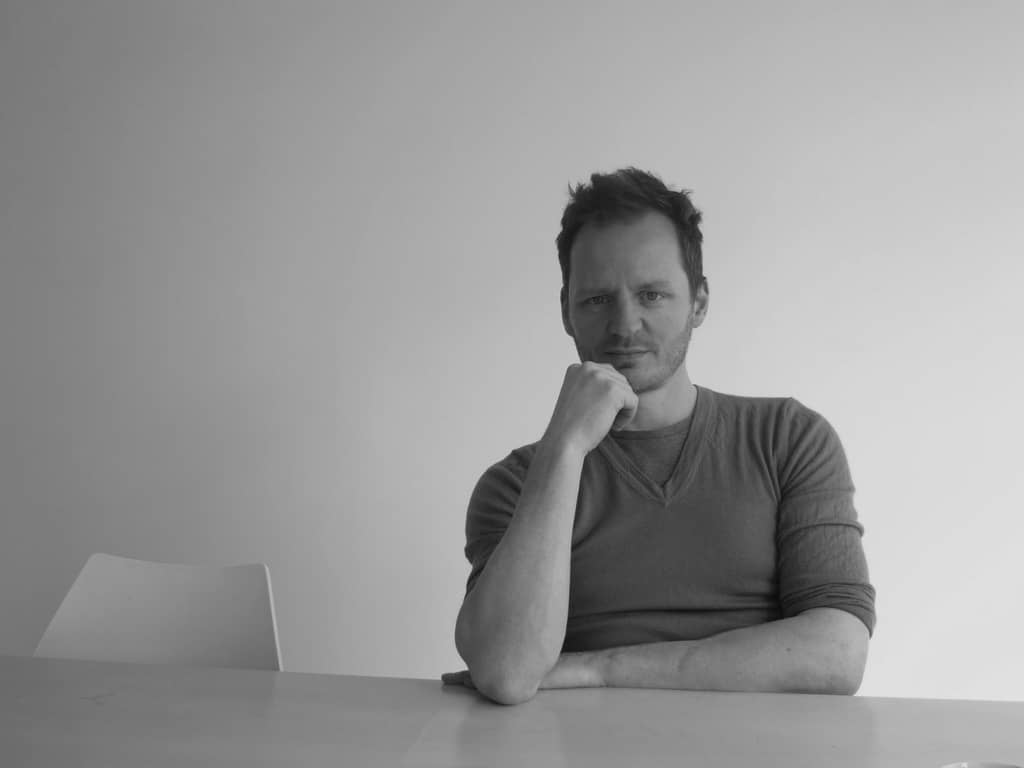
Hans Op de Beeck is a Belgian artist known for large-scale installations, sculptures, films, drawings, paintings, photographs, and texts that often appear in a muted grayscale palette. His work builds staged environments and objects that feel suspended between reality and fiction, using everyday materials and carefully controlled surfaces to create scenes of stillness, memory, and unease.
- He works across sculpture, installation, moving image, drawing, painting, and writing.
- Much of his art is monochromatic, especially in shades of grey.
- His subjects often include domestic spaces, figures, landscapes, and childhood motifs.
- He aims for work that feels immersive and theatrical rather than purely pictorial.
- He was born in Turnhout in 1969 and is based in Brussels and Gooik.
What kind of artist is Hans Op de Beeck?
Op de Beeck is a multidisciplinary visual artist whose practice centres on constructed worlds. Rather than treating sculpture as a single object, he often arranges rooms, streets, gardens, or imagined interiors as complete environments. The result is closer to a set or stage than to a standalone monument, with lighting, scale, and composition working together to guide how a viewer moves through the work.
His imagery is recognisable for its restraint. Figures, props, and architectural details are often made in a uniform grey, which suppresses obvious spectacle and shifts attention to form, posture, and atmosphere. This palette gives his work a sculptural calm, but it also suggests photographs before colour, ghosts of things, or a world drained of distraction.
Why do his grayscale sculptures matter?
The monochrome surfaces are not just a style choice. They help turn ordinary subjects into scenes that feel mentally loaded: a child on a swing, a dining table, a boat, a suburban room, a tree line. By removing colour, Op de Beeck pushes form, shadow, and texture into the foreground. Materials such as resin, plaster, paint, and mixed media finishings are used to make surfaces read as stone, cloth, water, wood, or skin without fully pretending to be them.
This creates a tension between recognition and distance. The works invite close looking because they seem familiar, yet they remain deliberately unreal. That ambiguity is central to his practice: the pieces can look like frozen moments from a dream, a memory, or a film scene after the actors have left.
How are the installations made?
Op de Beeck often builds his works from multiple elements rather than a single sculptural block. A project may combine fabricated objects, architectural structures, sound, animation, and text, all arranged in one spatial composition. He uses scale carefully, sometimes enlarging familiar things and sometimes shrinking them, so that the viewer has to recalibrate bodily expectations while moving through the piece.
The theatrical aspect matters. His environments usually depend on controlled lighting and a strong sense of framing, which makes them feel cinematic. Even when the subject is quiet or domestic, the installation as a whole can feel staged with the precision of a film set, where every material choice helps produce mood.
What ideas run through his work?
Op de Beeck’s art often returns to transience, mortality, memory, and the oddness of everyday life. He has said that he is interested in how people move through the world with a mix of seriousness and absurdity, and that balance appears repeatedly in his imagery. A toy, a landscape, or a simple room can carry melancholy without becoming sentimental.
Childhood is another recurring subject, but not in a nostalgic way. In his hands, children’s figures or childlike settings can appear solemn, reflective, or quietly unsettling. That approach gives his work emotional range: it can hold tenderness, stillness, and loss at the same time.
Where has his work been shown?
Op de Beeck has exhibited widely in solo and group exhibitions internationally, including major biennials and triennials. His work has appeared at the Venice Biennale, the Shanghai Biennale, the Aichi Triennale, the Singapore Biennale, Tate Modern’s Art Summer University, Kochi-Muziris Biennale, and Art Basel Miami Beach. That level of exposure reflects how adaptable his practice is across exhibition formats, from gallery rooms to large institutional displays.
He was born in Turnhout in 1969 and lives and works in Brussels and Gooik, Belgium. Those base locations matter less as a regional label than as part of a practice grounded in studio construction, fabrication, and careful control over presentation.
Frequently Asked Questions
Is Hans Op de Beeck mainly a sculptor?
No. Sculpture is central to his practice, but he works across installation, film, drawing, painting, photography, and text. The sculptural work often acts as the core of a larger environment that includes light, sound, and narrative cues.
Why are so many of his works grey?
Grey removes the immediate signals of realism that colour can provide. That choice makes the viewer notice texture, volume, and composition more directly, while also giving the work a dreamlike or suspended quality. The palette helps his scenes feel both familiar and detached.
What should be looked for in an Op de Beeck work?
Look for how space is staged, how materials imitate or suggest other materials, and how scale alters recognition. The most important effects usually come from atmosphere rather than incident. A quiet object or figure can carry the emotional weight of the whole piece.
Articles mentioning Hans Op de Beeck

