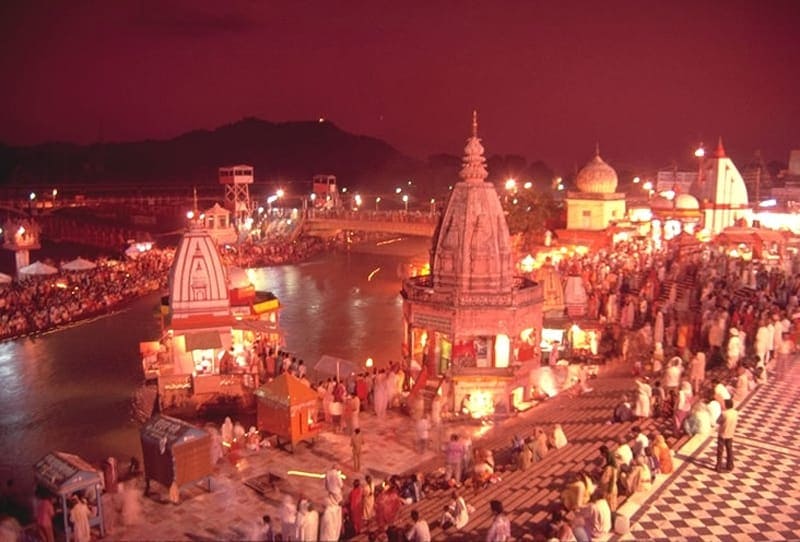
Haridwar is a pilgrimage city and municipality in Uttarakhand, India, where the River Ganges first leaves the Himalaya and enters the Indo-Gangetic plains. Its name means “gateway to the Ganga,” and the city has long been known in Sanskrit as Gangadwára. For Hindu pilgrims, it is one of the seven sacred places most closely tied to ritual bathing, prayer, and the movement of large festival crowds.
- Haridwar sits at the point where the Ganges emerges from the foothills onto the plains.
- It is one of Hinduism’s seven holiest pilgrimage sites.
- The city is closely associated with bathing ghats, river rituals, and mass festivals such as the Kumbh Mela.
- Its religious importance comes from geography as much as from legend: the river’s crossing of the mountains marks a sacred threshold.
- Modern Haridwar is both a working city and a ritual landscape shaped by pilgrims, priests, and festival infrastructure.
Why Haridwar matters
Haridwar matters because it concentrates geography, myth, and ritual in one place. The Ganges changes character here: from a mountain river to a broad plain river, from a source associated with austerity to a site of public devotion. That transition gives the city its symbolic power. For many Hindus, a bath in the river at Haridwar is not simply cleansing but an act tied to merit, remembrance, and release.
The city also matters as a civic and religious crossroads. Temple complexes, market streets, ghats, akharas, and temporary festival grounds all operate side by side. During major gatherings, Haridwar becomes a place where processions, tents, drums, bathing platforms, police barriers, and food stalls reshape the city around ritual time.
What does Haridwar look like in practice?
Haridwar is defined by its riverfront. Stone and concrete ghats step down to the water, where pilgrims gather for early-morning baths, offer flowers and lamps, and watch priests conduct prayers. The visual language is precise and repetitive: saffron cloth, smoke from incense, copper vessels, marigold garlands, conch shells, and the constant motion of people moving between water and shrine.
Beyond the ghats, the city becomes denser and more ordinary. Narrow lanes carry vendors selling puja supplies, sweets, metal vessels, religious images, and textiles. During pilgrimage seasons, the built environment absorbs temporary structures: shade canopies, loudspeakers, wayfinding signs, and camps for visitors and ascetics. Haridwar’s form is therefore not only architectural but logistical, built to handle both everyday urban life and sudden ritual expansion.
How did Haridwar become a sacred city?
Haridwar’s sanctity comes from layered tradition. In Hindu mythology, the Ganges descends from heaven and enters the world of humans in a form made usable for worship and salvation. The city is linked to that descent as a threshold point, where river, story, and landscape meet. Its older name, Gangadwára, captures that idea directly: a door or gateway to the Ganga.
Over time, pilgrimage practice fixed that sacred geography into the city itself. Bathing, ancestor rites, temple visits, and festival assemblies turned Haridwar into more than a remembered holy site. It became an active ritual machine, with routes, calendars, and institutions that continue to organize how people arrive, stay, pray, and leave.
Why is Haridwar associated with the Kumbh Mela?
Haridwar is one of the principal sites of the Kumbh Mela, the massive Hindu pilgrimage and bathing festival held on a rotating schedule at four river cities. In Haridwar, the event centers on ritual bathing in the Ganges at auspicious times, when millions may gather over the course of the festival. The city’s riverbanks, roads, and open grounds are temporarily reorganized to support processions of sadhus, crowds of pilgrims, and the movement of local authorities.
That association matters because Kumbh Mela shows Haridwar at its largest scale. The city’s sacred identity is not abstract; it depends on bridges, sanitation systems, camp layouts, temporary stages, and disciplined crowd control. The festival makes visible how religious life in Haridwar is produced through planning, labor, and material arrangement as much as through belief.
Frequently Asked Questions
Is Haridwar a city or a pilgrimage site?
It is both. Haridwar functions as a municipality with shops, neighborhoods, transport, and local government, but its public identity is dominated by pilgrimage and river ritual. The two are inseparable because the city’s economy, streetscape, and calendar all respond to sacred traffic.
Why is the Ganges important in Haridwar?
The Ganges gives Haridwar its religious meaning and much of its physical form. At this point, the river marks a transition from Himalayan terrain to the plains, which Hindu tradition treats as a powerful threshold. Ritual bathing in the river is the city’s central act of devotion.
What should Haridwar bring to mind visually?
Haridwar should bring to mind ghats descending to the river, pilgrims in bright cloth, priests performing rites, and crowds gathering for bathing. It also includes the less visible infrastructure that makes those scenes possible: temporary shelters, public address systems, security barriers, and market stalls. The city is ceremonial, but it is also intensely practical.