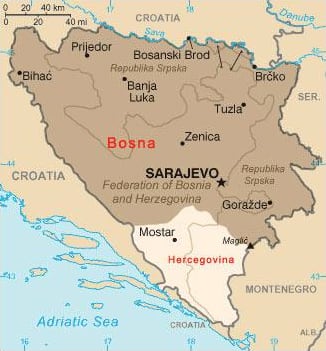
Herzegovina is the southern region of Bosnia and Herzegovina, a historical and geographic area shaped by the Neretva river valley, karst limestone hills, Adriatic proximity, and long Ottoman and Austro-Hungarian periods of rule. It is not an administrative unit with fixed borders, but a region commonly understood through its landscape, towns, and cultural history.
- Herzegovina lies in the south of Bosnia and Herzegovina, extending toward Croatia and Montenegro.
- Its most visible features are dry karst terrain, river corridors, and a warmer Mediterranean-influenced climate.
- The region includes cities and towns such as Mostar, Trebinje, Stolac, Čapljina, and Ljubuški.
- Its visual culture reflects layered histories: Ottoman architecture, Catholic and Orthodox traditions, and later Yugoslav modernity.
- Herzegovina often appears in photography, portraiture, and documentary work because of its stark light, stone architecture, and strong regional identity.
Where is Herzegovina, exactly?
Herzegovina occupies the southern half of the country of Bosnia and Herzegovina, but it is better understood as a historical region than as a strictly bounded territory. Its northern edge is often described by local custom rather than law, and its extent shifts depending on whether the reference point is geography, administration, or cultural history. In everyday use, the name points to the southern zone around Mostar and the Neretva basin, stretching toward the Adriatic hinterland and the borderlands with Croatia and Montenegro.
The region’s geography explains much of its character. Limestone bedrock creates a rugged karst landscape with sparse soil, caves, dry fields, and sudden changes in elevation. The Neretva and its tributaries cut through this terrain, creating the green corridors where settlement, agriculture, and trade became concentrated.
Why does Herzegovina matter?
Herzegovina matters because it is one of the main historical and cultural components of Bosnia and Herzegovina, and because it has a distinct visual identity within the state. Its towns preserve layers of empire and religion: Ottoman mosques, stone houses, Catholic and Orthodox churches, bridges, and market streets. Those traces make the region legible in photographs and in built form, where material contrasts are strong and easy to read.
The region also matters politically and socially. Its identity has often been discussed alongside questions of national belonging, language, and post-Yugoslav statehood. That makes Herzegovina more than a place name: it is a region people invoke when describing family origins, architecture, dialect, migration, and the differing histories of the country’s north and south.
What does Herzegovina look like on the ground?
Herzegovina is defined by hard light, pale stone, and open space. The climate is warmer and drier than much of Bosnia, with more Mediterranean influence, so olive trees, vineyards, figs, tobacco, and other sun-loving crops appear alongside rough pasture and rocky slopes. In the built environment, that tends to produce compact settlements using local stone, with thick walls, red-tile roofs, courtyards, and streets designed to manage heat and slope.
Mostar is the best-known urban image of the region: a river city organized around the Neretva, the rebuilt Stari Most, and a mix of Ottoman, Austro-Hungarian, and socialist-era fabric. Smaller towns such as Stolac or Trebinje often feel more intimate and materially consistent, with masonry churches and mosques, narrow streets, and nearby rural structures in the same limestone palette. In photography and portrait work, that combination of bright sun, textured stone, and weathered surfaces creates a strong graphic setting.
How is Herzegovina used in art and visual culture?
For artists and photographers, Herzegovina offers a recognizable register of place without needing spectacle. The region’s interiors, façades, and people are often framed through texture: aged plaster, carved stone, patterned headscarves, weathered doorways, and the contrast between skin and bright daylight. That is one reason it appears in portraiture and documentary work, where the landscape can carry as much information as the sitter.
Its cultural history also gives makers a wide set of reference points. Ottoman urban forms, church architecture, memorial landscapes, and postwar reconstruction all coexist in the same region, so images from Herzegovina often hold several time periods at once. Even small details, such as bridge masonry or the surface of a village wall, can signal a larger history of adaptation to climate, empire, and local craft.
Frequently Asked Questions
Is Herzegovina a country?
No. Herzegovina is a region within the sovereign state of Bosnia and Herzegovina. It has a strong historical identity, but it does not function as an independent country or a separate administrative state.
How is Herzegovina different from Bosnia?
Herzegovina is generally the southern, warmer, and more karstic part of the country, while Bosnia refers to the central and northern areas. The distinction is historical and cultural as much as geographic, and it is not marked by a single official boundary. In practice, the names are often used together to describe the whole country and separately to describe regional identity.
Why do photographers and artists work in Herzegovina so often?
The region offers strong visual conditions: bright light, pale stone, river valleys, and built forms that preserve multiple historical layers. Those conditions help portraits and documentary images feel immediate and materially grounded. Herzegovina also carries a clear sense of place, which is useful when an image needs regional specificity without elaborate staging.
At a glance
- Address
- Bosnia and Herzegovina
- Coordinates
- 43.476944, 17.815
Articles mentioning Herzegovina