
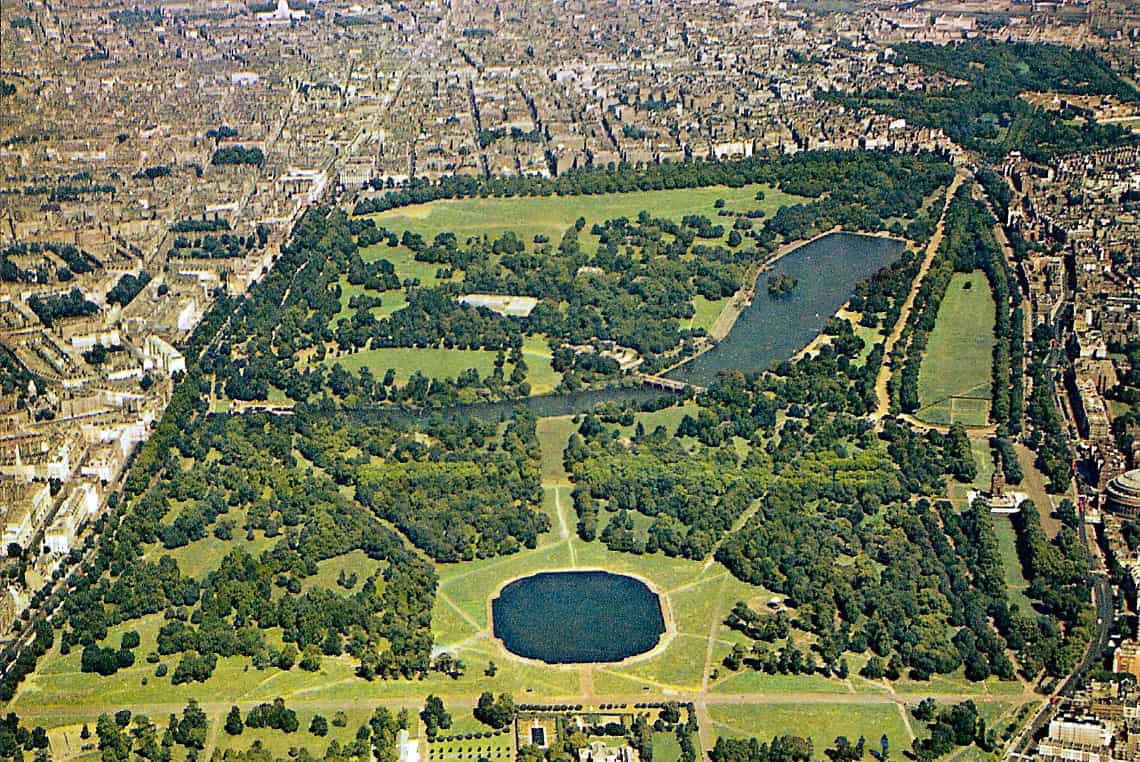
Hyde Park is a large Royal Park in central London, known for public assembly, ceremonial events, and open-air recreation. It sits west of the West End and has long been used as a stage for exhibitions, protests, concerts, and informal gathering. Its broad lawns, tree-lined paths, lake, and perimeter roads make it one of the city’s most visible public landscapes.
| Type | Royal Park |
|---|---|
| Location | Central London, United Kingdom |
| Area | About 350 acres |
| Known for | Speakers’ Corner, mass demonstrations, the 1851 Great Exhibition site |
| Managed by | The Royal Parks |
What makes Hyde Park important?
Hyde Park matters because it functions as both a piece of landscape and a public platform. Many London parks are primarily for leisure, but Hyde Park has also served as a place where political speech, spectacle, and civic life become visible at scale. That dual role gives it a special place in the city’s cultural memory.
The park’s openness is part of its meaning. Wide sightlines, large grassed areas, and multiple entrances allow crowds to gather and disperse easily. For event organisers, artists, and campaigners, those practical conditions matter as much as the symbolic prestige of the address.
How did Hyde Park become a public stage?
The park’s public character was shaped over centuries. Once part of a hunting ground for Henry VIII, it later became more accessible as London expanded around it. By the nineteenth century it was already associated with large gatherings, but the Great Exhibition of 1851 made that role unmistakable. Joseph Paxton’s Crystal Palace stood in the park as a vast prefabricated glass-and-iron structure, turning open land into a showcase for industry, design, and imperial display.
After that, Hyde Park became a familiar site for mass demonstration. Reformers, suffragettes, labour movements, and anti-war campaigners have all used it to claim visibility in the centre of the capital. Speakers’ Corner, near Marble Arch, formalised a tradition of public speaking that still gives the park an outsized political presence.
What does the park look like in practice?
Hyde Park is not a single image. It combines landscaped openness with pieces of infrastructure: roads, railings, memorials, a boating lake, and large lawns that can absorb foot traffic without feeling enclosed. The Serpentine divides part of the park, and the surrounding streets constantly remind visitors that this is urban space, not rural retreat.
For artists and event makers, the park’s scale changes how work is built and seen. Large temporary structures, outdoor installations, sound systems, stages, and crowd-control barriers all have to respond to weather, access routes, and sightlines. A sculpture made from thousands of barrels, for example, reads differently here than in a gallery because the park allows it to meet passers-by, commuters, and demonstrators in the same space.
Why does Hyde Park keep being reused?
Hyde Park endures because it accommodates contradiction. It is formal and informal, historic and practical, scenic and political. Royal Parks, campaign groups, festivals, and artists all use the same ground for very different purposes, yet the park’s size and centrality make those uses compatible.
That flexibility has kept it relevant to visual culture. Public art, processions, memorial events, and political assemblies all depend on a location that can handle scale without shutting down the city around it. Hyde Park remains one of London’s clearest examples of how landscape can function as civic infrastructure.
Frequently Asked Questions
Is Hyde Park the same as Kensington Gardens?
No. Hyde Park and Kensington Gardens are separate parks that sit beside one another and are divided by a road and formal boundary. They are often discussed together because they form a continuous green area in west-central London, but their histories and uses are distinct.
Why is Speakers’ Corner associated with Hyde Park?
Speakers’ Corner became associated with Hyde Park because it developed as a recognised site for public speech and debate in the nineteenth century. Its reputation comes from a long tradition of open political argument, especially on Sundays, when speakers have gathered to address whoever stops to listen. The area remains one of the park’s most famous features.
What kind of events happen in Hyde Park?
Hyde Park hosts concerts, commemorations, public art installations, sporting activity, and political demonstrations. Its size and central location make it suitable for events that need room for large audiences and temporary infrastructure. Many events use the park precisely because it can shift quickly from everyday leisure space to public forum.
At a glance
- Address
- City of Westminster, United Kingdom
- Coordinates
- 51.5073, 0.1657
Articles mentioning Hyde Park, London
