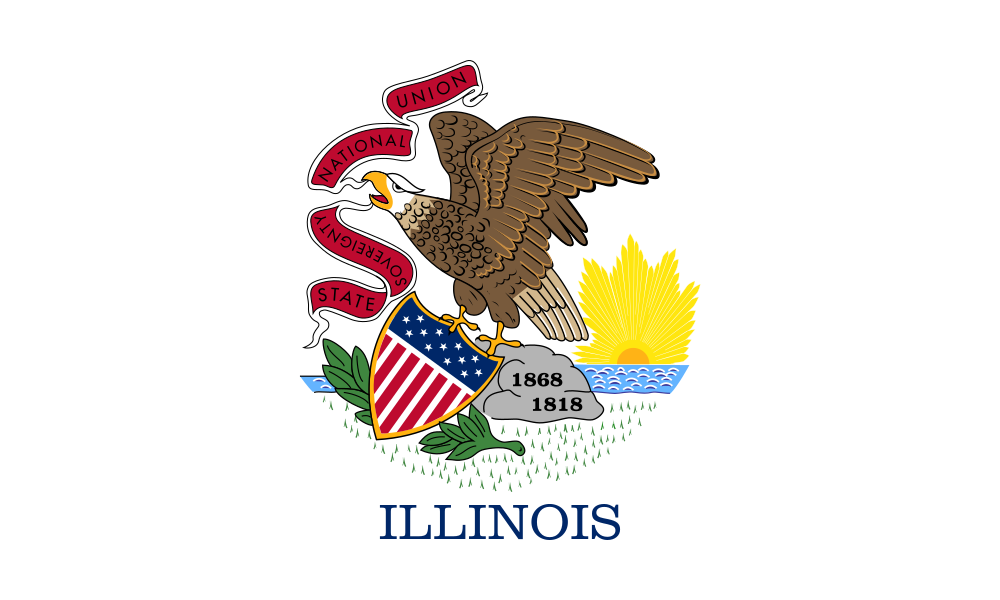
Illinois is a Midwestern U.S. state whose economy, cities, and landscapes range from Chicago’s dense urban core to farmland, river corridors, and southern coal country. It sits at a crossroads of rail, road, river, and air traffic, which has made it one of the country’s most important transportation and distribution states. It also functions as a useful shorthand for the United States itself: industrial North, agricultural heartland, big-city culture, and rural landscape all appear within its borders.
| Type | State in the United States |
|---|---|
| Capital | Springfield |
| Largest city | Chicago |
| Region | Midwestern United States |
| Joined the Union | 1818 |
| Known for | Transportation networks, manufacturing, agriculture, and Chicago’s cultural institutions |
| Landscape | Prairie, river valleys, urban districts, coalfields, and lakefront |
What makes Illinois distinctive?
Illinois is distinctive because its geography compresses several different American economies into one state. Chicago anchors finance, publishing, design, museums, architecture, and freight logistics in the northeast. Central Illinois is dominated by corn and soy production, while southern Illinois includes smaller towns, wooded terrain, and long-settled extractive industries such as coal mining and oil. That mix makes the state easy to read as a practical cross-section of the country.
The state’s physical form also matters. Broad plains, long straight roads, navigable rivers, and major rail lines encourage movement of goods at scale. For a visual culture reader, that means Illinois often appears not just as a backdrop, but as a system: warehouses, storefronts, farm fields, train yards, and the layered streets of Chicago all carry strong graphic and material presence.
Why does Illinois matter in American culture?
Illinois matters because Chicago has been one of the country’s most influential cultural engines for more than a century. The city shaped modern architecture, graphic design, jazz and blues circuits, print culture, museum collections, and contemporary commercial art. Many photographers, painters, and designers use Chicago as a source of facades, signage, interiors, and street life, while the wider state supplies a different visual register: barns, grain silos, small-town storefronts, and industrial edges.
Illinois also matters because it links regional and national stories. The state’s population concentration in Chicago and its surrounding suburbs sits beside wide agricultural counties and smaller industrial towns. That contrast produces a familiar American visual field of density and emptiness, production and consumption, transit and stasis. It is one reason Illinois often feels representative rather than exceptional.
How does Illinois look in practice?
Illinois in practice looks like infrastructure. Freight trains, elevated rail, interstates, bridges, port facilities, and distribution centers all shape how the state is seen and used. In Chicago, this infrastructure becomes architectural: the Loop, warehouse districts, alleyways, brick industrial buildings, and lakefront high-rises create a layered city where commerce and image-making overlap. Outside the city, the look changes into level fields, grain elevators, water towers, and long horizons.
That visual range matters to artists and editors because it supplies both subject matter and atmosphere. A painting, photograph, or sculpture that references Illinois may pull from the urban polish of Chicago, the faded material culture of older industrial towns, or the utilitarian surfaces of agricultural life. The state’s visual identity is not one style but a collision of styles, from steel and glass to weathered wood, concrete, paper, and soil.
What should a reader know about Illinois and making things?
Illinois has long been a place where things are made, assembled, stored, and moved. Manufacturing, printing, food processing, and machine-related industries have left a strong material trace, especially in Chicago and its surrounding corridor. That industrial history shapes everything from building types to signage to the look of workwear, packaging, and warehouse interiors.
At the same time, Illinois remains deeply tied to land-based production. Corn and soybeans dominate large parts of the state, and that agricultural scale influences the built environment through silos, barns, drainage systems, and rural roads. For a publication interested in how things are made, Illinois is useful because it shows the overlap between urban production and agricultural production, both of which leave visible systems behind.
Frequently Asked Questions
Is Illinois mostly an urban state or a rural one?
Both, but in different ways. Chicago gives Illinois its largest population center and much of its cultural influence, while most of the land area remains rural or small-town. The state’s identity comes from the tension between those two facts rather than from either one alone.
Why is Chicago so closely associated with Illinois?
Chicago dominates the state’s population, economy, and cultural reputation. It is the main gateway for finance, transit, publishing, architecture, museums, and media in Illinois. For many outsiders, the city effectively stands in for the state, even though Illinois extends far beyond it.
What kinds of imagery are commonly associated with Illinois?
Common imagery includes Chicago skylines, elevated trains, brick warehouses, farm fields, grain silos, and long Midwestern roads. There is also a strong association with industrial materials such as steel, concrete, glass, and rail infrastructure. Together these images create a state that reads as both metropolitan and working landscape.
At a glance
- Address
- United States
- Coordinates
- 41.278217, -88.38024
Articles mentioning Illinois