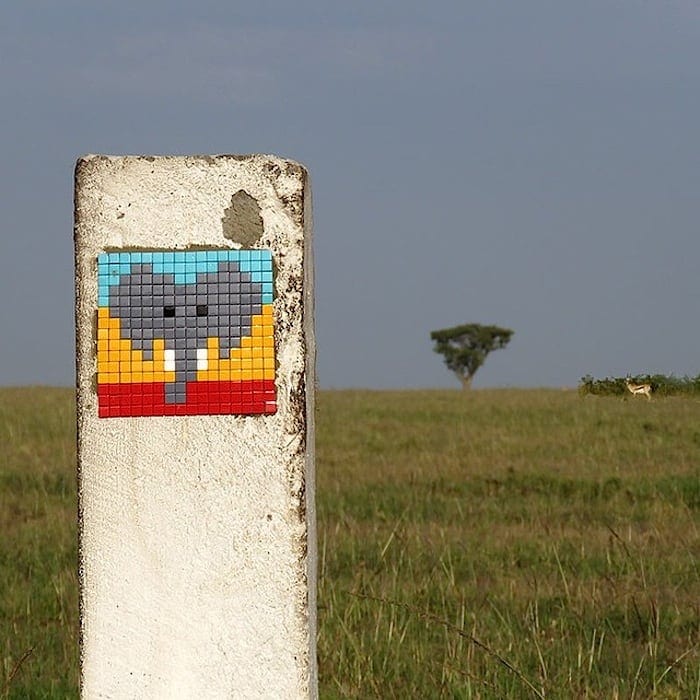
Invader is the pseudonym of a French urban artist born in 1969 who makes mosaic murals of pixelated characters based on the 1978 arcade game Space Invaders. He installs them illegally or semi-legally on walls, roofs, bridges, and other surfaces in cities around the world, then records each campaign as an “Invasion” with maps, books, and catalogues that track the works and their locations.
- Uses small coloured ceramic or glass tiles to build square, game-like figures.
- Places works in public space, often high up or hard to reach.
- Treats each city intervention as part of a larger, numbered invasion.
- Combines street art, mosaic craft, and cartographic documentation.
- Has made one of the most widely recognised forms of contemporary street art.
How Invader’s work is made
Invader’s pieces are built from tiny mosaic tesserae cut or chosen to produce a blocky, low-resolution image. The form usually starts from a simple grid: a familiar alien from Space Invaders, sometimes repeated, sometimes altered into local references or new figures. The craft matters as much as the joke. Mosaic has a long history in architecture and decoration, but Invader uses it as a fast, modular street material that can survive weather better than paint or paper.
Installations are planned in advance, assembled off-site, and then fixed to a surface in a quick intervention. That process lets the artist work across many cities while keeping the visual language consistent. The result is a repeated sign system that reads instantly from a distance and rewards close inspection with tile colour, grout lines, and irregularities from hand placement.
Why use Space Invaders imagery?
The reference to the arcade game gives the work its basic shape and its cultural charge. The original game’s alien sprites were built from a limited digital grid, so they translate naturally into mosaic, which is also grid-based and made from discrete units. That formal fit is part of the appeal: a 1970s game image becomes a durable street object through an older material process.
Invader also uses the characters as a kind of visual tag. Like graffiti signatures, they mark presence and territory, but they are more elaborate and more collectible. The image is recognisable enough to be read quickly by passersby, yet open enough to absorb local references, colour shifts, and custom variants. That balance has helped the work move between street art, urban prank, and contemporary art market object.
What is an “Invasion”?
Invader does not treat each mosaic as an isolated artwork. He groups them into city-based or country-based campaigns called “Invasions,” often numbered and documented with maps, books, app-based guides, and inventories. The documentation turns scattered wall pieces into a larger narrative of occupation, discovery, and collection.
For viewers, this means the work extends beyond the object on the wall. Finding a tile figure can become part of the experience, and the hunt is often encouraged by published location data or fan-made tracking. The physical piece and the archival system reinforce each other: the mosaic creates the event, while the map makes it repeatable and legible.
Why does Invader matter?
Invader matters because he helped define a form of street art that is both site-specific and serial, handmade and reproducible. The work sits between sculpture, graphic design, and urban intervention. It is not just an image pasted onto a wall; it is a system built from material consistency, city-scale distribution, and public recognition.
He also widened the idea of what street art could look like without abandoning the basic grammar of graffiti culture: repetition, visibility, and a public claim to space. The pieces are often playful, but the underlying method is disciplined and logistical. That combination has made Invader influential far beyond the original mosaic tiles, especially for artists working with repeat motifs, urban mapping, and collectible public art.
Frequently Asked Questions
Is Invader’s work graffiti or mosaic?
It is best understood as a hybrid. The images use mosaic, a traditional craft built from individual tiles, but the way they are placed, repeated, and documented follows street art and graffiti logics. The public wall location is essential to the work’s meaning.
Are the mosaics permanent?
They are more durable than paint or wheatpaste, but they are not permanent. Weather, demolition, removal, and restoration can all affect them. Their survival often depends on the condition of the building and whether property owners or city authorities leave them in place.
Why do people look for them?
The maps and “Invasion” catalogues encourage a scavenger-hunt experience. Many viewers enjoy the mixture of urban exploration and art spotting, especially because the works are often small, hidden, or placed in unlikely locations. That hunt has become part of the artwork’s public identity.
Articles mentioning Invader (artist)