
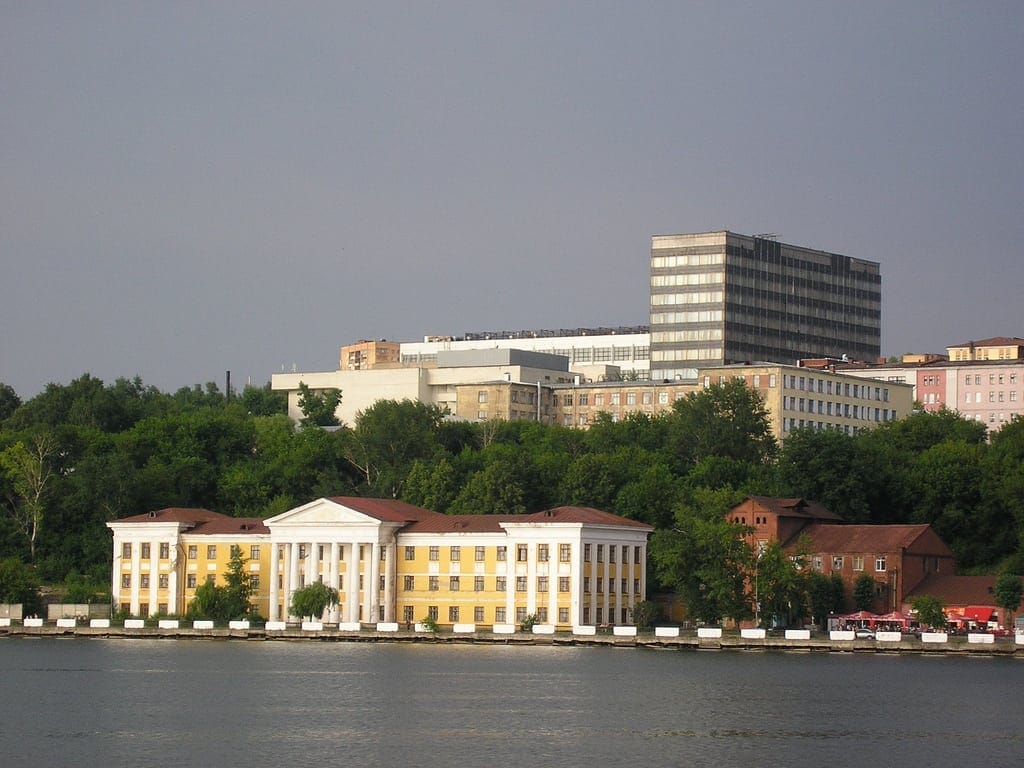
Izhevsk is the capital of the Udmurt Republic in Russia and the largest city in Udmurtia, set on the Izh River in the Volga region. It grew as an industrial centre and remains known for metalworking, engineering, commerce, education, and cultural institutions. For designers and artists, its importance lies in how manufacturing, Soviet urban planning, and regional identity shaped a city that is both administrative capital and production base.
| Fact | Detail |
|---|---|
| Country | Russia |
| Federal subject | Udmurt Republic |
| River | Izh River |
| Status | Capital city; largest city in Udmurtia |
| Population | About 628,000 (2010 Census) |
| Area | 122 sq mi / 315 sq km |
| Former name | Ustinov, 1984 to 1987 |
Why does Izhevsk matter?
Izhevsk matters because it sits at the meeting point of industry and public life. The city developed around manufacturing and later expanded into a broad regional centre with schools, theatres, museums, and administrative offices. That combination gives it a distinct profile: not just a factory town, but a place where technical production and civic culture grew together.
In Russian visual culture, cities like Izhevsk often appear indirectly rather than as famous monuments. They show up through industrial landscapes, workers’ housing, machine-made objects, and the visual language of state-era planning. A city built around production leaves traces in architecture, signage, streetscapes, and the everyday objects made there.
Where is Izhevsk and how did it develop?
Izhevsk lies in western Russia, in the Udmurt Republic, on the Izh River. Its location helped support transport, industry, and settlement, and the river also gave the city its name. Over time, the city became the administrative centre of Udmurtia and a major urban node in the Volga region.
The city’s modern identity was shaped by industrial growth, especially engineering and metalworking. Like many Russian industrial cities, it expanded through Soviet-era planning, with large residential districts, wide streets, and infrastructure designed around workplaces and public institutions. The brief renaming to Ustinov from 1984 to 1987 reflects that Soviet period and the political symbolism attached to city names.
What does Izhevsk look like in practice?
Izhevsk is marked by the visual grammar of an industrial capital: large-scale housing blocks, municipal buildings, transport corridors, and factory-related districts. At street level, that can mean a mix of utilitarian Soviet architecture, later commercial development, and older traces of the city’s manufacturing past. The result is a cityscape that reads as functional first, decorative second.
Its cultural life also matters. Museums, universities, performance spaces, and local institutions give the city a public face beyond industry. For a reader encountering Izhevsk in an art or design context, it may serve as a setting for work shaped by regional identity, post-Soviet urban experience, or the aesthetics of manufacture.
Frequently Asked Questions
Why is Izhevsk associated with industry?
Izhevsk developed as a manufacturing centre and became known for engineering and metalworking. Those sectors influenced the city’s economy, layout, and built environment. Even now, its identity still reflects that industrial base.
Was Izhevsk always called Izhevsk?
No. From 1984 to 1987, the city was renamed Ustinov. The older name returned after that short period, which makes the renaming a notable detail in its late Soviet history.
Is Izhevsk important outside Russia?
It is better known within Russia than internationally, but it matters as a regional capital and industrial city. In cultural writing, it can appear as a specific example of post-Soviet urban life, production, and regional identity. That makes it relevant well beyond local history.
At a glance
- Address
- Udmurtia, Russian Empire
- Coordinates
- 56.833332, 53.183334
Articles mentioning Izhevsk
