John Lennon was an English musician, singer, and songwriter who became famous as a founder of the Beatles and later as a solo artist, political commentator, and cultural symbol. Born John Winston Lennon in Liverpool in 1940, he built his reputation through sharp melody, biting wit, and a public image that moved between rebellious pop star, antiwar campaigner, and intimate collaborator. His work with Paul McCartney helped define the sound of modern pop songwriting.
- British singer-songwriter and founding member of the Beatles
- Known for his partnership with Paul McCartney, often credited as one of pop’s most influential songwriting teams
- Worked across rock, pop, experimental music, and protest songs
- After the Beatles, made solo records that mixed personal confession with politics and satire
- Also became a visual icon, often photographed in round glasses and simple streetwear
How did John Lennon become famous?
Lennon first gained attention in the late 1950s as the leader of the Quarrymen, a Liverpool skiffle group that evolved into the Beatles. When the band broke through in the early 1960s, Lennon’s aggressive rhythm guitar, dry humor, and lead vocals gave the group a distinctive edge. The Beatles did not rise on image alone: they were a tight studio and performance unit whose recordings depended on vocal blend, arrangement, and the craft of producers and engineers as much as on star power.
His role in the band was not simply as a singer. Lennon wrote songs that ranged from bright teenage rock to more fractured, introspective pieces, and he pushed the group toward stranger studio techniques as their work became more ambitious. That shift mattered because it helped turn the Beatles from a touring pop act into a recording-era band, where editing, tape manipulation, and layered production became part of the music itself.
What made Lennon’s songwriting different?
Lennon’s songs often relied on plain language, sharp turns of phrase, and emotional contradictions. He could write direct love songs, but he was also drawn to irony, self-examination, and political provocation. Tracks such as “Help!,” “Strawberry Fields Forever,” “A Day in the Life,” and “Imagine” show how he moved between vulnerability, abstraction, and public statement.
With McCartney, he formed a partnership that became central to pop history. Their names appeared together on Beatles songs even when one wrote more of a given piece than the other, and that shared credit turned authorship into a brand as much as a bookkeeping fact. The collaboration worked because their instincts differed: McCartney often favored polish and lift, while Lennon brought abrasion, tension, and a more skeptical tone.
Why do Lennon’s glasses, clothes, and portraits matter?
Lennon became a visual subject as much as a musical one. His wire-rimmed round glasses, straight hair, and simple jackets became a reproducible image that photographers, illustrators, and designers have returned to for decades. The look suggested both intellect and informality, and it made him easy to recognize even when stripped of stage context.
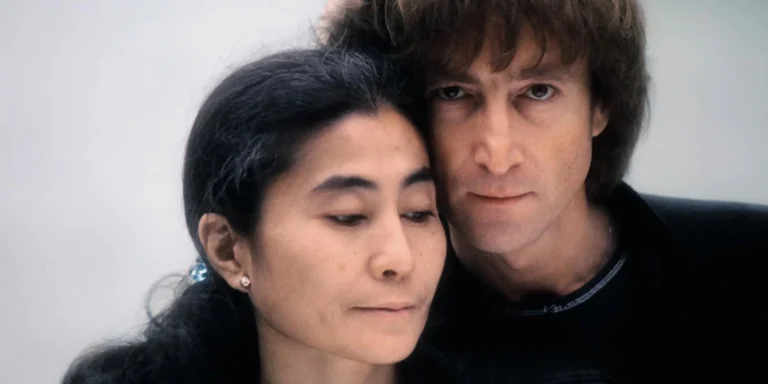
That image proved useful in portraiture and editorial design because it reads quickly. A pair of round glasses can signal Lennon immediately, which is why artists have used them as shorthand in posters, magazine features, album art, and graphic tributes. His face also appears in archival photography from the Beatles years and in later images with Yoko Ono, where the domestic setting often contrasts with the scale of his fame.
What was Lennon’s later life and legacy?
After the Beatles split, Lennon released solo work that ranged from raw confession to activism. Albums and singles from the early 1970s addressed childhood, fame, marriage, and politics, often with less polish than Beatles records. He also collaborated closely with Yoko Ono, whose influence extended into both his personal life and his artistic choices.
Lennon was shot and killed in New York in 1980, ending a career that had already become part of modern cultural memory. His legacy is unusually broad: he remains a key figure in popular music, a symbol of 1960s counterculture, and a recurring reference point for image-makers who want a face that carries instant historical weight. The continued circulation of his portrait says as much about design and reproduction as it does about music.
Frequently Asked Questions
Was John Lennon the main writer in the Beatles?
Not by a simple measure. Lennon and McCartney were a writing team whose songs were officially shared under the Lennon-McCartney credit, even though many tracks were more heavily shaped by one than the other. Lennon contributed many of the band’s rougher, more searching songs, while McCartney often handled melody-driven and structurally polished material.
Why is Lennon so often shown wearing round glasses?
The glasses became part of his public identity and helped fix his image in memory. They were practical eyewear, but over time they also functioned as a visual signature that artists and photographers could use as shorthand. In portraits and graphic work, the frames are often enough to identify him without a name.
Did Lennon only matter because of the Beatles?
No. The Beatles made him globally famous, but his solo records, public statements, and collaboration with Yoko Ono kept him influential after the band ended. He remained a visible figure in music, politics, and visual culture until his death. His post-Beatles work also changed how critics and fans understood the range of a pop songwriter.
Articles mentioning John Lennon