
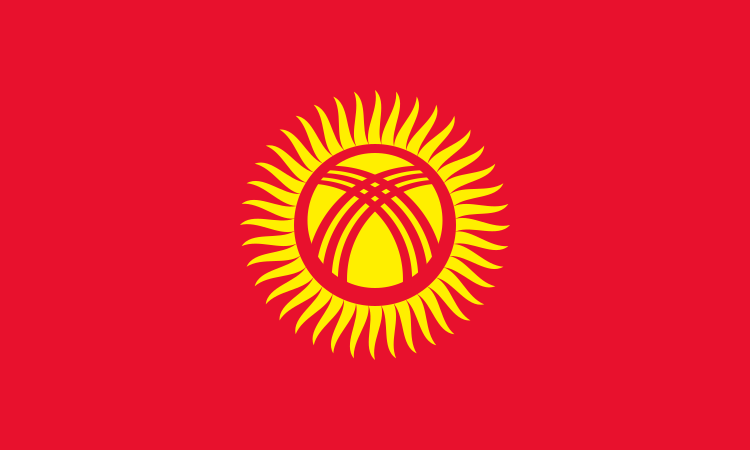
Kyrgyzstan is a landlocked country in Central Asia, officially called the Kyrgyz Republic. It sits in the Tien Shan mountain range, bordered by Kazakhstan, Uzbekistan, Tajikistan and China, with Bishkek as its capital and largest city. The country is known for high-altitude pastureland, alpine lakes and a political history shaped by the collapse of the Soviet Union, repeated protests and changing governments.
| Fact | Detail |
|---|---|
| Official name | Kyrgyz Republic |
| Region | Central Asia |
| Capital | Bishkek |
| Government | Unitary parliamentary republic |
| Neighbours | Kazakhstan, Uzbekistan, Tajikistan, China |
| Terrain | Mostly mountainous |
What kind of place is Kyrgyzstan?
Kyrgyzstan is a small but geographically dramatic state whose identity is closely tied to mountain life. Much of the country lies above 1,500 metres, and the Tien Shan dominates its landscape. That terrain has shaped settlement patterns, transport routes, agriculture and even national imagery: horses, felt tents, summer pastures and glacier-fed valleys appear repeatedly in Kyrgyz cultural life.
Its modern borders were fixed in the Soviet period, when the territory became the Kyrgyz Soviet Socialist Republic. Independence in 1991 brought a new national state, but also the challenge of building stable institutions in a country divided between lowland urban centres and highland rural regions.
Why does Kyrgyzstan matter?
Kyrgyzstan matters because it has been a testing ground for post-Soviet politics in Central Asia. It experienced the 2005 Tulip Revolution, the 2010 uprising that toppled another administration, and several rounds of constitutional and governmental change. Compared with some neighbours, it has allowed more open political competition, but that openness has also made coalitions unstable and protests more frequent.
For visual culture, Kyrgyzstan matters less as a market than as a source of material and formal references. Designers and artists working with nomadic heritage often draw on shyrdak felt rugs, yurt construction, silver ornament, embroidery and horse culture. The country’s rugged terrain also gives its built environment a distinct contrast: Soviet apartment blocks and civic buildings sit alongside vernacular mountain architecture and pastoral landscapes.
What does Kyrgyzstan look like in practice?
In everyday life, Kyrgyzstan is a place where urban and pastoral systems overlap. Bishkek has broad Soviet-era avenues, public squares and institutions inherited from the twentieth century, while smaller towns and villages may still rely on seasonal migration to mountain pastures. Livestock, especially sheep, horses and cattle, remains important, and mobile or semi-mobile forms of shelter and craft still carry practical weight.
The country’s visual signature often comes from this combination of scale and material economy. Felt, wool, leather, wood and metal recur in traditional making; in contemporary work they may be reworked into fashion, product design and exhibition graphics. The result is a visual field that feels both modern and rooted in a landscape of weather, altitude and movement.
How should Kyrgyzstan be understood in a design context?
Kyrgyzstan should be understood as a place where modern statehood, Soviet inheritance and nomadic material culture coexist. That makes it useful for designers and writers looking beyond generic “Central Asian” shorthand. The country has its own history, its own craft traditions and its own political texture, and all three affect how objects, spaces and images are made and read.
Its strongest influence lies in materials and motifs rather than in a single dominant style. Felt in particular has become a symbol of national continuity, but it is only one part of a wider field that includes carved wood, woven textiles, metalwork and monumental public architecture. In practice, Kyrgyzstan appears wherever those forms are adapted, simplified or reinterpreted for contemporary use.
Frequently Asked Questions
Is Kyrgyzstan the same as Kyrgyz Republic?
Yes. Kyrgyzstan is the common English name, while the Kyrgyz Republic is the official state name. Both refer to the same country.
Is Kyrgyzstan mostly mountain or desert?
Kyrgyzstan is overwhelmingly mountainous, not desert. The Tien Shan and related ranges cover much of the territory, creating high valleys, alpine meadows and long, cold winters in many areas. This geography is one reason pastoral life remains important.
Why does Kyrgyzstan appear in design and art references?
It appears because its crafts and landscapes offer strong visual forms: felt rugs, yurts, embroidered textiles, horses and mountain scenery. Those elements are often used to signal heritage, mobility and handmade material culture. At the same time, Soviet urban design and contemporary political imagery give the country a more complex visual profile than folk motifs alone.