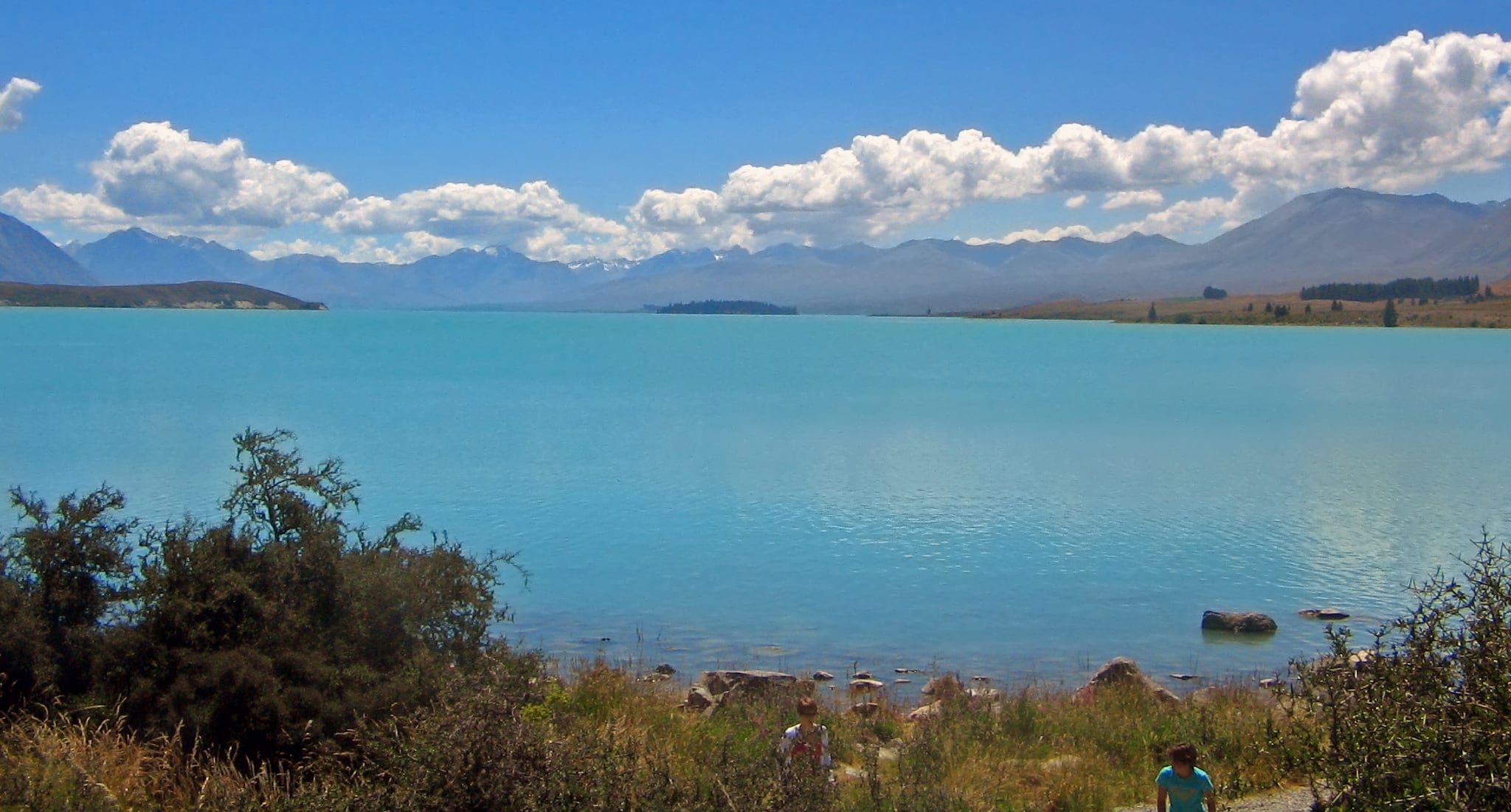
Lake Tekapo is a high-country lake in the Mackenzie Basin of New Zealand’s South Island, known for its bright turquoise water, wide glacial landscape, and position beneath the Southern Alps. It sits about 700 metres above sea level and covers roughly 83 square kilometres. The lake is fed at its northern end by the braided Godley River and forms part of a line of three major lakes running north to south along the basin’s edge.
- A glacially shaped lake in inland South Island, not a coastal lagoon or estuary.
- Part of the Mackenzie Basin’s chain of three parallel lakes.
- Fed by alpine river systems, especially the Godley River from the Southern Alps.
- Known for vivid blue-green water caused by suspended fine rock particles.
- Closely associated with landscape photography, night skies, and tourism.
Where is Lake Tekapo?
Lake Tekapo lies on the eastern side of the South Island, near the northern edge of the Mackenzie Basin. The basin is a broad interior plain framed by mountain ranges, and the lake sits in a landscape shaped by ice, wind, and sparse vegetation. Its position gives it the severe clarity associated with New Zealand’s high country: open horizons, low humidity, and strong changes in light across the day.
The lake is one of three roughly parallel lakes in the basin, alongside Lake Pukaki and Lake Ohau. These lakes occupy valleys and outwash plains formed by glacial action, which explains their elongated shape and their alignment through the landscape. Lake Tekapo’s setting matters as much as the water itself; the surrounding land reads as part of the same geological system.
Why is the water so blue?
Lake Tekapo’s colour comes from finely ground rock particles known as glacial flour. Meltwater from the surrounding mountains carries this silt into the lake, where the particles stay suspended and scatter sunlight. The result is a milky turquoise or blue-green tone that shifts with weather, season, and angle of light.
That colour is not static or decorative. It is the visible trace of erosion in the mountains above the basin, where ice and moving water continually break rock into fine sediment. In photographs, the lake often appears almost unreal, but the effect is physical and repeatable, not an image trick. The same process that gives the water its colour also links the lake to the broader glacial system of the Southern Alps.
What does Lake Tekapo look like in practice?
Lake Tekapo is usually read as a landscape of contrast: bright water, tawny grasslands, pale stones, and dark alpine ridges. The lake’s shoreline is broad and open rather than wooded, so the relationship between water and sky becomes visually dominant. In strong sun, the surface can appear flat and opaque; in cloud or wind, it takes on a deeper and more mineral quality.
Photographers are drawn to the lake because it offers clear layers of scale. Foreground stones, mid-ground water, and distant mountain ranges all remain legible in a single frame. The lake also has a strong association with night photography, because the Mackenzie Basin has low light pollution and a dry atmosphere that suits astronomy and long-exposure work. In that sense, Lake Tekapo is not only a scenic location but a place where light itself becomes part of the subject.
How did Lake Tekapo come to matter?
Lake Tekapo matters because it compresses several important New Zealand landscapes into one place: glacial geology, high-country farming land, alpine river systems, and tourism focused on scenery and stargazing. It has become one of the South Island’s most recognisable inland views, used in travel imagery to represent both wilderness and carefully managed access. The lake also helps explain how the Mackenzie Basin reads as a distinct visual region rather than a simple empty plain.
Its importance is practical as well as aesthetic. The basin’s water systems, land use, and settlement patterns all connect to lakes like Tekapo, which sit at the junction of mountain catchments and open inland country. For artists, designers, and photographers, the lake offers a specific palette: turquoise water, dry grass, bleached stones, and long horizontal space. Those elements make it easy to recognise and difficult to confuse with any other landscape.
Frequently Asked Questions
Is Lake Tekapo a natural lake?
Yes. Lake Tekapo is a natural lake formed within a glacial landscape. Its shape and position reflect the movement of ice and meltwater over long periods, even though modern river flow still feeds it.
The lake’s colour and basin form come from natural processes rather than engineering or damming. Human activity has influenced the surrounding region, but the lake itself is not an artificial reservoir.
Why does Lake Tekapo often appear in photography?
It offers a combination of strong colour, open composition, and highly legible landscape form. The turquoise water, sparse shoreline, and mountain backdrop make it easy to frame cleanly, whether the subject is panoramic or close-up.
It is also associated with clear skies and low light pollution, which makes it attractive for night photography. That dual appeal, daytime colour and nighttime sky, has helped establish its visual reputation.
Is Lake Tekapo the same as the town of Tekapo?
No. The lake and the nearby settlement are related but distinct. The town takes its name from the lake and serves as a base for visitors, but the lake itself is the geographical feature.
The distinction matters because the lake is part of a wider high-country system, while the town is a service centre shaped by tourism and local infrastructure. The two are often discussed together, but they are not the same place.