Light painting is a photographic technique that creates images by moving a light source during a long exposure, or by moving the camera itself while the shutter stays open. It can also mean a photograph lit from outside the frame with handheld lights, especially when the light is used as a visible drawing tool rather than simple illumination. The result is an image built from traces of light rather than a single instant.
- Light painting depends on long exposures, a dark or dim setting, and a controllable light source.
- It began as an experimental tool in early twentieth-century photography and later became a creative genre.
- The technique can record motion, sketch shapes in space, or illuminate a scene selectively.
- It ranges from practical demonstration images to highly staged night photography and abstract art.
- Modern light painters often use LEDs, flashlights, pixel sticks, and camera movement to control color and form.
How light painting works
Light painting relies on the camera’s ability to collect light over time. With the shutter open for seconds or minutes, a moving light source leaves a visible trail on the sensor or film. A person can “draw” in the air with a torch, reveal parts of a subject one section at a time, or move the camera through a lit space to smear the scene into lines and arcs.
The technique has two broad forms. In one, the camera stays still and the light moves; this is the version most people mean by light painting. In the other, the camera moves and the light or scene stays fixed, producing blurred streaks, halos, and layered motion. Both depend on exposure time, intensity, distance, and color temperature, which makes the method highly controllable once the basic setup is understood.
Where did it come from?
Light painting grew out of early twentieth-century industrial and photographic experiments. Frank and Lillian Moller Gilbreth used small lights and open-shutter photography in 1914 to study the movements of factory workers and clerical staff. Their purpose was analytical rather than artistic: they wanted to chart efficient motion in the workplace. That early use established a principle that later photographers would adopt for creative ends, turning trace, movement, and duration into visual material.
Later photographers expanded the method into art, portraiture, and night scenes. As film stocks improved and then digital cameras made long exposures easier to preview and repeat, light painting became more accessible. What began as a tool for recording motion became a flexible form of image-making in its own right.
What does light painting look like in practice?
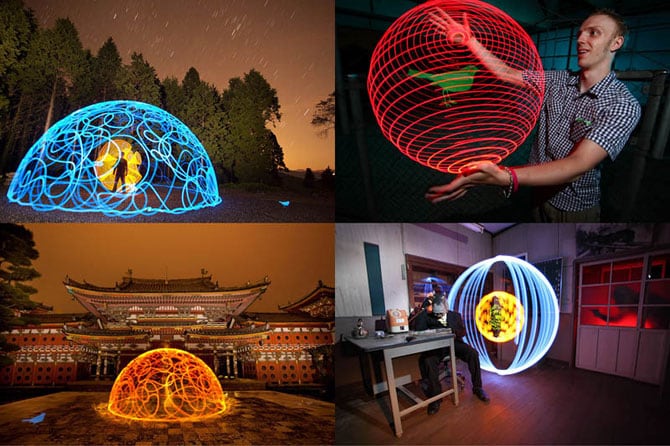
Light painting can produce many different kinds of images. Some are literal: a handwritten word suspended in the air, a figure outlined by a flashlight, or a landscape selectively lit against a dark background. Others are abstract: ribbons of color, geometric grids, or glowing shells that appear to float around a person or object. The visible hand of the maker is often part of the appeal, because the image keeps a record of the movement that produced it.
In practice, light painters often work at night or in a dark studio, using tripods, remote triggers, and steady light sources such as LEDs, torches, fiber optics, or flashlights. Colored gels, mirrors, and homemade tools can shape the beam. Some artists combine light painting with still portraiture; others use it to photograph architecture, landscapes, or astronomical scenes. The technique can feel playful and immediate, but it also rewards planning, because small changes in speed or angle alter the final image.
Why does it matter?
Light painting matters because it turns photography from a passive record into an active drawing process. Instead of capturing only what is already visible, it allows the photographer to build an image over time, marking space with light. That gives the medium a sculptural quality: lines can be placed, layered, and erased through movement, and the finished photograph holds evidence of that labor.
It also broadens what photography can describe. Light painting can show motion, reveal hidden parts of an object, or create scenes that do not exist in ordinary vision. For that reason it appears in both scientific and artistic histories, and in contemporary work by artists such as Hannu Huhtamo, Darren Pearson, and Janne Parviainen, who use it for luminous figures, city scenes, and atmospheric nocturnes.
Frequently Asked Questions
Is light painting the same as long-exposure photography?
Not exactly. Light painting uses long exposure, but long exposure covers a wider set of techniques, including blurred water, star trails, and low-light street scenes. Light painting specifically involves deliberate drawing or shaping with light during the exposure.
What equipment is needed?
At minimum, a camera that can hold the shutter open, a light source, and a way to keep the camera steady. A tripod helps, and a remote release or timer reduces shake. Many practitioners also use LED tools, colored filters, and dark clothing so their own bodies do not show up in the frame.
Why do some light paintings look like they were made in space?
That effect comes from a dark environment, a long exposure, and a moving point of light. When the background stays nearly black, the light trail reads as a floating object or a drawn line without obvious spatial reference. The illusion is strongest when the photographer controls both the brightness of the tool and the path it takes through the frame.
Articles mentioning Light painting