
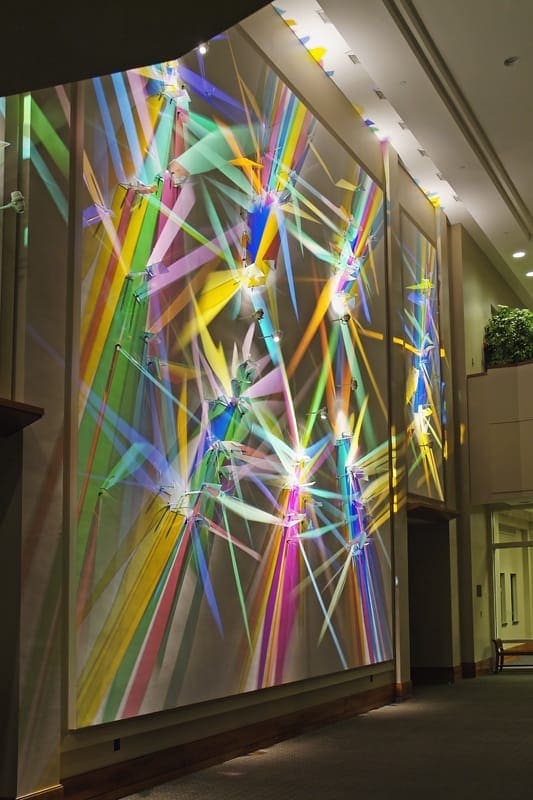
Lightpainting is a sculptural art form developed by Stephen Knapp in 2002 that uses beams of white light, colored glass, and polished metal to create fixed compositions that seem to emit color without pigment. It is distinct from light painting as a photographic technique: Lightpainting is a physical object, while light painting records moving light on film or a digital sensor.
- Developed by Stephen Knapp in 2002 as a new kind of wall-mounted light sculpture.
- Uses white light as the source, then splits and redirects it through glass and reflective surfaces.
- Creates saturated color and visible geometry without traditional paint.
- Often reads like a hybrid of sculpture, painting, and optics.
- Depends on installation conditions: angle, ambient light, and viewing position affect the image.
What makes Lightpainting different from painting?
Lightpainting does not rely on pigment brushed onto a surface. Instead, Knapp built works from layered glass, acrylic, and metal components that bend, filter, and reflect light into colored fields. The final image is produced by optics, not dyes, so the work can appear luminous even though no actual light source is visible in the finished face of the piece.
That difference matters because it changes how the work is made and how it is experienced. A painting fixes color into a stable surface. A Lightpainting requires engineering: the artist has to calculate how rays enter the object, how they split, and where they land. The result sits between a sculpture and an image, with the object’s material structure inseparable from the colors it produces.
How does a Lightpainting work?
A Lightpainting usually begins with a source of white light aimed into the artwork. Inside the structure, transparent and reflective materials redirect that beam through colored glass or coated surfaces. As the light travels, it separates into bands and planes of color, which can read as arcs, wedges, rays, or glowing panes depending on the geometry of the piece.
Knapp treated each work as a controlled optical system. Small changes in angle or surface finish alter the effect, which is why these pieces are usually shown in carefully staged installations rather than casual settings. They are not meant to be viewed as static drawings on a wall; they are built to activate a room through emitted color and reflected light.
Where did Lightpainting come from?
Stephen Knapp introduced Lightpainting in 2002 after years of work in painting and sculpture. His aim was to free color from conventional paint and give it a physical, architectural presence. The name signals that ambition: the work “paints” with light itself, but it does so through constructed objects rather than through performance or photography.
The form emerged from broader late-20th-century interests in perceptual art, kinetic display, and the use of industrial materials in fine art. It also fits a long lineage of artists who worked with transparency, reflection, and illumination, from stained glass traditions to modern light-based installation. Knapp’s contribution was to make those concerns into a distinct object form with its own method and identity.
Why does Lightpainting matter?
Lightpainting matters because it treats light as a material with structure, weight, and surface. That is a serious shift from using light as mere effect. In Knapp’s work, light is cut, folded, and recomposed the way a sculptor might handle wood or stone, except the result is chromatic and immaterial at first glance.
The form also expands the vocabulary of visual culture beyond the usual categories of painting and sculpture. It offers a way to think about how color can be manufactured, not applied, and how an object can depend on scientific behavior while still belonging to art. For writers and designers, Lightpainting is useful because it sits at the meeting point of craft, optics, installation, and image-making.
Frequently Asked Questions
Is Lightpainting the same as light painting?
No. Lightpainting is the name of Stephen Knapp’s sculptural art form, written as one word. Light painting, written as two words, usually means the photographic technique of moving a light source during a long exposure to create trails or patterns.
What materials are used in Lightpainting?
Lightpainting typically uses glass, acrylic, polished metal, and other reflective or translucent materials. The exact mix depends on the work, but the essential method is to shape light through surfaces rather than to apply pigment. The materials matter because their optical properties determine the color and geometry that appear.
Where would a Lightpainting normally be shown?
Lightpainting works are usually displayed in galleries, museums, or purpose-built installations where the lighting can be controlled. Because the effect depends on angle and illumination, the environment is part of the artwork. A poorly lit or overly bright room can flatten the color and weaken the composition.
Articles mentioning Lightpainting
