Luigi Serafini is an Italian artist, architect, and designer best known for Codex Seraphinianus, a surreal illustrated book that presents an imaginary encyclopedia in an invented writing system. Born in Rome in 1949, he built a reputation through work that sits between drawing, design, architecture, and fabricated scholarship, with the Codex becoming his most influential and widely discussed project.
| Born | Rome, Italy, 4 August 1949 |
|---|---|
| Fields | Art, architecture, design |
| Best known for | Codex Seraphinianus (1981) |
| Notable characteristic | Uses a constructed script and encyclopedic format to depict an impossible world |
What made Serafini notable?
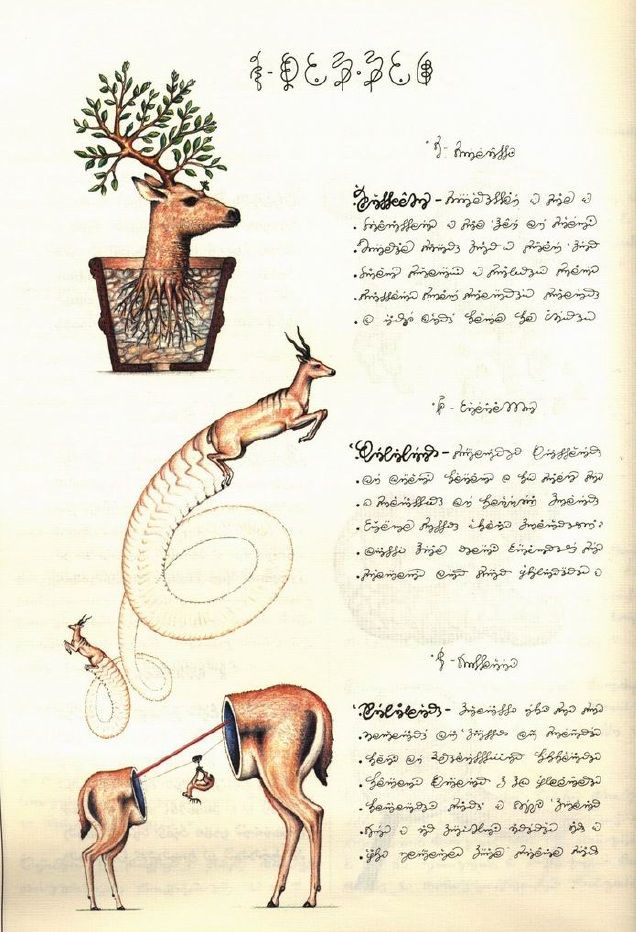
Serafini became known through a single book that behaves like a reference work while refusing ordinary meaning. Codex Seraphinianus is arranged like an encyclopedia, with plates, captions, categories, and a systematic visual logic, but its contents describe creatures, plants, tools, customs, and machines that do not exist. The text appears to be written in a constructed language that resists translation, so the reader has to respond to the work as image, rhythm, and structure rather than as readable prose.
That combination made Serafini important to designers, artists, and bookmakers. The book is not only a strange object; it is also a carefully made one, with the authority of an atlas or natural-history volume and the density of a collector’s catalogue. It shows how page design, illustration, sequencing, and binding can create a complete fictional system.
What is Codex Seraphinianus?
Published in 1981 by Franco Maria Ricci in Milan, Codex Seraphinianus is a large illustrated book that imitates the form of an encyclopedic survey. It contains detailed drawings of hybrid animals, uncanny machines, impossible plants, and invented domestic scenes. Many images are rendered with the seriousness of scientific illustration, which makes their absurdity feel even sharper.
The book’s script is one of its defining features. It looks like writing, with consistent shapes and a stable system, but it remains unreadable as standard language. That decision turns the page into a visual field where meaning comes from repetition, diagram, proportion, and the tension between order and nonsense.
How did his background shape the work?
Serafini’s training and practice in architecture and design matter because the Codex depends on systems. The book is not a loose sketchbook of odd images. It is built like a planned object, with recurring forms, modular pages, and an internal logic that suggests classification, measurement, and use. That formal discipline is part of the joke and part of the achievement.
His wider career also fits that method. As an artist who moves across disciplines, Serafini treats illustration, page layout, invented alphabets, and object design as related tools. The result is work that feels crafted rather than improvised, even when it depicts things that could never function in the real world.
Why does Luigi Serafini matter?
Serafini matters because he expanded what a book can do. Codex Seraphinianus is often treated as a cult object, but its influence is broader than novelty. It has affected how designers think about fictional systems, how illustrators handle imaginary worlds, and how publishers can stage a book as an art object rather than a container for text.
He also clarified a useful distinction in visual culture: a work can be deeply ordered without being readable in the usual sense. That makes Serafini relevant to people interested in typography, speculative design, invented languages, and the visual language of authority. The book borrows the look of knowledge-making while exposing how much of knowledge depends on convention.
What does his work look like in practice?
In practice, Serafini’s signature style combines precision with estrangement. Figures are often drawn with the confidence of field illustration, but their anatomy, function, or scale will suddenly slip into fantasy. Machines may look engineered, yet no practical mechanism is fully legible. Species are categorized with the tone of a scientific manual, though the categories themselves belong to an invented world.
That same approach extends to the page. The layout often uses symmetry, labeling, and repetition to create a sense of system. Color and line are handled with care, so the pages feel finished and authoritative even when they describe impossible things. The effect is not chaos; it is a counterfeit order that remains visually persuasive.
Frequently Asked Questions
Is Luigi Serafini mainly known as a writer or as a visual artist?
He is known primarily as a visual artist, though his most famous work uses the form of a book and depends on language-like invention. Codex Seraphinianus is read more as an illustrated artwork than as a conventional text. The writing matters, but its function is visual and structural as much as linguistic.
Can the text in Codex Seraphinianus be translated?
No standard translation has been established, and the script is generally treated as constructed and undeciphered rather than secreted ordinary language. That unreadability is central to the work’s effect. The book asks for interpretation through images, sequence, and form instead of translation.
Why do designers and artists keep returning to Serafini?
They return to him because he shows how a book can be designed as an entire world. The balance of system, invention, and material polish makes the Codex a reference point for speculative publishing and visual storytelling. It offers a model for building meaning through structure alone.
Articles mentioning Luigi Serafini