
Mahatma Gandhi was an Indian anti-colonial leader who made nonviolent civil disobedience the central method of the struggle against British rule. He helped turn independence into a mass political movement and gave modern political culture one of its most influential models of resistance: organized refusal without armed struggle.
Stories from Mahatma Gandhi
4 stories
About Mahatma Gandhi
- Born Mohandas Karamchand Gandhi in 1869 in western India; later known by the honorific Mahatma, meaning “great soul.”
- Built a political practice around ahimsa, or nonviolence, and satyagraha, a form of truth-force or disciplined resistance.
- Led major campaigns including the Salt March, boycott drives, and mass civil disobedience against colonial law.
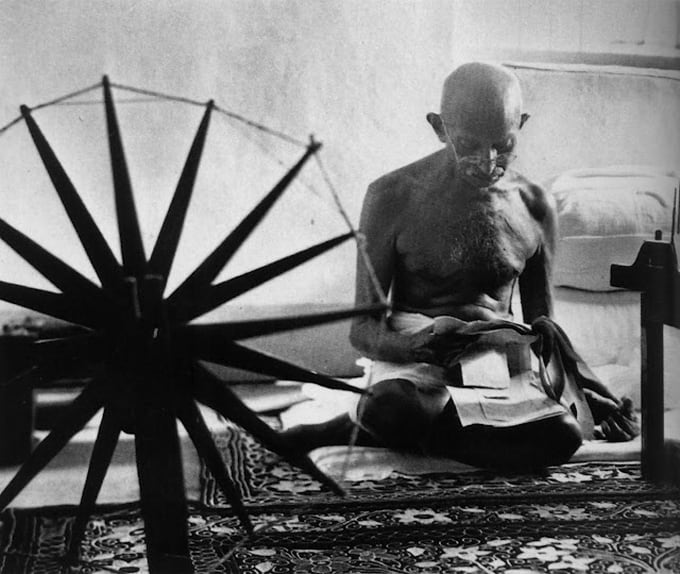
- His public image—simple clothing, shaved head, walking staff, and spinning wheel—became as significant as his speeches.
- His influence extended far beyond India, shaping civil rights and liberation movements around the world.
Read the full overviewWho was Gandhi?, What did nonviolent resistance mean in practice?, Why does Gandhi matter in visual culture?, What is his legacy now?
Who was Gandhi?
Gandhi was a lawyer, organizer, editor, and political strategist who became the best-known figure in India’s independence movement. After training in law in London and working in South Africa, where he confronted racial discrimination, he returned to India with a political method that depended on discipline, sacrifice, and mass participation rather than military force. His authority came less from office than from moral example and an ability to turn personal austerity into political theatre.
The title Mahatma was attached to him as a mark of respect, but it also reflects how his contemporaries saw him: as a public moral figure as much as a politician. That reputation made him unusually powerful and unusually controversial. Admirers treated him as a symbol of conscience; critics pointed to the limits of his politics, especially around caste, gender, and communal conflict.
What did nonviolent resistance mean in practice?
Gandhi did not use “nonviolence” as passive refusal. He treated it as a demanding form of action. Ahimsa meant not harming others, while satyagraha involved mass pressure through marches, strikes, boycotts, tax refusal, and the deliberate breaking of unjust laws. The point was to expose the violence already built into colonial rule and to make repression visible.
His campaigns were carefully staged. The Salt March of 1930, for example, turned a basic material—salt—into a political weapon by challenging the British monopoly over its production and sale. That logic shaped many Gandhi-led actions: choose an everyday object, law, or habit; make it the site of collective refusal; and force the state to answer a moral claim with coercion. The method mattered because it could be repeated, scaled, and adapted in other struggles.
Why does Gandhi matter in visual culture?
Gandhi’s influence on visual culture comes from the way he fashioned a legible public image. His austere dress, usually a plain dhoti and shawl, signaled identification with rural India and rejection of elite status. The spinning wheel, or charkha, became a political emblem of self-reliance and home production, appearing in posters, flags, photographs, and campaign graphics. His appearance was never incidental; it was part of the message.
Photographers and illustrators found in Gandhi a figure who could be portrayed with very little stage machinery. A profile in white cloth, a bare torso, a walking stick, and a thin frame made for instantly readable images. At the same time, the visual record around him helped fix an idea of leadership that mixed asceticism, discipline, and mass politics. In modern portraiture, few political figures are as recognizable before a viewer has even seen the face.
What is his legacy now?
Gandhi’s legacy remains broad and disputed. He is remembered as a founder of Indian independence, a theorist of nonviolent resistance, and a global reference point for protest politics. Leaders from civil rights, anti-apartheid, and democracy movements have drawn on his example, often adapting his methods to very different conditions. His core lesson—that power can be challenged through organized moral pressure—has proved durable.
At the same time, Gandhi is studied critically. Historians have examined his views on race in South Africa, his relationship to caste hierarchy, and the compromises of late-colonial politics. That tension is part of his importance: he is not a simple icon, but a figure whose ideas, performance, and contradictions all shaped twentieth-century political imagery and practice.
Frequently Asked Questions
What is the difference between ahimsa and satyagraha?
Ahimsa means non-harm or nonviolence. Satyagraha is the active political method Gandhi built from that principle: disciplined resistance, often through civil disobedience, meant to confront injustice without physical aggression. One is the ethical basis; the other is the strategy.
Why is Gandhi often shown with a spinning wheel?
The spinning wheel, or charkha, stood for self-reliance and opposition to colonial economic control. Gandhi promoted hand-spinning and handwoven cloth as part of the swadeshi movement, which encouraged local production and the boycott of imported goods. In images, the wheel condensed economics, politics, and identity into one object.
Was Gandhi only a political leader?
No. He was also a writer, publisher, religious thinker, social reformer, and a highly self-conscious maker of public image. His political work cannot be separated from his moral language, daily habits, and visual presentation. That combination is one reason his influence spread well beyond India.