
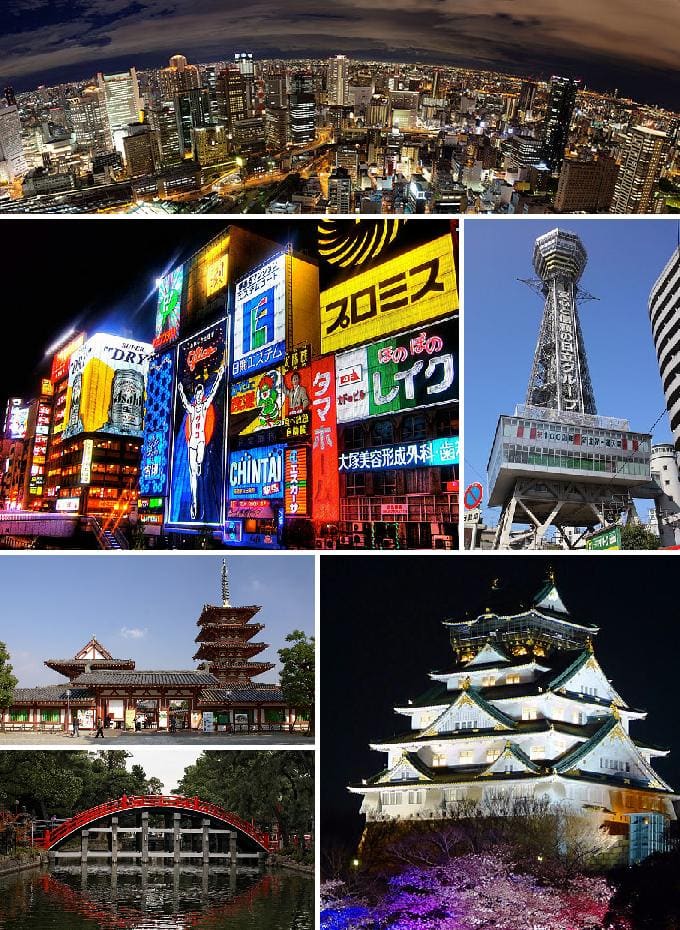
Osaka is a major Japanese city on Osaka Bay, at the mouth of the Yodo River, and the capital of Osaka Prefecture. It sits in the Kansai region on Honshu and forms the core of the wider Keihanshin metropolitan area with Kyoto and Kobe. As Japan’s third-largest city by population, Osaka is both a dense urban centre and a place with a distinct practical, commercial character that has shaped its architecture, crafts, and design culture.
- Located in the Kansai region of Honshu, on Osaka Bay
- Capital of Osaka Prefecture and a designated city under Japan’s Local Autonomy Law
- Part of the Keihanshin metropolitan area with Kyoto and Kobe
- Known for commerce, manufacturing, and a strong culture of making
- Often appears in design coverage because of its buildings, product brands, and urban textures
Why does Osaka matter?
Osaka matters because it has long functioned as one of Japan’s main engines of trade and production. Its role as a commercial city gave it a different reputation from nearby Kyoto, which is more associated with courtly tradition and preservation. That split still shapes how Osaka is read: less ceremonial, more improvised, more attached to practical solutions, storefront culture, and the everyday city.
For design and visual culture, that matters because Osaka offers a setting where new buildings, retail interiors, signage, and manufactured objects often feel direct and unadorned. The city’s identity is not built around a single style. It comes from density, transport infrastructure, riverside development, postwar rebuilding, and a long habit of making things for use rather than display.
What does Osaka look like?
Osaka mixes high-rise commercial districts, tight residential neighbourhoods, rivers, ports, and older shopping streets. Large-scale developments stand beside low-rise blocks, arcades, and narrow lanes packed with restaurants, workshops, and small retailers. The urban fabric often feels layered rather than monumental, with architecture responding to limited land, heavy foot traffic, and intense commercial pressure.
In practice, that creates a city of surfaces: illuminated signs, utilitarian façades, tightly managed interiors, and bold street-level graphics. Contemporary architecture in Osaka often has to work within small plots and complicated sites, which encourages inventive massing, deep eaves, compact forms, and careful control of light and circulation. Those conditions make the city a useful reference point for designers interested in how buildings behave in a crowded, working metropolis.
How is Osaka connected to making and design?
Osaka’s commercial history helped it become a centre for manufacturing, distribution, and retail. That background still appears in the city’s design culture, where furniture, fashion, industrial products, and architecture often carry a clear relationship to process and fabrication. The city is not just a backdrop for finished objects; it is a place where the logistics of making are visible in markets, warehouses, workshops, and city planning.
This is one reason Osaka frequently appears in articles about contemporary Japanese design and architecture. A residence in Osaka can register as a response to dense urban conditions. A product or garment associated with the city may pick up its practical, experimental energy. Even when the object is not made there, Osaka often stands for a particular kind of urban seriousness: efficient, compact, and materially direct.
What is Osaka’s place in Japanese culture?
Osaka has a strong local identity and a reputation for openness, humour, and commercial savvy. That cultural profile has influenced how the city is represented in film, literature, food culture, and popular media. It also affects design reception: work associated with Osaka is often read through ideas of accessibility, experimentation, and street-level vitality rather than formal restraint.
The city’s relation to neighbouring Kyoto and Kobe is also important. Together they form one of Japan’s largest urban regions, but each city carries a different cultural weight. Osaka’s role within that trio is often the most overtly urban and industrial, which makes it especially relevant in discussions of objects, buildings, and visual systems shaped by everyday use.
Frequently Asked Questions
Is Osaka a city or a prefecture?
Osaka is a city, and it is also the capital of Osaka Prefecture. The city sits within the prefecture rather than replacing it. In Japanese administrative terms, Osaka is a designated city with a large degree of local autonomy.
Why do design articles mention Osaka so often?
Design articles mention Osaka because the city has a strong architectural and manufacturing context. It is dense, commercial, and highly urban, which makes it a natural setting for buildings, interiors, products, and photographic work. Its reputation also carries a clear visual tone: practical, energetic, and materially grounded.
How is Osaka different from Kyoto?
Kyoto is more closely associated with heritage, temples, and preservation, while Osaka is better known for commerce, industry, and urban immediacy. The difference is not absolute, but it shapes how each city is used in cultural writing. Osaka tends to signal movement, trade, and everyday life; Kyoto more often signals continuity and tradition.