
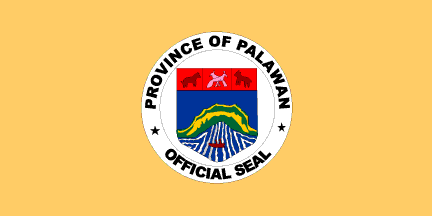
Palawan is an island province in the western Philippines, stretching between Mindoro and Borneo and lying between the South China Sea and the Sulu Sea. Its capital is Puerto Princesa City. It is the country’s largest province by total area of jurisdiction, and its long chain of islands has made it one of the Philippines’ most recognisable places.
- An island province in the MIMAROPA region of the Philippines.
- Its main city is Puerto Princesa, which serves as the provincial capital.
- It spans a long arc of islands and coastlines rather than a single compact landmass.
- Its location between two seas has shaped fishing, trade, travel, and settlement.
- Palawan is widely associated with beaches, limestone cliffs, coral-rich waters, and protected natural areas.
Where is Palawan, and what does it look like?
Palawan sits at the western edge of the Philippine archipelago. On a map, it appears as a narrow, elongated province made up of the main Palawan island and many smaller islands and islets. Its geography is maritime first: long shorelines, deep coves, karst limestone formations, mangroves, reefs, and forested hills.
That landscape matters because Palawan is not defined by a single urban centre or interior plain. Movement across the province often happens by boat, and many places remain closely tied to the sea. The physical form of the province has also helped preserve large tracts of habitat, which is why Palawan is frequently discussed alongside conservation, biodiversity, and low-impact tourism.
Why does Palawan matter?
Palawan matters because it combines strategic location, ecological value, and cultural visibility. It sits along routes that have linked the Philippines with Borneo and the wider Southeast Asian maritime world, so it has long been a place of exchange. At the same time, its reefs, forests, and coastal environments hold unusual ecological richness, making the province central to environmental debates in the Philippines.
It also matters in visual culture because it has become shorthand for a particular idea of tropical beauty: clear water, dramatic limestone, and a relatively undeveloped shoreline. That image has helped make Palawan one of the country’s best-known destinations for travel photography, resort design, and nature writing. The gap between that image and the realities of local settlement, infrastructure, and conservation pressure is part of what makes the place significant.
What is Palawan like in practice?
In practice, Palawan is a province of ports, small towns, fishing communities, and protected landscapes. Puerto Princesa is the administrative centre, but much of the province’s identity comes from places such as El Nido, Coron, and the surrounding island groups, which are known for diving, boat travel, and steep karst coastlines. Local life is shaped by weather, seasonal seas, and the logistics of moving people and goods across water.
For makers and designers, the province is also a place where material culture emerges from environment. Boats, woven goods, seafood markets, timber, shellwork, and architecture adapted to heat and humidity all reflect the conditions of island life. Tourism has added resorts, guesthouses, and transport infrastructure to that mix, creating a visible contrast between vernacular building, conservation practice, and commercial development.
How has Palawan been represented?
Palawan’s image has been built through photography, travel media, and conservation campaigns as much as through geography. The province is often presented as pristine, with empty beaches and untouched landscapes, even though it is home to long-established communities and active land-use pressures. That representational layer matters because it shapes how the place is marketed, protected, and visited.
In design terms, Palawan is often framed as a source of natural reference: pale sand, dark green vegetation, limestone white, and sea tones that shift from turquoise to deep blue. Those colours and textures recur in hospitality branding, editorial photography, and architectural styling. The result is a place that functions both as a lived province and as a visual shorthand for the tropical Philippines.
Frequently Asked Questions
Is Palawan a city or a province?
Palawan is a province, not a city. Its capital is Puerto Princesa City, which is politically separate from the province even though it serves as its administrative centre. The province includes the main Palawan island and many smaller islands.
What is Palawan known for?
Palawan is known for its beaches, limestone formations, reefs, and protected natural areas. It is also known as one of the Philippines’ most prominent tourism destinations. Outside travel writing, it is recognised for its ecological importance and maritime geography.
Why does Palawan appear so often in travel and design features?
Palawan offers a strong visual vocabulary: clear water, sharp rock formations, dense vegetation, and a sense of space. Those features photograph well and translate easily into branding and editorial layouts. That visibility has made the province a recurring reference point in stories about landscape, luxury, and conservation.