Rosie Huntington-Whiteley is an English model and actress whose career moved from runway and lingerie campaigns into beauty, lifestyle, and film. She became widely known through work for Victoria’s Secret and Burberry, then reached a broader audience as Carly Spencer in Transformers: Dark of the Moon in 2011.
| Born | 18 April 1987, Plymouth, England |
|---|---|
| Known for | Fashion modeling, lingerie campaigns, film acting |
| Associated brands | Victoria’s Secret, Burberry |
| Notable screen role | Carly Spencer in Transformers: Dark of the Moon |
| Also credited as | Huntington-Whiteley |
How did Rosie Huntington-Whiteley become known?
Huntington-Whiteley entered fashion through modeling, where her look fit the clean, polished aesthetic that major commercial labels wanted in the 2000s and early 2010s. Her work for Victoria’s Secret helped make her a recognizable face internationally, while Burberry placed her within a more British, editorial mode of fashion image-making.
That combination mattered. Victoria’s Secret gave her mass-market visibility through lingerie advertising and runway spectacle, while Burberry tied her to a luxury brand with a sharper, more restrained visual language. Together, those jobs marked her as a model who could move between glamour, commerce, and high-fashion branding.
What does her work look like in practice?
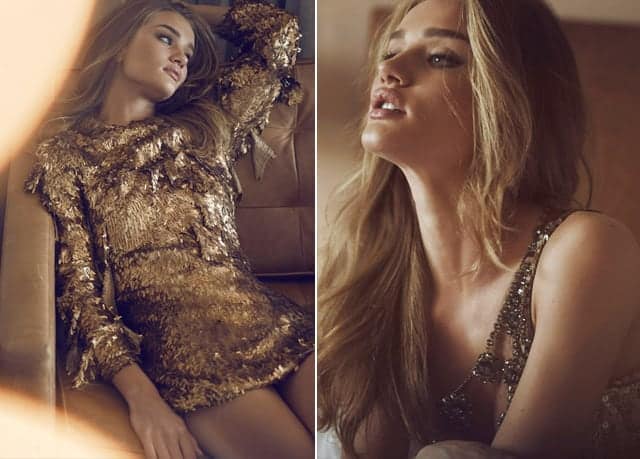
As a model, Huntington-Whiteley is usually presented through controlled styling: glossy skin, precise hair, and poses that emphasize confidence rather than performance. Her images often depend on a balance between softness and structure, especially in lingerie and beauty work, where the camera is used to produce an idealized but approachable figure.
In editorial and campaign settings, she often appears in looks that foreground material quality—silk, lace, tailored wool, polished leather, or clean cotton basics. That matters because fashion photography does not only sell a person’s face; it sells a whole set of textures, fittings, and finishes. Huntington-Whiteley’s image has been built around clothes and cosmetics that read clearly under studio light.
Why does she matter in fashion media?
Huntington-Whiteley is part of a generation of models whose fame extended beyond fashion magazines into film, celebrity coverage, and beauty branding. That shift changed how models were used by magazines and advertisers: a face could function simultaneously as a fashion subject, a lifestyle symbol, and a commercial asset.
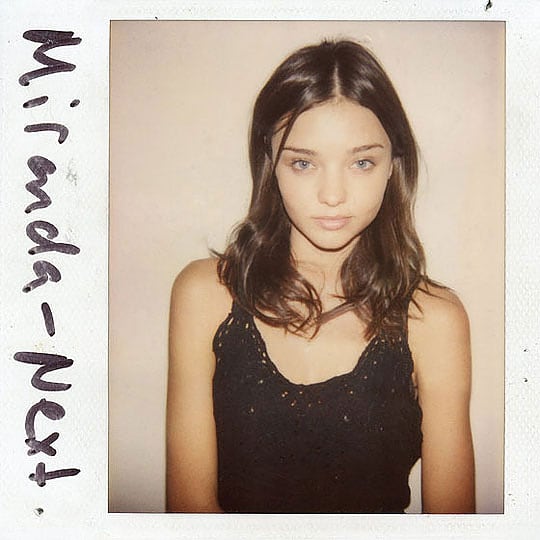
Her presence in work such as Rosie Huntington-Whiteley by Tom Munro for Harper’s Bazaar UK and Rosie Huntington Whiteley for Vogue Brazil shows how editorial photography often constructs a public persona as carefully as it presents clothing. In images associated with “Models Without Make-Up,” she also fits a later fashion-media interest in apparent naturalness, where the editorial goal is to show the face with less cosmetic mediation while still controlling lighting, styling, and framing.
Has she only worked as a model?
No. Huntington-Whiteley also worked as an actress, most visibly in Transformers: Dark of the Moon, where she played Carly Spencer. That role expanded her public profile beyond fashion and placed her in a franchise built around large-scale visual effects, action spectacle, and celebrity casting.
Even so, modeling remains central to her cultural identity. Her acting career did not replace fashion work; instead, it added another layer to a public image already shaped by advertising, editorial photography, and brand association. For that reason, she is often discussed as a crossover figure rather than as a performer who left modeling behind.
Frequently Asked Questions
Is Rosie Huntington-Whiteley a fashion model or a film actor?
She is both, but modeling is the foundation of her public career. Her fashion work made her famous first, and acting later broadened her audience. Most references to her still treat her primarily as a model.
Why is she linked to Victoria’s Secret and Burberry?
Those brands were key points in her rise to prominence. Victoria’s Secret gave her global visibility through lingerie campaigns and runway shows, while Burberry placed her in a luxury British fashion context. Together they show the range of image-making she could inhabit, from commercial glamour to high-end editorial style.
What does “Models Without Make-Up” suggest about her image?
It points to a fashion-media interest in apparent naturalness, where a model is photographed with minimal cosmetic emphasis. In practice, such images are still carefully staged through lighting, pose, and retouching choices. The result is less about complete absence of makeup than about a different kind of polish.
Articles mentioning Rosie Huntington-Whiteley