
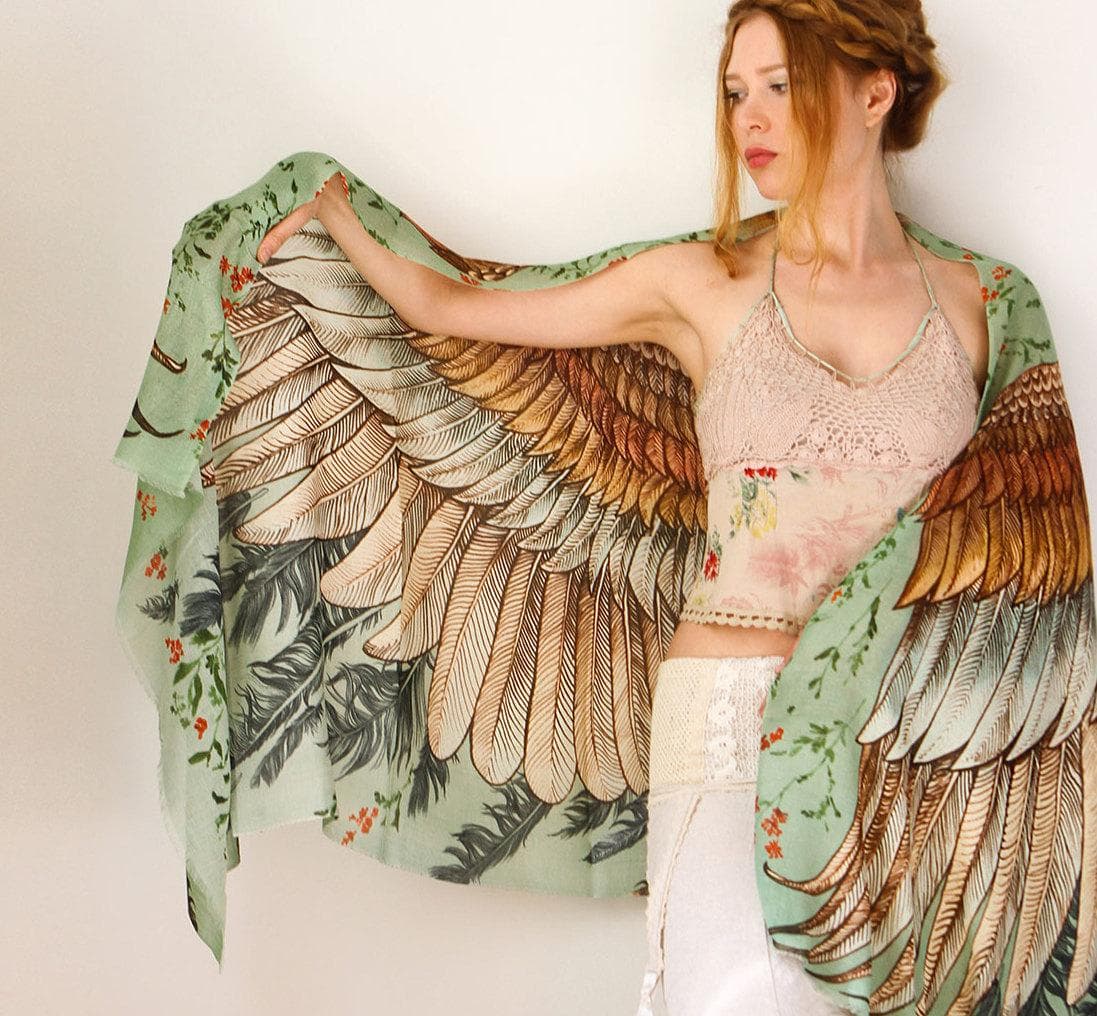
Roza Khamitova is a Kazakh visual artist and designer known for hand-drawn textile imagery, especially scarves decorated with birds, wings, and botanical forms. Her work sits between illustration, fashion accessory design, and fine art: she draws directly for fabrics and prints, then turns those images into wearable objects and printed collections. That blend of image-making and garment surface is what gives her work its identity.
- Origin: Raised in Kazakhstan, with an early attachment to landscape and nature.
- Training: Studied design and moved toward visual art rather than engineering.
- Known for: Hand-drawn scarves and art books that collect her imagery.
- Materials: Fabric, print, ink-like drawn line, and color-focused surface design.
- Why it matters: Her practice shows how illustration can live on clothing as a finished design object.
From landscape to line drawing
Khamitova’s work grows out of observation. The natural world around her shaped her eye early, and that background shows in the recurring subjects of her drawings: feathers, flowers, leaves, and winged forms. Rather than treating nature as a distant theme, she uses it as a vocabulary of shapes and rhythms. The result is work that often feels delicate at first glance but is built from careful contour, repetition, and strong contrast.
Her path into art also matters. She did not arrive there through a conventional fine-art academy alone. Design training gave her a practical relationship to image-making, composition, and object-making, while her interest in visual art pushed the work beyond pure decoration. That combination is visible in the finished pieces: they are meant to be seen, worn, and handled, not just framed.
What does her work look like?
Roza Khamitova’s best-known pieces are scarves with drawn or printed wing motifs, often arranged so the textile becomes a kind of moving picture. When folded, draped, or wrapped, the image changes. A bird wing can spread across the body like a costume element; a botanical pattern can read as ornament at one moment and as an illustration the next. The surface carries the image, but the body activates it.
That gives her practice a specific visual language: precise outlines, airy forms, and color that supports the drawing rather than overpowering it. Her work tends to rely on recognizable shapes rather than abstraction, which makes it accessible, but the compositions are not simple repeats. They are arranged to create motion and to give the textile a sense of life. That is especially important in fashion-related art, where a pattern can easily become static if it is not designed for movement.
Why scarves?
The scarf is a useful format for Khamitova because it sits between art and everyday use. It offers a flat field for drawing, but once it is worn it becomes unstable and alive. A scarf can frame the face, fall like a banner, or wrap the body in a way that changes the image completely. For an artist interested in birds and wings, that flexibility is ideal: the object can suggest flight without pretending to be literal.
Scarves also connect her to a long tradition of textile design in which pattern carries meaning as well as style. In practice, this means the drawing has to work at several distances. It must be legible from far away as a striking shape, and still reward close looking through line quality and detail. That balance is part of what distinguishes a designed textile from a casual illustration placed on fabric.
How has she been presented publicly?
Khamitova’s work has appeared in collections such as Roza Khamitova Art Book (Timeless Collection) and Roza Khamitova Colors, which present her imagery as a coherent body of work rather than isolated products. That matters because it frames her output as an authored visual practice. Viewers encounter not just a single scarf, but a set of recurring concerns: nature, movement, ornament, and the body as a site for display.
She has also been associated with interiors and domestic design contexts, including coverage of a bathroom transformed with art. That points to a broader way of working: her imagery is not confined to one category. It can appear on fabric, in books, and within rooms, which places her within a contemporary field where illustration and design often cross over into environment.
Frequently Asked Questions
Is Roza Khamitova mainly a fashion designer or an artist?
She works across both categories, but her strongest identity is as a visual artist who applies her imagery to designed objects. The scarves are not just accessories; they are part of her artistic output. That is why her work is often described in terms of illustration, textile design, and art at the same time.
What makes her scarves distinctive?
Their imagery is the key feature. Birds, wings, and natural forms are drawn so the scarf reads as an image first and a garment second. Because the textile moves with the body, the design changes as it is worn, which gives the work a sense of motion that a flat print cannot match.
What themes recur in her work?
Nature is the most visible thread, especially forms associated with flight and growth. There is also a strong interest in elegance, surface, and transformation: a drawing becomes an object, and an object becomes part of dress. That combination gives her work its character and explains why it appeals to readers interested in how image-making enters daily life.
Articles mentioning Roza Khamitova

