
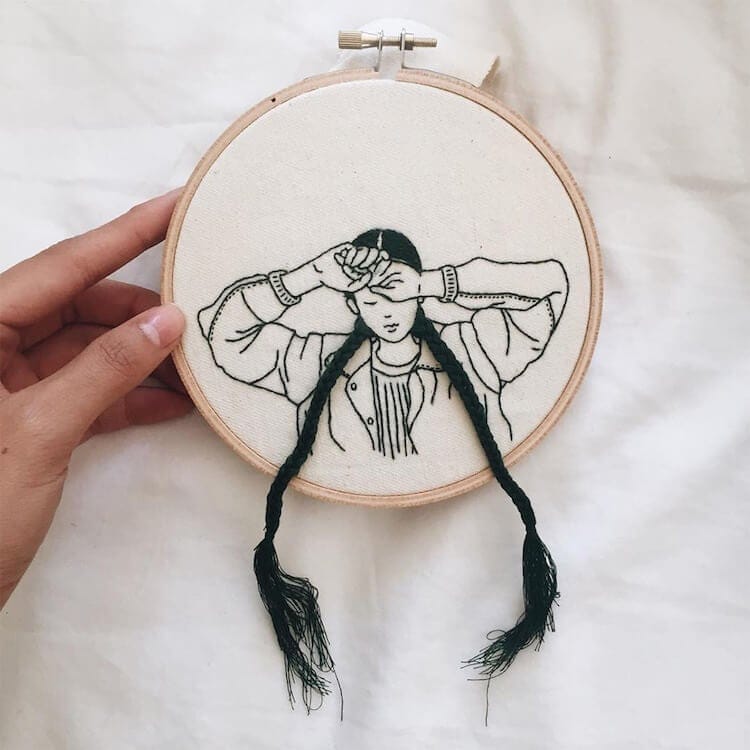
Sheena Liam is a Malaysian artist and embroiderer known for portrait works that combine stitched faces with loose, sculptural threads that spill outward as hair. Her practice sits between embroidery, textile art, and drawing, using thread not just as line and surface but as a physical material with weight, movement, and shadow.
Stories from Sheena Liam
2 stories
About Sheena Liam
- Best known for embroidered women’s portraits with long, cascading thread hair.
- Works with a restrained palette and fine hand stitching to build faces and garments.
- Uses thread extension as a sculptural element, letting embroidery move into space.
- Her work helped broaden public attention on contemporary embroidery as fine art.
Read the full overviewWhat makes Sheena Liam’s work distinctive?, Where did her style come from?, How is the embroidery made?, Why does Sheena Liam matter?
What makes Sheena Liam’s work distinctive?
Liam’s portraits often begin with a stitched figure rendered in a minimal, quiet style. The faces and clothing are kept economical, while the hair becomes the main event: strands of thread are left hanging, braided, looped, or tangled so they break out of the flat plane. That contrast gives the work a sense of motion and presence that ordinary embroidery cannot achieve.
The effect depends on careful control of material. Embroidery thread can fray, sink into fabric, or lose definition if handled loosely, so the work requires precise tension and placement. Liam uses that vulnerability deliberately. The hanging thread reads as hair, but it also announces itself as thread, reminding the viewer that the image is made by hand and is still physically attached to its support.
Where did her style come from?
Liam emerged as part of a wider shift in contemporary embroidery, where artists began treating stitch as a medium for image-making rather than decoration. That shift built on domestic and craft traditions, but moved them into galleries and online image culture. Her work belongs to a generation of makers who use textile techniques to make portraiture feel intimate, tactile, and slightly unstable.
Her signature use of thread hair also reflects a practical understanding of embroidery’s limits. Most stitched portraits rely on flattened mark-making, but Liam pushed beyond the fabric surface to create a third dimension. The result feels closer to a drawing that has escaped its page than to conventional textile work.
How is the embroidery made?
Liam’s portraits depend on embroidery techniques such as satin stitch, outline stitch, and layered thread work to establish faces, shoulders, and clothing. The base image is usually controlled and sparse, with enough detail to identify expression and posture without overfilling the fabric. This restraint leaves space for the hair to carry the composition.
The hair is often made from long, uncut thread lengths attached to the embroidered head area. Once released, those strands can hang freely, twist with gravity, and react to airflow. That choice makes each piece part image, part object: the stitched portrait remains fixed, while the thread hair behaves like a soft sculpture.
Why does Sheena Liam matter?
Liam matters because she helped popularize a form of embroidery that feels contemporary without abandoning the handwork at its core. Her pieces show that thread can describe identity, movement, and mood as effectively as paint or ink, while also carrying the material history of domestic craft. That shift has been important for embroidery’s standing in contemporary art.
Her work also broadened how portraiture can look. Instead of relying on facial likeness alone, she uses material excess in the hair to create character. That approach makes the portraits memorable at a glance and gives the medium a clear visual signature: stitched restraint interrupted by unruly thread.
Frequently Asked Questions
Is Sheena Liam primarily an embroiderer or a visual artist?
Sheena Liam is best described as a visual artist whose best-known works use embroidery as the main medium. The stitching is not decorative finishing; it is the structure of the image. Her practice shows how embroidery can function as contemporary art, not just craft.
What materials does she use?
Her work centers on fabric, embroidery thread, and hand stitching. The specific thread matters because it needs enough strength and sheen to hold its form when left loose, especially in the hair sections. The material choice is part of the visual effect, not an afterthought.
Why do her portraits feature thread hair?
The thread hair gives the portraits movement, volume, and a sense of individuality. It also pushes the work beyond the flat embroidered surface and into sculpture. That single device is what makes her style immediately recognizable.