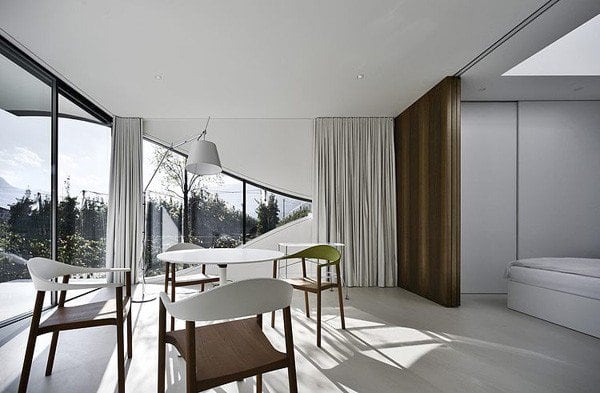
South Tyrol is an autonomous province in northern Italy, centred on the city of Bolzano and known for its mixed German– and Italian-speaking culture, Alpine landscape, and unusually strong regional autonomy. It sits in the eastern Alps, borders Austria and Switzerland, and forms the northern half of the Trentino-Alto Adige/Südtirol region. For architects and designers, it matters because local building often has to negotiate climate, topography, tourism, and a bilingual public culture at the same time.
- An autonomous province in northern Italy, with Bolzano as its capital.
- Part of the larger region of Trentino-Alto Adige/Südtirol, alongside Trentino.
- Majority German-speaking, with a strong Austro-Bavarian cultural heritage.
- Shaped by alpine geography, cross-border trade, and winter tourism.
- Frequently appears in architecture as a setting for contemporary work in wood, concrete, glass, and stone.
Where is South Tyrol, and what makes it different?
South Tyrol lies at Italy’s northern edge, where the Alps widen into a series of valleys and high plateaus. It is not a historic Italian core region in the usual sense. Its modern identity reflects a long political shift from the Habsburg Empire to Italy after the First World War, followed by decades of cultural negotiation and the creation of special autonomy.
That autonomy shapes everyday life. Public administration, schooling, and signage operate in a multilingual framework, and many towns use both German and Italian names. In practice, the province feels more Central European than much of Italy in language, settlement pattern, and building tradition, even while remaining firmly within the Italian state.
Why does South Tyrol matter in architecture?
South Tyrol’s architecture is closely tied to its mountain setting. Buildings must respond to steep slopes, heavy snow, strong sun, and a long winter season. That has encouraged compact forms, deep eaves, careful insulation, and materials that can handle sharp temperature changes.
At the same time, the province has become a site for ambitious contemporary design. Architects working there often combine local references with modern systems: exposed concrete for retaining walls and thermal mass, timber for warmth and lower embodied carbon, and large glazing to frame the landscape. The result is a regional architecture that often looks restrained from the outside but is technically detailed and highly specific to place.
What does South Tyrol look like in practice?
In built form, South Tyrol often blends old alpine types with new ones. Traditional farmhouses, fortified houses, and village clusters sit alongside hotels, cable-car infrastructure, and contemporary villas or museums. Facades frequently use rendered masonry, larch timber, stone cladding, or crisp concrete, depending on whether a building aims to feel rooted in vernacular tradition or deliberately contemporary.
This balance is visible in recent work that treats the landscape as an active material. Projects in the province often open rooms toward mountain views while controlling privacy and heat gain through recessed openings, screens, or carefully placed mirror surfaces. The setting is not only scenic; it shapes plan, section, and material choice at every scale.
How did its culture shape the region?
South Tyrol’s built environment carries the marks of its bilingual and cross-border history. German-speaking traditions remain strong in domestic architecture, rural construction, and local craft, while Italian administrative structures and postwar modernisation brought new institutions, roads, and public buildings. The province therefore contains a layered visual culture rather than a single dominant style.
That layered identity also affects how projects are received. A building in South Tyrol is often judged not only on aesthetics but on whether it fits the Alpine landscape, respects local customs, and acknowledges the region’s distinct history. For designers, the province can be a demanding context: technically exacting, culturally alert, and closely watched by residents who know the difference between generic mountain design and something made for this place.
Frequently Asked Questions
Is South Tyrol the same as Alto Adige?
Yes, both names refer to the same autonomous province. South Tyrol is the English and German-facing form most often used in cultural and architectural writing, while Alto Adige is the Italian name. The dual naming reflects the region’s bilingual character and its layered political history.
Why do so many buildings in South Tyrol use wood and concrete?
Wood suits the region’s alpine craft traditions and creates a warmer visual relation to forests and farms. Concrete is often used where a building must anchor itself into a slope, retain earth, or provide thermal mass in a cold climate. Contemporary projects often combine the two to balance structure, insulation, and atmosphere.
What kind of place is South Tyrol for a visitor interested in design?
It is a region where landscape and building are tightly linked, so design is easiest to read in relation to topography, climate, and local identity. Villages, tourist developments, and experimental houses all show how materials and forms adapt to the Alps. The province is especially useful for seeing how contemporary architecture can feel precise without being detached from place.
At a glance
- Address
- Trentino-South Tyrol, Italy
- Coordinates
- 46.5, 11.35
Articles mentioning South Tyrol