
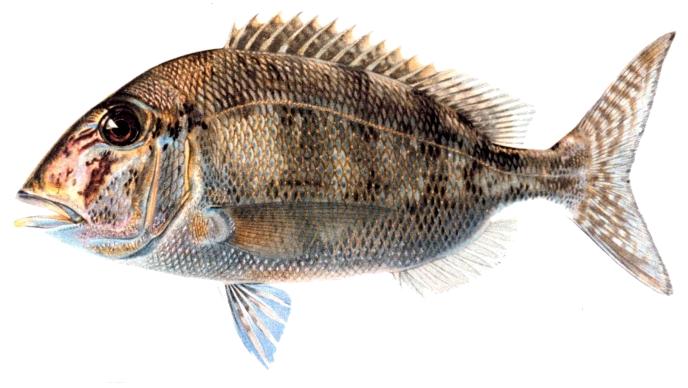
Sparidae is a family of ray-finned fish, commonly known as sea breams and porgies, that live in shallow temperate and tropical waters and feed near the seabed. The family includes familiar species such as the sheepshead, scup, and red seabream. Many sparids have stout bodies and heavy, molar-like teeth adapted for crushing shellfish and other hard prey.
- Marine fish family in the order Perciformes
- Common names include sea bream and porgy
- Usually bottom-dwelling predators in shallow coastal waters
- Many species have rounded, grinding teeth for crushing prey
- Some species have been heavily overfished, including the endangered Polysteganus undulosus
What makes sparids distinct?
Sparids are built for life along the seafloor. Their bodies are typically compressed from side to side, and many species carry strong jaws with teeth shaped for crushing rather than slicing. That feeding style suits a diet of crustaceans, molluscs, sea urchins, and other hard-shelled animals found over rocks, reefs, and sandy bottoms.
The family is diverse, and not every species looks or feeds in exactly the same way. Some are prized table fish with delicate flesh; others are recognized more for their role in coastal ecosystems. The shared features that tie them together are their marine habitat, bottom-oriented feeding, and dental adaptations.
Where do sea breams come from?
The family has a broad distribution in warm and temperate seas, especially around Europe, Africa, the Mediterranean, southern Asia, and parts of the Atlantic and Pacific coasts. The common names change by region: sea bream is used widely, while porgy is more common in North America. That naming split can make the family seem larger or smaller depending on the local fish market or field guide.
Because many sparids live in shallow water, they have long been visible to coastal fishing communities. They turn up in commercial landings, angling, and local food traditions. Their visibility has also made them sensitive to pressure from intensive harvesting.
Why do sparids matter in fishing and food culture?
Sparidae matters because several species are economically important and widely eaten. Red seabream, for example, has major value in East Asian fisheries and aquaculture, while other sea breams are staples in Mediterranean and Atlantic coastal cuisines. Their firm flesh and moderate size make them useful both for whole-fish cooking and for restaurant display.
That same value has sometimes led to overfishing. Species such as Polysteganus undulosus have been depleted by exploitation beyond sustainable recovery, a reminder that even common-looking coastal fish can be vulnerable when harvest outpaces reproduction. In fishery science, sparids often serve as examples of the need to balance demand with stock management.
How are sparids identified in practice?
Identification usually starts with body shape, mouth structure, and habitat. A fisher or biologist will look for a laterally compressed body, a small to moderate mouth, and teeth that may appear blunt, rounded, or molar-like. Coloration varies widely: some species show silver sides and pinkish fins, while others have deeper gold, red, or dusky tones.
Because many sparids resemble one another, local knowledge and close inspection matter. Market names can blur the differences between species, and some fish sold as sea bream may belong to different genera within the family. In practice, the term often functions as both a taxonomic label and a culinary name.
Frequently Asked Questions
Is sea bream the same as Sparidae?
Sea bream is the common name used for many members of the Sparidae family, but it does not always mean the exact same thing in every region. Some fish sold as sea bream belong to different sparid species, and the name can cover more than one local catch. In taxonomic terms, Sparidae is the family; sea bream is the broad everyday label.
What do sparids eat?
Most sparids feed on hard or shelled animals near the bottom, including crabs, molluscs, sea urchins, and worms. Their molar-like teeth help them crush prey that other fish cannot handle easily. A few species take a more varied diet, but bottom feeding is the family’s general pattern.
Are all sparids threatened?
No. Some sparid species remain abundant and are fished sustainably in well-managed waters. Others have suffered heavy declines from overfishing, especially where harvest has exceeded the pace of recovery. Conservation status depends on the individual species, not the family as a whole.