
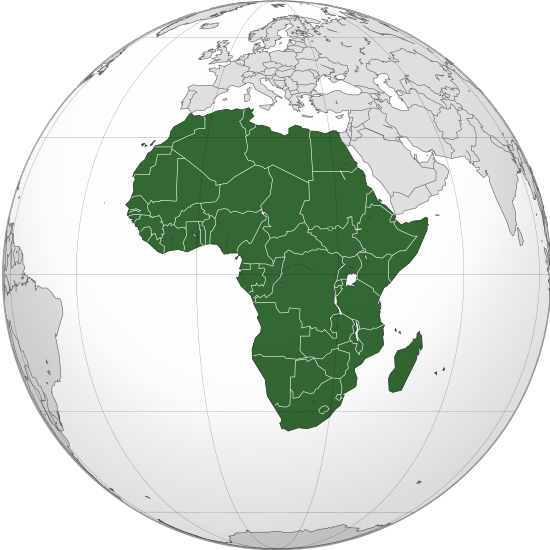
Africa is the second-largest continent on Earth and the second-most populous, covering about 30.2 million square kilometres including nearby islands. It stretches across the equator, reaches from the Mediterranean to the southern Atlantic and Indian oceans, and contains a huge range of climates, landscapes, languages, and built traditions.
- It spans deserts, savannas, rainforests, mountains, river basins, and long coastal zones.
- Its material cultures are shaped by local resources such as clay, stone, timber, fiber, metal, and later imported industrial goods.
- Design and architecture across the continent often respond directly to heat, dust, seasonal rain, water scarcity, and trade routes.
- Africa is not one visual style or one cultural region; its art and making traditions vary sharply by place, history, and language.
What Africa means as a place
Africa is a continent, not a country and not a single cultural unit. It contains 54 internationally recognized states and hundreds of major language groups, along with countless local communities and histories. Any serious description of African art, architecture, or design has to begin with that scale and diversity, because forms that look similar on the surface may come from very different environments and social systems.
The continent’s size matters in practical terms. A design used in the Sahel may rely on mud brick, deep shade, and narrow openings to handle dry heat, while a coastal city in East or West Africa may favor open ventilation, coral stone, timber verandas, or metal roofing shaped by humid air and heavy rain. Landscape is not just backdrop here; it is one of the main forces shaping how things are made.
How does geography shape making in Africa?
Material culture across Africa is tightly linked to climate and access. In arid zones, builders have long used earth, clay, and sun-dried brick because these materials hold steady temperatures and can be renewed locally. In forested regions, carved timber, woven fibers, raffia, and bark cloth have been central to shelter, clothing, and ceremonial objects. In riverine and trading regions, metalworking, beadwork, glass, and imported textiles often sit alongside local materials, producing hybrid forms.
Patterns of movement also matter. Caravan routes across the Sahara, Indian Ocean trade along the east coast, and Atlantic exchange on the west coast all carried techniques, pigments, textiles, and tools. Those exchanges did not erase local practice; they added layers. A mosque, market, or domestic compound in Africa often shows that overlap in its proportions, ornament, and construction logic.
What does African design look like in practice?
There is no single African style, but certain practical approaches recur. Architecture often emphasizes shade, airflow, layered thresholds, and courts or shaded gathering spaces. Decoration can be structural rather than applied: carved screens, patterned brickwork, painted walls, woven partitions, or textured plaster. In objects, function and symbol often coexist, so a vessel, stool, textile, or mask may carry social meaning while still solving a specific task.
Contemporary makers continue these traditions while using new tools and supply chains. Architects across the continent work with concrete, steel, glass, and solar systems, but often adapt them to local climate and maintenance realities. Designers and artists also frequently reuse discarded plastics, textiles, metal, and wood, turning scarcity and waste into a source of invention rather than a limitation.
Why Africa matters in visual culture
Africa matters because so much of global visual culture has been shaped by African materials, labor, and imagination, often without proper credit. That includes historic architecture, textile systems, metal casting, ceramics, carving, beadwork, and contemporary film, photography, and graphic design. It also includes the colonial and postcolonial histories that distorted how African work was collected, classified, and exhibited.
For a publication concerned with how things are made, Africa is essential not as a category of style but as a vast field of making practices. To name Africa is to point to many intertwined histories of resourcefulness, exchange, adaptation, and precision. Any one article may touch only a small part of that field, but the continent’s scale and variety shape the possibilities for art and design across the world.
Frequently Asked Questions
Is Africa one cultural region?
No. Africa contains many regions, empires, language families, religions, and local traditions. Treating it as one culture flattens major differences in climate, material resources, and history.
Useful discussion of African art or architecture names the specific place, people, and period involved. That is the only way to describe how an object or building was actually made.
Why do African buildings often use earth or mud?
Earth is available in many places, and it performs well in hot climates. Thick earthen walls slow heat gain during the day and can help hold cooler temperatures indoors.
These methods are also repairable. Mud plaster, brick, and rammed earth can be renewed with local labor and materials, which makes them practical as well as expressive.
Why is Africa important in design history?
Africa holds some of the oldest continuous traditions of making on the planet, including pottery, metalworking, textile production, and monumental architecture. Its cities and trade networks also connected regions long before modern nation-states existed.
Design history cannot be accurate if it treats African work as peripheral. The continent has shaped global ideas of structure, ornament, utility, and reuse for centuries.
At a glance
- Coordinates
- 21.09375, 7.1881
Articles mentioning Africa


