Tianjin

Tianjin is a major port city and one of China’s four direct-controlled municipalities, governed at the same level as a province and administered directly by the central government. It sits on the coast of northern China, bordering Beijing and Hebei and opening onto the Bohai Gulf. As a city, Tianjin has long mattered because it links inland northern China to the sea, and because its modern identity has been shaped by trade, foreign concessions, industry, and large-scale urban development.

  • Direct-controlled municipality in northern China, with provincial-level status.
  • Key port and industrial center on the Bohai Gulf.
  • Historically shaped by river trade, treaty-port development, and foreign-built districts.
  • Known today for heavy industry, logistics, and large civic and commercial construction.

Why does Tianjin matter?

Tianjin matters because it is both a transportation hinge and a visual record of modern Chinese urban change. Its port position made it a gateway for goods moving between Beijing, north China, and overseas markets. That role brought warehouses, railways, docks, factories, and diplomatic compounds, all of which left a built environment that mixes Chinese city forms with European-style streetscapes and later socialist-era planning.

For design and visual culture, Tianjin is useful because it shows how cities absorb outside influences without becoming copies. The city’s streets, façades, and public buildings often combine imported materials and planning ideas with local building traditions, commercial needs, and contemporary Chinese development strategies. It is a place where architecture can read as both infrastructure and image-making.

How did Tianjin develop?

Tianjin grew where the Grand Canal met the Hai River, giving it an early advantage as a transport hub. Its rise accelerated in the nineteenth century, when the city became a treaty port and foreign powers established concessions there. Those concessions introduced new street grids, civic buildings, and construction methods, including masonry façades, ironwork, and imported decorative styles that contrasted sharply with older Chinese urban fabric.

In the twentieth century, Tianjin became a major industrial base and later a planned center within the PRC’s north China economy. State-led development added factories, housing blocks, transit systems, and new business districts. More recently, the city has been associated with high-rise construction, advanced manufacturing, and spectacle-driven architecture, including projects that use glass, steel, and large-span structural systems to project technical capability.

What does Tianjin look like on the ground?

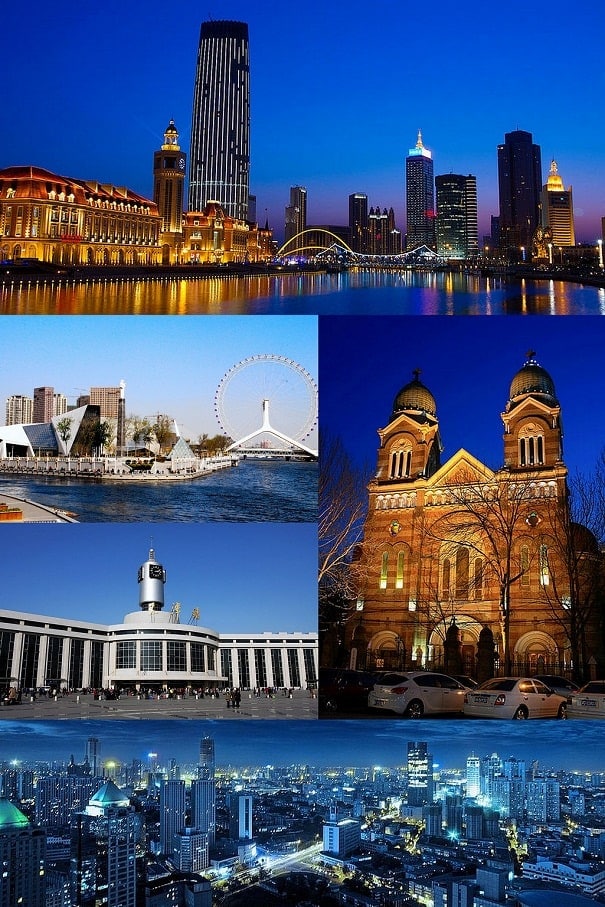
Tianjin is not a single image but a stack of different city types. Older riverfront areas and treaty-port districts include compact streets, arcaded shopfronts, former consulates, churches, and European-style villas. These coexist with broad boulevards, apartment compounds, industrial zones, and newly built commercial districts. The result is a city where walking a few blocks can mean moving between very different eras of planning and construction.

In practice, Tianjin often appears as a city of surfaces and systems. Its built environment includes brick, stucco, glazed tile, concrete, curtain wall glass, and steel frame construction. Its waterfront and transport infrastructure reinforce its identity as a working city rather than only a symbolic one. That matters to designers and architects because Tianjin offers examples of how port logistics, political status, and urban branding all shape what a city looks like.

Frequently Asked Questions

Is Tianjin part of Beijing?

No. Tianjin is a separate municipality with its own city government, though it is close to Beijing and economically linked to the capital region. Both are direct-controlled municipalities, which means they report directly to the central government rather than to a province. Tianjin is also a major city in its own right, with its own port, industry, and urban history.

Why does Tianjin appear in architecture coverage?

Tianjin appears in architecture coverage because it has a strong record of large civic projects, international influence, and ambitious urban redevelopment. The city’s treaty-port past left a dense architectural inheritance, while its present-day growth has produced stadiums, office towers, cultural buildings, and infrastructure on a large scale. That makes it a useful reference point for discussing how modern Chinese cities build identity through form and material.

What is Tianjin best known for?

Tianjin is best known as a northern port city with a long history of trade, industry, and foreign concessions. It is also known for its role in the Bohai economic region and for its mix of historic streetscapes and modern construction. In visual terms, the city stands out for the way old concession districts and new developments sit side by side.