
A zoetrope is a rotating viewing device that makes a sequence of still images appear to move. It uses persistence of vision: as the cylinder spins, the viewer looks through narrow slits and sees each image in rapid succession, creating the impression of animation.
Stories from Zoetrope
1 story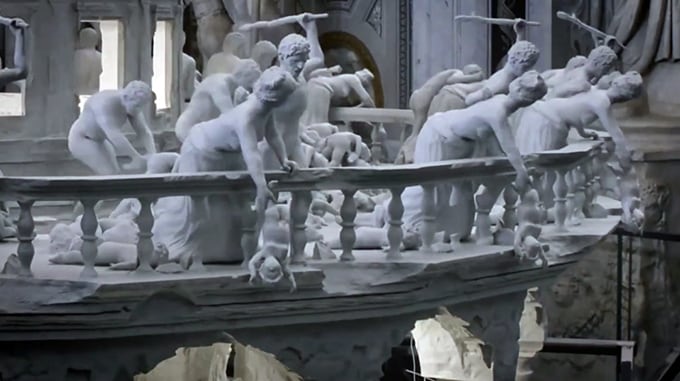
About Zoetrope
- It is an early form of animation display, not a projector.
- Its standard form is a slotted cylinder with an image strip mounted inside.
- The viewer sees motion only when the drum rotates at the right speed.
- The name comes from Greek roots meaning “life” and “turn.”
- Contemporary artists still use the form for kinetic sculpture and illusion work.
Read the full overviewHow a zoetrope works, Where did it come from?, Why does the zoetrope matter?, What does it look like in practice?
How a zoetrope works
The classic zoetrope is a simple mechanical device: a hollow cylinder with evenly spaced vertical slits around the top edge. Inside the cylinder sits a continuous band of drawings or photographs, each image showing a slight change from the one before it. When the cylinder spins and someone looks through the slits, the gaps act like a shutter, briefly isolating each image and preventing motion blur.
The effect depends on timing. If the drum turns too slowly, the pictures look like separate frames. If it turns too fast, the sequence can smear into a blur. At the correct speed, the eye and brain combine the images into a single animated action, such as a running figure, a jumping animal, or a face changing expression.
Where did it come from?
The zoetrope emerged in the 19th century during a period of intense invention around optical toys and pre-cinema apparatus. It developed from earlier devices such as the phenakistoscope, which also created motion from sequential drawings, but did so on a flat disc viewed in a mirror. The zoetrope improved on that idea by allowing multiple viewers to watch at once and by making the device easier to build as a table-top object.
Its name reflects that fascination with animated life. From the Greek zoē for life and tropē for turning, the word suggests a “wheel of life.” That phrase captures the device well: it turns static artwork into a moving figure through nothing more than rhythm, spacing, and light.
Why does the zoetrope matter?
The zoetrope matters because it sits near the beginning of moving-image culture. Before film cameras and digital animation, it showed that motion could be constructed from still frames arranged in sequence. The principle behind it survives in cinema, GIFs, flipbooks, stop-motion animation, and many forms of screen-based motion graphics.
It also matters as a design object. A zoetrope is not only a demonstration of visual theory; it is a carefully engineered experience. The width of the slits, the number of images, the spacing of the sequence, and the rotation speed all shape the final illusion. That makes it a useful example of how image, mechanism, and perception work together.
What does it look like in practice?
Traditional zoetropes are compact and often made from painted metal, cardboard, or wood. The outer surface is usually plain or decorated, while the inner band carries the image sequence. Some versions place the drawings on a removable strip so that a different animation can be inserted. Others use a mirrored interior and change the viewing method, but the classic slotted-cylinder form remains the most recognisable.
Contemporary artists and designers have expanded the device into larger installations. Instead of hand-drawn figures, they may use 3D-printed forms, sculpted models, or complex digital sequences. In those works, the “frames” are no longer flat drawings but physical objects or reliefs, and the spinning mechanism turns them into one continuous animated scene. Mat Collishaw’s large-scale zoetropes are a strong example of that approach: the form becomes a sculpture, but the underlying trick is still the same.
Frequently Asked Questions
Is a zoetrope the same as a flipbook?
No. A flipbook relies on a person turning pages by hand, while a zoetrope spins a set of images inside a cylinder. Both create motion from still images, but the viewing experience and mechanism are different.
Why do the slits matter?
The slits act like a timing gate. They let the eye see one image at a time and cut down on blur caused by rotation. Without them, the sequence would be much harder to read as motion.
Are zoetropes still used today?
Yes, though mostly as artistic, educational, or decorative objects rather than everyday tools. Museums, studios, and artists use them to demonstrate animation principles or to create striking kinetic works. Their appeal comes from the fact that the illusion is built in plain sight, with no screen involved.