

For more than five decades, Finnish-American photographer Arno Rafael Minkkinen has pursued one of the most singular and demanding projects in contemporary photography: the integration of his own body into natural landscapes. Born in Helsinki in 1945, Minkkinen emigrated to the United States and built a practice that sits at the intersection of fine art, conceptual photography, and the self-portrait tradition — though none of those labels fully contains what he does.
A Practice Built on Physical Commitment
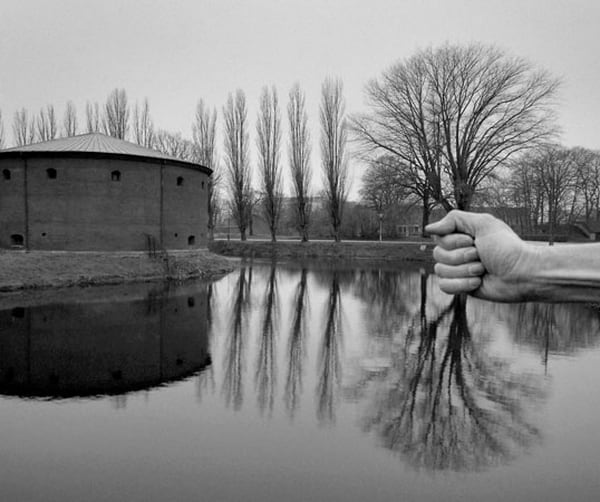
Minkkinen works exclusively in black and white, and almost exclusively outdoors. His method requires genuine physical effort: contorting his body, submerging it in freezing water, balancing on rock faces, or extending a limb into a composition so that it reads as an organic extension of the terrain. There are no assistants, no digital manipulations, and no second photographer. Minkkinen sets his camera on a tripod, composes the frame, and then places himself within it — often with only seconds to achieve the image before conditions change.
The Self-Portrait Reimagined
What distinguishes Minkkinen from more conventional self-portrait photographers is the degree to which the self is subsumed by the environment. In many of his images, the human body functions less as a subject than as a compositional element — a form that rhymes with a branch, mirrors a shoreline, or disappears into the geometry of ice and shadow. The result is a body of work that asks persistent questions about identity, mortality, and the relationship between human beings and the natural world.
Harpers Ferry and the Continuing Journey
Minkkinen articulated his working philosophy most clearly in what has become known as the “Harpers Ferry address” — a speech in which he described photography as a long journey rather than a destination, urging photographers to commit to a single vision rather than constantly chasing novelty. It has been widely quoted in photography education and speaks to the discipline that underpins his own practice.
His work has been exhibited internationally and held in major collections, and he has taught at institutions including the University of Massachusetts Lowell. Yet the photographs themselves resist any institutional framing. They feel elemental and private — one man, one camera, and an unending conversation with the natural world.
A Legacy in Monochrome
Few photographers have committed so completely to a single visual language over such a sustained period. Minkkinen’s black-and-white tonality is not a stylistic choice so much as a philosophical one: color would pull the images back toward the documentary, toward the specific and the datable. In monochrome, they exist outside of time — which is, ultimately, where the best of his work belongs.