| Field | Details |
|---|---|
| Name | ROA |
| Also known as | ROA (no alternate public aliases) |
| Born | c. 1975 |
| Origin | Ghent, Belgium |
| Known for | Large-scale graffiti and mural paintings of animals, especially birds and mammals, usually rendered in black and white |
| Working method | Street painting and mural work on walls in public space, often using spray paint and other mural techniques suited to large surfaces |
| Notable context | Gained wider UK attention in 2010 when a legally painted rabbit mural in Hackney drew a threatened removal by the local council |
What ROA makes
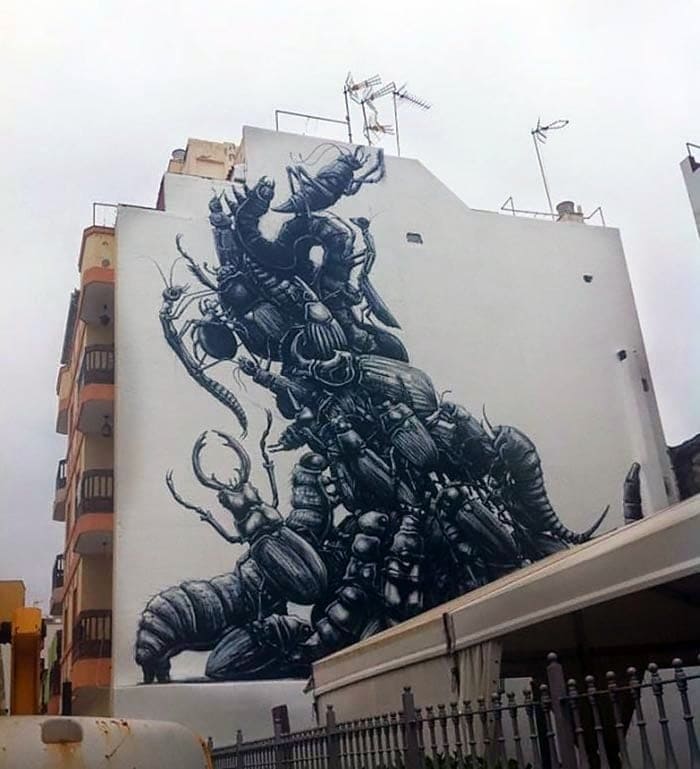
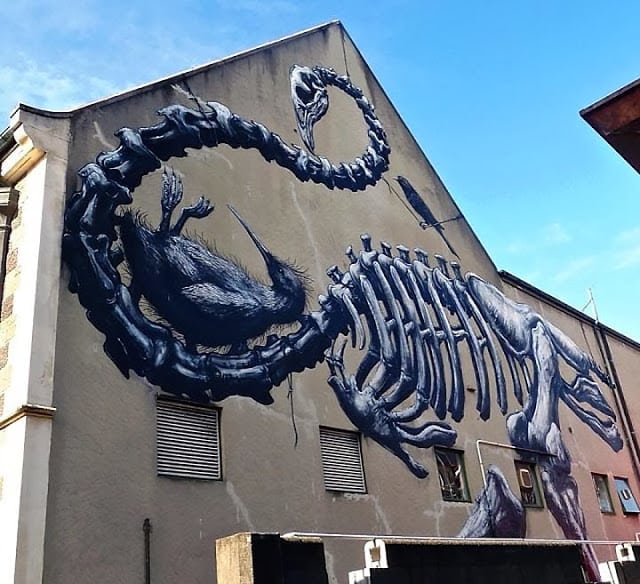
ROA is the pseudonym of a graffiti artist from Ghent, Belgium, known for stark black-and-white images of animals painted directly onto walls. His subjects are usually wild creatures or birds shown at large scale, often with careful anatomical detail that makes the bodies feel both scientific and ghostly. The work sits at the meeting point of street art, mural painting, and graffiti, but its subject matter sets it apart from lettering-based graffiti traditions.
ROA’s palette is usually limited to black, white, and shades of grey. That restraint gives the animals a clean, graphic presence and lets their fur, feathers, bones, and poses read clearly from a distance. On a city wall, the result often looks less like decoration than a field note expanded to architectural scale.
Where did ROA come from?
ROA emerged from the European street-art scene and built a reputation through murals in cities across Europe and the United States. Like many graffiti and mural artists, he worked in public space first, where visibility, placement, and local response matter as much as image-making. His name became widely associated with animal imagery rather than tagging, which made his work easy to recognise even for people who do not follow graffiti closely.
The 2010 rabbit mural in Hackney helped broaden that recognition in the UK. The painting had been legally made on the wall of a recording studio on Hackney Road, London, but the council still threatened to cover it. That episode revealed a recurring tension in street art: a work can be both sanctioned and vulnerable, admired and treated as blemish depending on who controls the wall.
Why animals?
Animals are central to ROA’s visual language. He often paints species that are familiar, feral, or vulnerable, showing them with a directness that avoids cartoon stylisation. The bodies can appear lifeless, still, or freshly present, which gives the images a forensic quality and pushes the viewer to look closely at fur, plumage, and posture.
This focus also connects his work to biology and natural history illustration. ROA does not simply copy an animal from an encyclopedia plate; he isolates it, enlarges it, and places it in an urban setting where the creature becomes an interruption. A rabbit, bird, or fox on brick or concrete can read as a reminder of what cities displace, contain, or ignore.
How his murals work in practice
ROA’s murals depend on wall scale, surface texture, and location. A building facade gives him a field large enough to render ribs, claws, feathers, or fur with sharp contrast. The black-and-white scheme also helps the work survive visually in changing light and against the visual noise of streets, signage, and traffic.
Because the images are usually site-specific, they interact with local architecture rather than floating as standalone pictures. A rabbit on a narrow wall, a bird on a warehouse, or a mammal spread across an industrial facade will use the wall’s seams, windows, and edges as part of the composition. In that sense, the animal becomes a temporary inhabitant of the building rather than a picture merely attached to it.
Why ROA matters
ROA matters because he helped define a strand of street art that combines technical control with a limited, memorable subject range. His work is easy to identify but rarely repetitive in effect, since each wall changes the scale, context, and meaning of the animal. He also shows how graffiti can move beyond letters and crews into a more image-led practice without losing its public edge.
His murals have appeared in festivals, commissioned projects, and unsanctioned contexts, which places him inside the shifting economy of contemporary street art. That breadth matters: the same visual language can operate as civic ornament, cultural event, or contested marking. ROA’s animals stay legible across those settings because they are painted plainly and with confidence.
Frequently Asked Questions
Is ROA a graffiti artist or a muralist?
ROA is both. His roots are in graffiti, but his best-known works are large animal murals painted on building walls. The distinction matters less than the setting: he works in public space and uses scale, surface, and visibility as part of the image.
What subjects does ROA usually paint?
He usually paints wild animals and birds, often in monochrome. Rabbits, foxes, birds, and other mammals appear frequently, rendered with close attention to fur, feathers, and skeletal structure. The repetition of subject gives his work a clear signature.
Why did the Hackney rabbit become so well known?
The rabbit drew attention because the council threatened to paint it over even though it had been legally painted. That conflict turned a single mural into a public debate about street art, permission, and civic control. The episode helped establish ROA’s name outside the specialist art press.
Articles mentioning ROA (artist)