
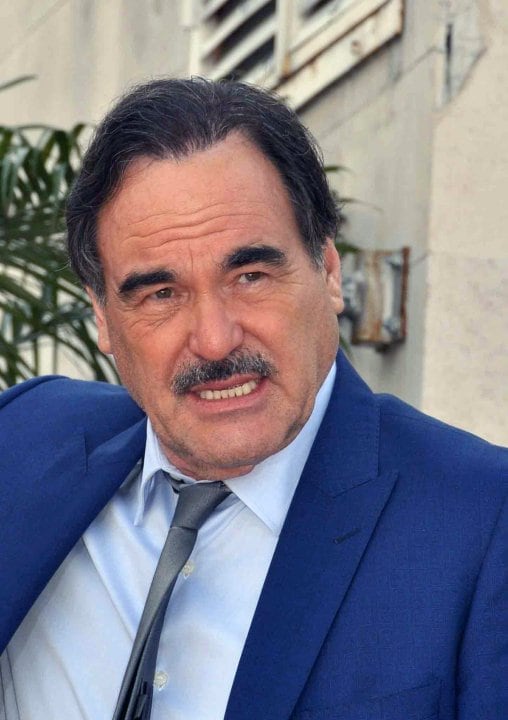
Oliver Stone is an American film director, screenwriter, and producer known for politically charged feature films that argue as forcefully as they entertain. He first became widely known in the 1980s with Vietnam War films drawn from his own military service, then built a career on dramas about American power, media, and public myth. His work is often confrontational in tone, with dense editing, emphatic performances, and a clear point of view.
| Born | September 15, 1946, in New York City, United States |
|---|---|
| Profession | Film director, screenwriter, producer |
| Known for | Vietnam War films; political dramas; controversial portrayals of American history |
| Breakthrough | Platoon (1986) |
| Notable films | Born on the Fourth of July, JFK, Natural Born Killers, Nixon |
How did Oliver Stone become important?
Stone entered cinema as a writer before becoming a major director. He won an Academy Award for writing Midnight Express and later used his own experience as a Vietnam infantryman in Platoon, which gave his war films an unusual blend of personal memory and political argument. That film won the Academy Award for Best Picture and made Stone one of the most visible American directors of the decade.
He followed it with Born on the Fourth of July and Heaven & Earth, extending the Vietnam cycle from the battlefield into American memory, disability, protest, and aftermath. These films made Stone’s subject clear: war not as spectacle, but as a force that shapes institutions, veterans, and national identity.
What kind of films does he make?
Stone’s films usually center on power: presidents, soldiers, journalists, criminals, and media figures. He works in a heightened dramatic style, using fast cutting, overlapping voices, aggressive music cues, archival footage, and sharp shifts in tone. The result often feels restless and urgent, as if the film is pushing the viewer toward a conclusion rather than simply presenting a story.
He is also known for mixing fact and invention. JFK is built like an investigation but stages a highly contested theory of the Kennedy assassination; Nixon turns the president into a tragic, almost Shakespearean figure; Natural Born Killers uses television aesthetics, satire, and violence to attack celebrity culture and mass media. The style is not neutral, and that is the point.
Why is Oliver Stone controversial?
Stone’s work has repeatedly drawn criticism for its historical interpretation, political bias, and willingness to flatten complexity into thesis. JFK angered historians and commentators who saw it as persuasive but speculative. Other films, including his documentaries and late-career political projects, have been criticized for treating conspiracy, state power, and foreign policy in highly selective ways.
That controversy is part of his reputation rather than a side effect of it. Stone rarely presents himself as a detached observer. He makes films that declare an argument, then uses performance, editing, and scale to make that argument emotionally persuasive.
What does his work look like in practice?
On screen, Stone’s cinema often feels crowded and unstable. Scenes may include television broadcasts, newspapers, military footage, street noise, and abrupt cuts between locations and timelines. He likes to place private lives inside public systems, so a family argument can sit beside a war room, a newsroom, or a protest march.
As a maker, he is disciplined about structure even when the surface feels chaotic. His best-known films rely on research, scripted speeches, and strong production design, then distort realism through montage and rhythm. That combination gives his work a recognizable form: historical drama that behaves like political combat.
Frequently Asked Questions
Is Oliver Stone mainly a political filmmaker?
Yes, though not in a single narrow sense. His films return to politics as history, media, war, and institutional power, but they also treat politics as personal damage and moral conflict. Even when the subject is a gangster or a pop star, the larger subject is usually the systems around them.
What is Oliver Stone most famous for?
He is best known for Platoon, JFK, Natural Born Killers, and Nixon. Platoon established him as a major director, while JFK became one of the most debated mainstream films of its era. Together, they define his combination of ambition, energy, and provocation.
Did Oliver Stone work in more than one role in film?
Yes. He has been a screenwriter, director, and producer, and he often shapes a project at multiple stages rather than only directing it. That broad control helps explain the consistency of his films’ tone and structure, since the writing, editing, and final presentation tend to serve one strong authorial view.