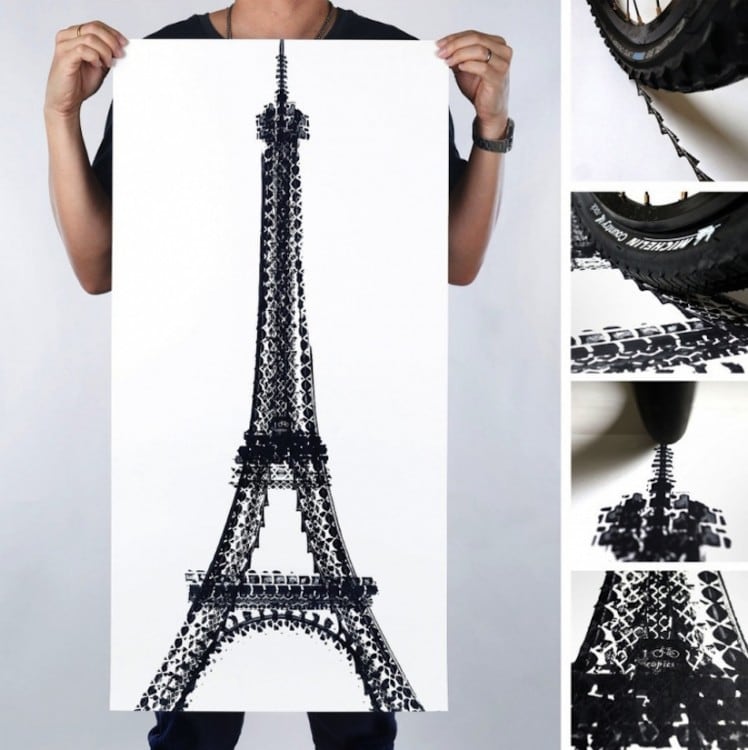
Thomas Yang is a Singaporean artist and printmaker known for making detailed city landmarks and architectural scenes with bicycle tire tracks instead of conventional drawing tools. His work turns cycling hardware into a mark-making instrument, producing images that look at once graphic, mechanical, and handmade.
| Field | Artist, printmaker |
|---|---|
| Known for | Prints made with bicycle tire treads |
| Active base | Singapore |
| Materials and tools | Bicycle tires, ink, paper, print surfaces |
| Best-known subject matter | Landmarks, skylines, urban architecture |
What makes his work distinctive?
Yang’s signature method is simple in concept but unusual in effect: he coats bicycle tires with ink and rolls or stamps them across paper to build an image from repeated tread marks. The tire pattern becomes both texture and line, so a bridge, tower, or facade can emerge from something that usually stays hidden in motion. That gives the finished print a strong physical link to cycling culture and to the act of movement through a city.
The images often focus on recognizable landmarks, especially dense urban scenes with strong silhouettes and fine structural detail. Because the tire tread carries a regular pattern, the work balances precision and repetition with the irregularities of hand printing. The result looks engineered, but it still records the pressure, spacing, and timing of the artist’s hand.
How are the prints made?
Yang’s process relies on printmaking as much as on drawing. A bicycle tire is treated as a stamp or rolling matrix: ink is applied to the tread, then transferred onto paper or another surface in controlled passes. Different tread widths, pressures, and directions change the density of the line, allowing him to shade surfaces and describe edges without conventional pen strokes.
This method matters because it turns an everyday cycling component into a visual language. The tire is not only a subject or a symbol; it is the tool that builds the image. That choice gives the work an immediate material logic, which is part of why it reads so clearly as contemporary visual culture rather than as a novelty act.
Why is Thomas Yang important?
Yang matters for the way he expands what counts as a printmaking tool. His work sits between illustration, graphic design, and fine art, but it stays grounded in a repeatable process that depends on material contact. In a field where technique often remains invisible, he makes the method obvious and central.
He is also part of a wider interest in local identity and urban imagery. By using a bicycle part to depict city landmarks, he connects transport, place, and craft in a single image system. That makes the work especially legible in cities where cycling, architecture, and street culture overlap.
What does his work look like in practice?
A Thomas Yang print typically has crisp outlines, layered texture, and a rhythmic surface. From a distance, it can resemble a monochrome architectural engraving or a high-contrast screen print. Up close, the repeated tire impression becomes visible as a pattern with tiny variations that reveal the hand behind the image.
The subject matter often includes famous buildings, skyline fragments, and urban icons. Rather than smoothing those forms into a polished digital finish, Yang lets the tread pattern remain present. That gives the work a tactile quality and a strong sense of process, as if the city itself has been mapped through repeated contact with the road.
Frequently Asked Questions
Is Thomas Yang mainly a fine artist or a designer?
He works in a space between fine art and design. The images are conceptually strong enough to read as contemporary art, but the clarity of their composition and their reproducible method also align with graphic design and print culture. That hybrid position is part of their appeal.
Why use bicycle tires instead of a traditional printing tool?
The tire tread gives the work a built-in visual pattern and a direct connection to cycling. It also creates a mark that is both mechanical and imperfect, which suits images of cities and landmarks. The tool itself becomes part of the meaning, not just the means.
What subjects does he usually print?
He is best known for landmarks, skylines, and architectural scenes. These subjects let the tire pattern describe structure, repetition, and density very effectively. The method is especially strong when the image depends on clean edges and recognizable silhouettes.
Articles mentioning Thomas Yang