
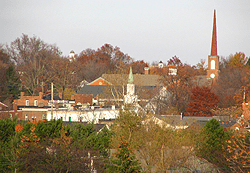
Hudson, Ohio, is a city in Summit County in northeastern Ohio, best known today as an affluent suburban and exurban community within the Akron metropolitan area. It grew from an early New England-style settlement into a residential city with a preserved historic core, tree-lined streets, and a strong association with schools, architecture, and commuter life.
| What it is | City |
|---|---|
| Location | Summit County, northeastern Ohio, United States |
| Metropolitan area | Akron Metropolitan Statistical Area; part of the Cleveland-Akron-Elyria combined area |
| Known for | Affluent residential character, historic village center, early New England settlement pattern |
| Population | 22,262 at the 2010 census |
Where Hudson came from
Hudson was founded in the early 19th century by settlers from New England, and that origin still shapes its built environment. The town grew with a planned center, formal public spaces, and a grid that reflects the habits of New England town building more than the looser patterns common to many Midwestern suburbs.
The city later developed as a residential place rather than a heavy industrial one. That history matters because it helped preserve a compact historic downtown and a more restrained scale of development than in many nearby Ohio cities.
What does Hudson look like?
Hudson is associated with tidy streets, mature trees, detached houses, and a village center that still reads as a civic core rather than a commercial strip. Architecture in the older parts of town includes Federal, Greek Revival, Colonial Revival, and later suburban styles, along with institutional buildings tied to education and local government.
The visual character comes from maintenance as much as form: brick, painted wood, pitched roofs, front porches, and generous setbacks appear more often than dense blocks or large industrial structures. For a publication concerned with how places are made, Hudson is a clear example of a community shaped by planning, settlement pattern, and long-term preservation.
Why Hudson matters in visual culture
Hudson often appears in photography and architectural writing because it offers a legible version of American small-city identity. It has enough historical continuity to show layers of building over time, but enough wealth and care to keep those layers visible.
That makes it useful as a subject for images of domestic architecture, streetscape order, and civic calm. In articles about architecture photography, Hudson can serve as a case study in how composition, light, and material details become more visible in a place where older structures remain intact and the public realm is carefully maintained.
How the city functions today
Today Hudson is primarily residential, with local schools, small businesses, and commuting ties to the broader Akron and Cleveland regions. Its role is less about producing goods than about housing, education, and maintaining a high-quality built environment.
The city’s affluence influences everything from property upkeep to landscaping and preservation policy. Those conditions produce a place where design decisions, from fence lines to storefront signage, are often conservative and controlled rather than improvised.
Frequently Asked Questions
Is Hudson, Ohio, a suburb of Cleveland or Akron?
Hudson is formally part of the Akron metropolitan area, though it also sits within the larger Cleveland-Akron-Elyria combined statistical area. In practice, it functions as an exurban and commuter community connected to both regional centers. Its geography makes it feel tied to northeastern Ohio as a whole rather than to a single city.
Why do photographers and writers mention Hudson?
Hudson offers a readable historic streetscape with enough preservation to make architectural details visible. That gives it value in photography, especially when the subject is the relationship between houses, civic buildings, trees, and street layout. It is a place where the built environment is organized enough to photograph cleanly, but not so uniform that it loses texture.
What kind of architecture is associated with Hudson?
Hudson is associated with early American revival styles and with later residential architecture that respects the scale of the historic core. Brick, clapboard, pitched roofs, porches, and formal civic buildings are common visual cues. The city’s architecture reflects both its New England settlement roots and its later life as an affluent suburban community.
At a glance
- Address
- Summit County, United States
- Coordinates
- 41.23984, -81.440834
Articles mentioning Hudson, Ohio
