
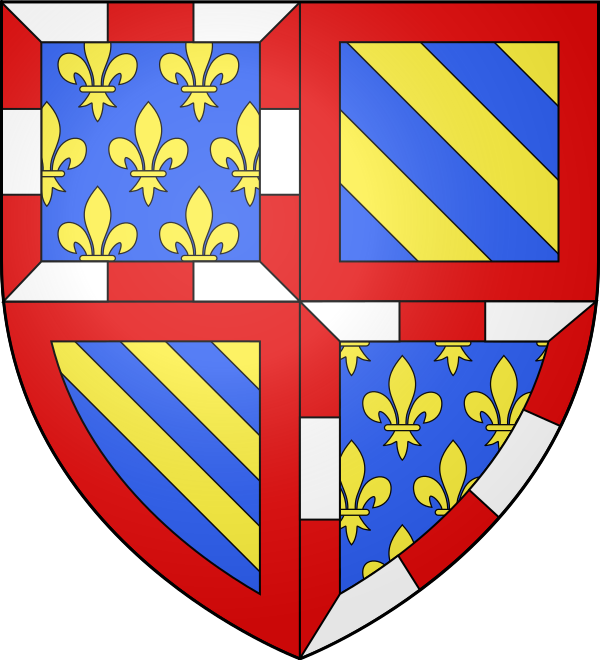
| Country | France |
|---|---|
| Status | Historical and administrative region; today split between Bourgogne-Franche-Comté and parts of the old province |
| Key departments | Côte-d’Or, Saône-et-Loire, Yonne, Nièvre |
| Main city | Dijon |
| Known for | Wine, stone, timber, monasteries, and a long visual culture tied to courtly and monastic patronage |
Burgundy is a historic region in east-central France known for its wine, stone architecture, monastic heritage, and long influence on European art and design. The name most often refers to the old duchy and province centered on Dijon, rather than only the modern administrative region.
What is Burgundy?
Burgundy refers to a cultural and geographic region that has helped shape French taste for centuries. Its core lies around the valleys and plains of the Saône, Yonne, and Loire basins, with a landscape of vineyards, limestone hills, river towns, and agricultural land. The four historic departments often associated with it are Côte-d’Or, Saône-et-Loire, Yonne, and Nièvre.
The region matters because it combines political history with material culture. Burgundy was once a powerful duchy whose courts patronized architecture, sculpture, manuscript illumination, and luxury craft. That legacy still reads clearly in the region’s abbeys, cathedrals, châteaux, and winery estates.
Why does Burgundy matter in design and visual culture?
Burgundy’s importance comes from the way power, religion, and craftsmanship met there. Medieval Burgundy supported some of the most ambitious building programs in France, especially through monastic sites such as Cluny and Cîteaux, and through princely patronage under the Valois dukes of Burgundy. Stone carving, stained glass, metalwork, and manuscript production all benefited from that patronage.
The region also matters as a source of materials and surfaces. Burgundy limestone has been used in regional construction for generations, giving many towns a pale, warm, sober palette. In contemporary interiors and product design, “Burgundy” also functions as a color reference: a dark red with wine and plum associations, often used for furniture, textiles, packaging, and tech finishes when a richer alternative to black or brown is wanted.
How does Burgundy appear in practice?
In built form, Burgundy often appears through ashlar stone facades, steep roofs, timber framing, and restrained ornament. Dijon and Beaune preserve streets and courtyards where stone dominates, while religious architecture in the region shows pointed arches, carved capitals, and a disciplined use of light. The visual effect is elegant but not flashy: weighty materials, clear geometry, and careful craft.
In product and interior work, the name “Burgundy” is frequently used for deep red finishes that suggest wine, leather, lacquer, or velvet. That makes it useful in branding and color systems where a warm, saturated tone signals maturity or luxury. It shows up in kitchenware, keyboards, upholstery, fashion accessories, and paint palettes because it reads as both traditional and contemporary.
Is Burgundy the same as Burgundy wine?
Not exactly, though the two are closely linked. Burgundy wine comes from vineyards in and around the region and is one of the main reasons the name is internationally recognized. The wine trade reinforced Burgundy’s reputation for refinement, and the color term “burgundy” later borrowed that association with dark red wine.
In everyday usage, the wine, the color, and the region often blur together. For a designer or editor, that overlap matters because “Burgundy” can indicate place, material culture, or chromatic tone depending on the context. In an article about an interior, for example, it may signal a palette choice; in a travel or art history piece, it usually points to the French region and its heritage.
Frequently Asked Questions
Is Burgundy a current administrative region of France?
Yes, but the term is used in two ways. Historically, Burgundy was a duchy and province with a strong cultural identity; today, the old administrative region was merged into Bourgogne-Franche-Comté. Many writers still use Burgundy to refer to the historic area and its associated visual culture.
Why is Burgundy associated with luxury?
The association comes from wine, court culture, and rich materials. Burgundy’s dukes were major patrons of art and ceremony, and the region’s wines became symbols of status across Europe. The color burgundy later inherited that same sense of depth, richness, and formality.
What materials are most closely linked to Burgundy?
Stone is the most obvious material, especially the local limestone used in civic, religious, and domestic architecture. Wood, tile, and vineyard-related materials also shape the region’s visual character. In contemporary design, the word more often refers to a color finish than to a physical material.