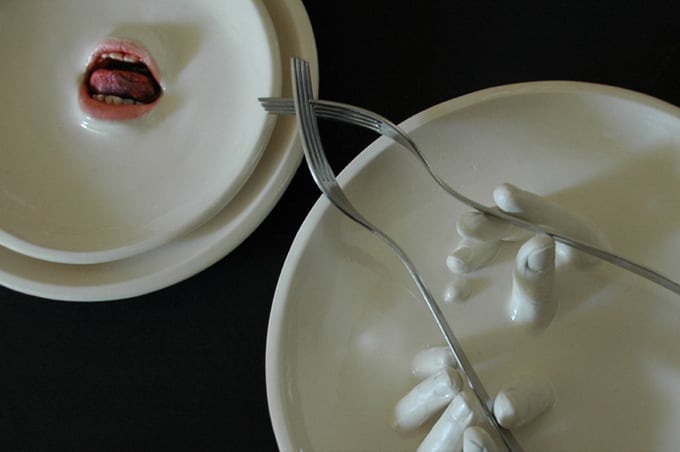
Roni Baranga is an Israeli sculptor and ceramic artist known for turning plates, cups, teapots, and other domestic vessels into uncanny objects with mouths, teeth, fingers, and hands. Her work sits at the edge of craft and sculpture, using glazed ceramics and painted surfaces to make familiar tableware look alive, damaged, or oddly sentient.
| Field | Sculpture, ceramics, installation |
|---|---|
| Nationality | Israeli |
| Known for | Ceramic tableware altered with human features |
| Materials | Clay, glaze, paint, ceramic forms, sometimes mixed sculptural supports |
| Visual style | Surreal, grotesque, playful, deliberately unsettling |
| Main concern | Transforming domestic objects into figures with psychological presence |
What does Roni Baranga make?
Baranga makes sculptural objects that begin as recognisable household items and end as things with personality, appetite, or threat. A teacup may sprout fingers around its rim. A plate may open a mouth full of teeth. A cake stand, bowl, or teapot may carry hands that grip, reach, or brace themselves as if the object were a body. The effect depends on a careful balance between the ordinary and the grotesque: the piece still reads as tableware, but it now seems to have a nervous system.
That shift matters because the work relies on craft knowledge as much as fantasy. The forms need to preserve the clean silhouettes and surfaces associated with ceramic ware while carrying highly detailed additions that can feel flesh-like, comic, or disturbing. Baranga’s pieces often look handmade in a very deliberate way, with visible modelling, glossy glaze, and painted accents that heighten the sense of animation.
Where did her approach come from?
Baranga’s work belongs to a broader contemporary tradition that uses ceramics to unsettle the boundary between the useful object and the art object. Ceramics has long carried this tension: vessels are among the oldest human-made forms, but they can also become sculptural and symbolic when removed from the table. Baranga pushes that history toward surrealism and body horror, using domestic craft forms as the base for figurative transformation.
Her imagery also draws on the visual language of anthropomorphism, in which objects are given human traits. Here, though, the effect is more than decorative. A hand on a bowl can suggest desire, need, possession, or dependence. A mouth on a plate can imply hunger or speech. By attaching body parts to utensils and vessels, she makes domestic culture feel unstable and alive.
Why do the pieces feel so unsettling?
The unease comes from the fact that Baranga’s subjects are so familiar. Plates, cups, and bowls are objects associated with use, service, and routine. Once they acquire teeth or fingers, those functions become ambiguous. A cup is no longer only for holding liquid; it may also seem to grasp, bite, or watch. The viewer has to reconcile the object’s usefulness with its new and intrusive anatomy.
Her colour choices often intensify that tension. Bright glazes and polished finishes can make the works seem cheerful at first glance, but the illusion breaks once the body parts register. That contrast between domestic prettiness and bodily distortion gives the work its force. It also places Baranga within a line of contemporary sculpture that uses charm as a route into discomfort rather than as an escape from it.
How is her work made in practice?
Baranga’s pieces depend on ceramic techniques that allow both precision and variation. The base forms are shaped in clay, then refined, fired, and glazed. The added fingers, lips, teeth, and hands are modelled separately or built as extensions, then attached so they appear to emerge naturally from the vessel. Surface finish is crucial: glaze can make the forms look edible, slick, or skin-like, while paint sharpens the expression of eyes, gums, nails, and seams.
The result is neither pure pottery nor simple figurative sculpture. It is hybrid work that uses the traditions of ceramics to stage a transformation. Because the objects often keep the scale and proportions of tableware, the viewer reads them instantly, and that recognition makes the distortion stronger. The craft has to be convincing enough that the fantasy feels physically present.
Frequently Asked Questions
Is Roni Baranga a ceramicist or a sculptor?
She is both. Her work uses ceramic methods, but the finished pieces behave like sculpture rather than functional pottery. The distinction matters because her objects are usually not made to be used; they are made to be looked at, and to carry narrative or psychological charge.
Why are mouths and hands such common features in her work?
Mouths and hands are among the most expressive body parts, and they immediately change the meaning of an object. A mouth suggests eating, speaking, or biting, while hands suggest grasping, touching, or agency. Baranga uses them to make tableware look as if it has intention and emotion.
What should a viewer notice first in her pieces?
First comes recognition: a plate, cup, or teapot looks almost normal. Then comes the disruption, when the added body parts reveal themselves and the object starts to feel animated. That delayed recognition is central to her work, because the surprise is what turns domestic ceramics into unsettling sculpture.
Articles mentioning Roni Baranga