
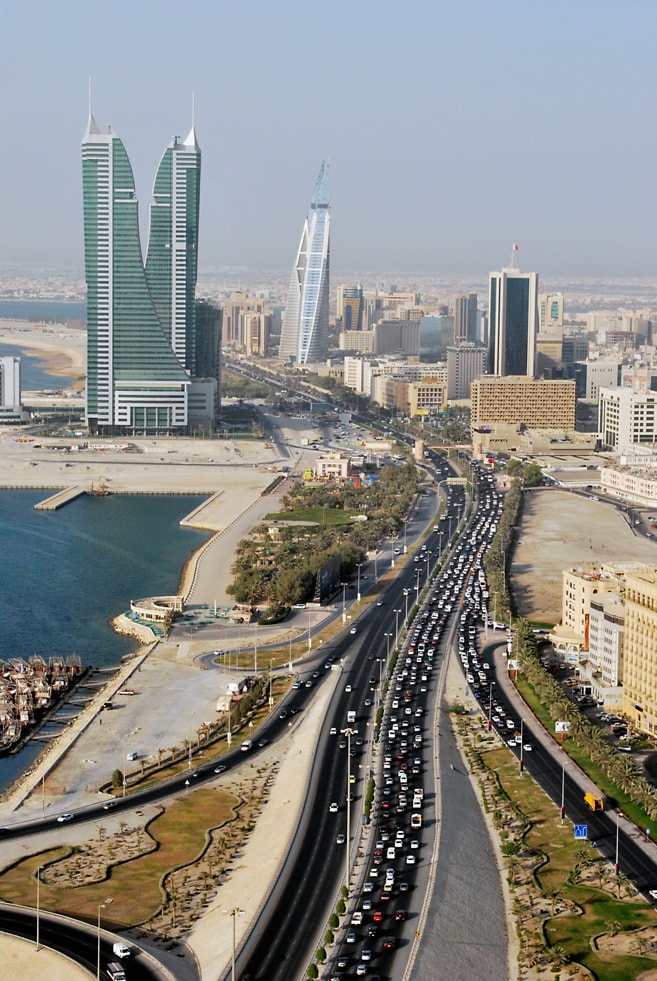
Manama is the capital and largest city of Bahrain, a Persian Gulf port whose modern life is shaped by trade, migration, finance, and the architectural layering of a small island state. It sits on the north-east coast of Bahrain Island and serves as the country’s administrative and commercial centre.
| Fact | Detail |
|---|---|
| Type | Capital city |
| Country | Bahrain |
| Location | North-east coast of Bahrain Island, Persian Gulf |
| Population | About 155,000 in the city proper |
| Role | Port, financial centre, seat of government |
| Historical significance | Longstanding trading hub with Ottoman, Portuguese, Persian and British-era influences |
Why Manama matters
Manama matters because it concentrates Bahrain’s political power and much of its cultural and economic activity in one place. As a port city, it grew through exchange rather than isolation. Merchants, pearl traders, administrators, migrant workers, and expatriate professionals all left their mark on the city’s streets, markets, and building stock.
That history makes Manama useful for understanding the Gulf as a region shaped by commerce and mobility. It is not a preserved old capital or a single-period city. Its identity comes from successive layers: pre-oil trading routes, colonial administration, post-independence statehood, and the rapid development that followed oil wealth and financial expansion.
How did Manama become Bahrain’s capital?
Manama rose from a trading settlement to the country’s political centre during the nineteenth and twentieth centuries, as Bahrain moved under British influence and then into modern statehood. Before that, the city and the wider archipelago passed through periods of Portuguese and Persian control, and it also felt the pressure of regional dynasties from Saudi Arabia and Oman. Those shifts did not erase the city’s role as a port; they reinforced its strategic value.
By the time Bahrain became independent in the twentieth century, Manama already functioned as the main urban node on the islands. Government offices, banking, retail, and transport accumulated there. Today the city’s importance is out of proportion to its size because national life is so concentrated in the capital.
What does Manama look like on the ground?
Manama combines narrow commercial streets, waterfront development, older neighbourhoods, and large modern districts. In the historic core, low-rise buildings, shaded arcades, and souq spaces still show the city’s older mercantile character. In newer parts of the capital, glass towers, hotels, and office blocks reflect Bahrain’s role in regional finance and services.
The city’s built environment also reflects its diverse population. Signage, shops, restaurants, and informal street life reveal the presence of long-settled Bahraini families alongside communities from South Asia, the Levant, Iran, and elsewhere. For a city of modest size, Manama feels dense in cultural contrast: formal government space, commercial bustle, and domestic neighbourhoods sit close together.
Manama in contemporary visual culture
For designers, artists, and writers, Manama often appears as a place where modernity and locality sit side by side. Its skyline, traffic corridors, mosques, markets, and harbour edges provide a compact visual field in which Gulf urbanism can be read clearly. The city is also useful as a reference point for work dealing with migration, trade routes, and the aesthetics of fast development.
Manama’s appearance in articles on objects, identity, or regional style often depends on this contrast: a capital city that is small enough to remain legible, yet complex enough to carry many histories at once. The city is not known for one iconic monument alone, but for the mix of public administration, commerce, and everyday life that gives it character.
Frequently Asked Questions
Is Manama the same as Bahrain?
No. Manama is the capital city of Bahrain, not the country itself. Bahrain is an island kingdom made up of multiple islands, while Manama is the main urban centre on Bahrain Island. The city often stands in for the country in political and economic discussions because so much national activity happens there.
Why is Manama important in Gulf history?
Manama grew as a trading port in a region defined by sea routes, pearling, and exchange. Its history includes periods of Portuguese and Persian control and later British influence, which shaped its institutions and urban development. That layered past makes it a strong example of how Gulf capitals formed through commerce and imperial pressure.
What kind of city is Manama today?
Manama is a compact capital with a mix of government buildings, financial services, older commercial districts, and dense residential areas. It is also highly diverse, with a population shaped by regional and international migration. The result is a city that feels both local and global, with strong ties to the wider Persian Gulf economy.