
An afro is a rounded, outward-facing hairstyle worn on hair with a naturally tight curl pattern, or shaped to imitate that texture with styling tools and products. It lifts the hair away from the scalp and builds a full silhouette around the head, usually with a pick or comb rather than being smoothed flat. The shape can read as soft, dense, halo-like, or sharply sculpted, depending on hair length, curl pattern, and grooming.
Stories from Afro
2 stories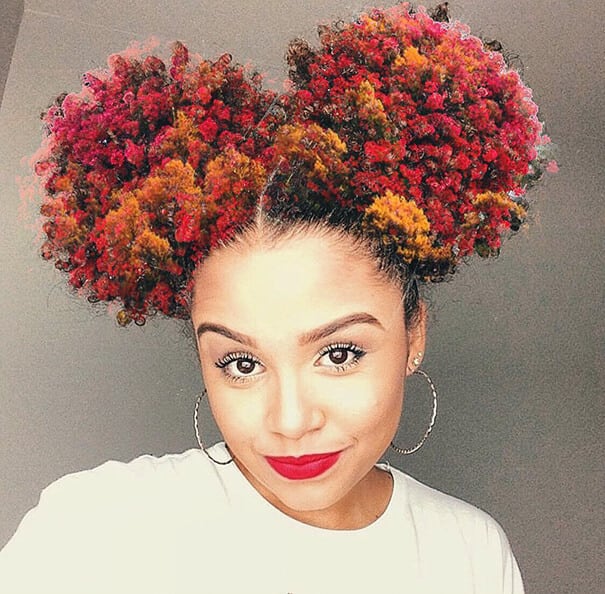

About Afro
- Built around volume rather than stretch or straightness
- Most closely associated with tightly coiled and kinky hair textures
- Can be worn as a natural state or as a deliberately shaped style
- Requires regular shaping, moisture, and detangling to hold its form
- Has strong cultural associations, especially in Black hair history and style
Read the full overviewHow is an afro formed?, Where did the afro come from?, Why does the afro matter in visual culture?, What does it look like in practice?
How is an afro formed?
The afro forms when textured hair is encouraged to grow outward instead of being compressed, stretched, or chemically straightened. A pick, wide-tooth comb, fingers, or blow-drying can lift the roots and separate the curls so the overall shape reads as a cloud or sphere. The exact outline depends on density, curl tightness, cut, and whether the wearer wants a tight, compact shape or a larger halo of volume.
Hair care matters here. Curly and coily hair tends to shrink as it dries, so the visible size of an afro can be much smaller than its actual length. Moisture, gentle detangling, and careful trimming help the shape stay even and prevent the top from collapsing or the sides from becoming lopsided.
Where did the afro come from?
The afro has deep roots in Black hair culture, but its modern public identity took shape in the 1960s and 1970s, when natural hair became a visible political and aesthetic statement. Wearing hair in its natural texture challenged pressure to straighten it in order to fit Eurocentric beauty standards. The style became associated with Black pride, civil rights, and cultural self-definition.
Earlier forms of rounded natural styling existed long before the term became common, but the afro became widely recognized as a named style during that period. It appeared in photography, film, music, and protest imagery, often alongside broader movements that treated hair as part of identity rather than a problem to be corrected. That history still shapes how the style is read today.
Why does the afro matter in visual culture?
The afro is more than a haircut because it changes the silhouette of the body. It makes hair into a visible form, often emphasizing scale, symmetry, and texture in a way that can be striking in portraiture, fashion, and editorial work. Artists and photographers often use it to create a graphic outline or to bring attention to the texture itself.
It also carries social meaning. In some settings, the afro signals natural hair politics, historical memory, or resistance to grooming norms that treat straight hair as standard. In others, it functions simply as an expressive style with strong shape and texture. Both readings can coexist, which is part of why the afro remains powerful in image-making.
What does it look like in practice?
An afro is not one fixed shape. Some versions are compact and round, held close to the head with a clean edge. Others are loose and expansive, with uneven coils, frizz, and visible texture. It can be paired with a center part, a line-up, a taper fade, or a shaped silhouette, and it can be altered daily depending on combing and moisture.
In fashion and portrait work, the afro often becomes a compositional element. It can frame the face, balance clothing with a strong upper shape, or act as a visual field for accessories, flowers, color, or sculptural treatments. Because the style is so dependent on texture and volume, it often photographs with depth and shadow that flatter close attention to surface.
Frequently Asked Questions
Is an afro only for Black hair?
No, the shape can be styled on different hair types, but the afro is historically and culturally tied to Black hair and tightly coiled textures. That history matters because the style is not just a volume choice; it emerged from specific hair politics and beauty standards. When worn outside that context, the look can carry different meanings and sometimes raises questions about appropriation.
What is the difference between an afro and natural hair?
Natural hair refers to hair worn without chemical straightening or relaxing, while an afro is a particular rounded shape. Natural hair can be worn in many forms, including twists, braids, puffs, coils, locs, or a loose shape with no defined silhouette. An afro is one possible way to style natural texture, but not the same thing as natural hair itself.
How is an afro maintained?
Maintenance usually involves moisture, gentle detangling, shaping, and regular trimming. A pick is often used to lift the roots without flattening the curl pattern, while oils, creams, or leave-in conditioners help keep the hair from drying out. The goal is to preserve fullness while protecting the curl structure and preventing breakage.