
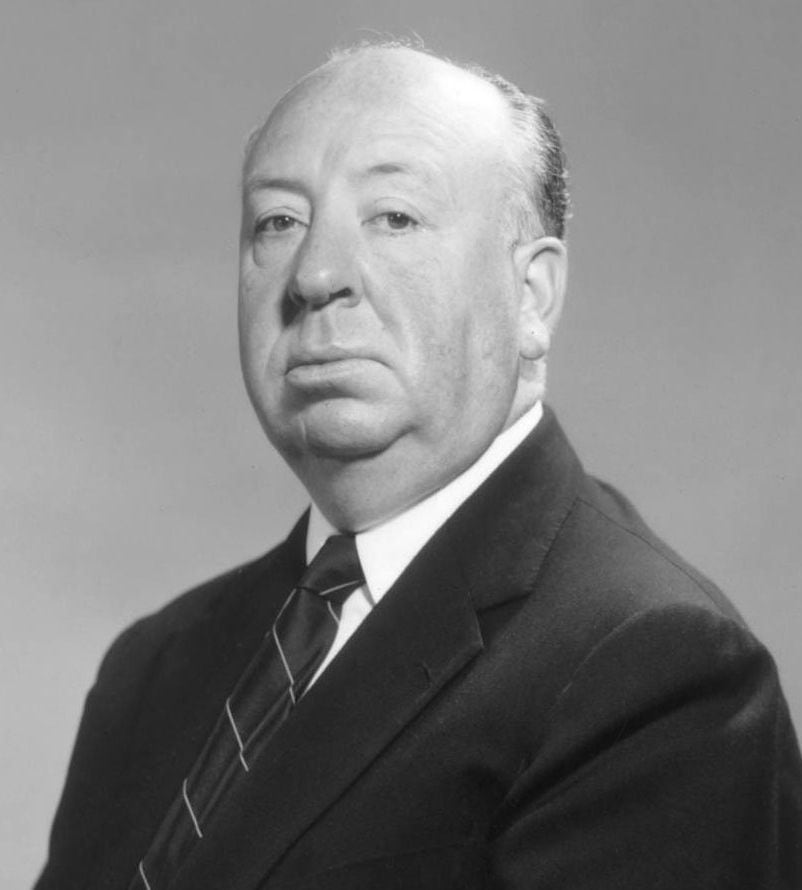
Alfred Hitchcock was an English film director and producer whose tightly controlled suspense films reshaped popular cinema. Working first in British silent film and then in Hollywood, he built a style based on visual planning, audience misdirection, and psychological pressure. His films made the mechanics of fear legible: framing, editing, sound, and performance all became tools for controlling what a viewer knew and when.
- He worked across silent film, early sound cinema, and the studio era, which gave him a long view of how film form changed.
- His best-known work uses suspense rather than surprise, often letting the audience know more than the characters do.
- He collaborated closely on storyboards, camera placement, and editing, treating direction as design.
- His influence reaches beyond cinema into posters, illustration, television, and the visual language of thrillers.
- Images associated with Hitchcock often rely on silhouette, profile, red accents, and tense compositions that echo his films.
How did Hitchcock work?
Hitchcock treated filmmaking as a precise construction problem. He planned shots in advance, often storyboarding scenes so that camera movement, blocking, and editing could carry the drama without much explanatory dialogue. That approach gave his films a crisp visual logic, where a glance, a cut, or a sudden change of angle could do the work of several pages of script.
He also understood that suspense depends on timing and on the viewer’s position relative to the characters. Rather than hiding everything, he often disclosed danger early and then stretched the moment before impact. That method appears in films such as Rear Window, Psycho, and North by Northwest, where ordinary spaces become charged through camera design and rhythm.
Why is Alfred Hitchcock important?
Hitchcock helped define the modern thriller. He showed that commercial cinema could be both accessible and formally exacting, using popular genres to explore voyeurism, guilt, mistaken identity, and fear of the ordinary. His work made audiences more aware of how images manipulate attention, which is one reason his films remain central to film studies.
He also left a durable production model. Hitchcock’s films depended on clear preproduction, disciplined collaboration, and a strong authorial signature, all of which influenced later directors and studios. The idea of the director as a recognisable creative brand owes a great deal to him, as does the expectation that a genre film can have a distinctive visual grammar.
What does Hitchcock’s style look like on screen?
His films often use clean compositions that suddenly turn unstable. A calm room may be framed with severe geometry, then broken by a looming close-up, an off-screen sound, or a cut that reveals threat. He used staircases, windows, mirrors, and doorways repeatedly because they let him turn simple spaces into systems of surveillance and concealment.
Colour and costume also matter in his later work. He liked strong contrasts, sharp tailoring, and controlled palettes that made figures stand out against their settings. Even when the plots become elaborate, the visual field stays disciplined, which is part of why his films are so identifiable in still images, posters, and graphic reinterpretations.
How has Hitchcock been used in visual culture?
Hitchcock’s face, silhouette, and film imagery have become shorthand for suspense itself. Designers and illustrators borrow his profile, birds, stairs, shadowed interiors, and severed-scale compositions to signal unease quickly. That visual shorthand works because his name already carries a set of expectations about mood and structure.
His films also provide a rich archive for reinterpretation. Poster artists, magazine illustrators, and collage makers often isolate a single motif – a keyhole, a pair of hands, a flight of stairs, a woman in profile – and let it stand for an entire film. The result is less about documentary likeness than about compressing a whole directing style into one image.
Frequently Asked Questions
Was Hitchcock only a suspense director?
No. Suspense became his signature, but he worked in comedy, melodrama, crime, and romance as well. Even in lighter material, he used the same careful control of gaze, timing, and visual information.
Why do so many artists reference Hitchcock?
His films are instantly legible as images. A shadowed staircase, a bird silhouette, or a tense profile can signal his influence without needing a long explanation. That makes him especially useful for posters, editorial illustration, and design that relies on quick recognition.
What makes Hitchcock different from other classic directors?
He combined a strong authorial style with unusually clear control over audience perception. Many directors build atmosphere; Hitchcock built systems of anticipation. The viewer often feels not just what the characters feel, but the pressure of how the scene has been arranged.