
Belin is a Spanish street artist known for large-scale murals that combine cubist fracture, graphic contour, and hyperrealist portraiture. His work turns faces and bodies into layered surfaces, often splitting them into angular planes while preserving enough realism to keep the image legible and psychologically immediate.
Stories from Belin
1 story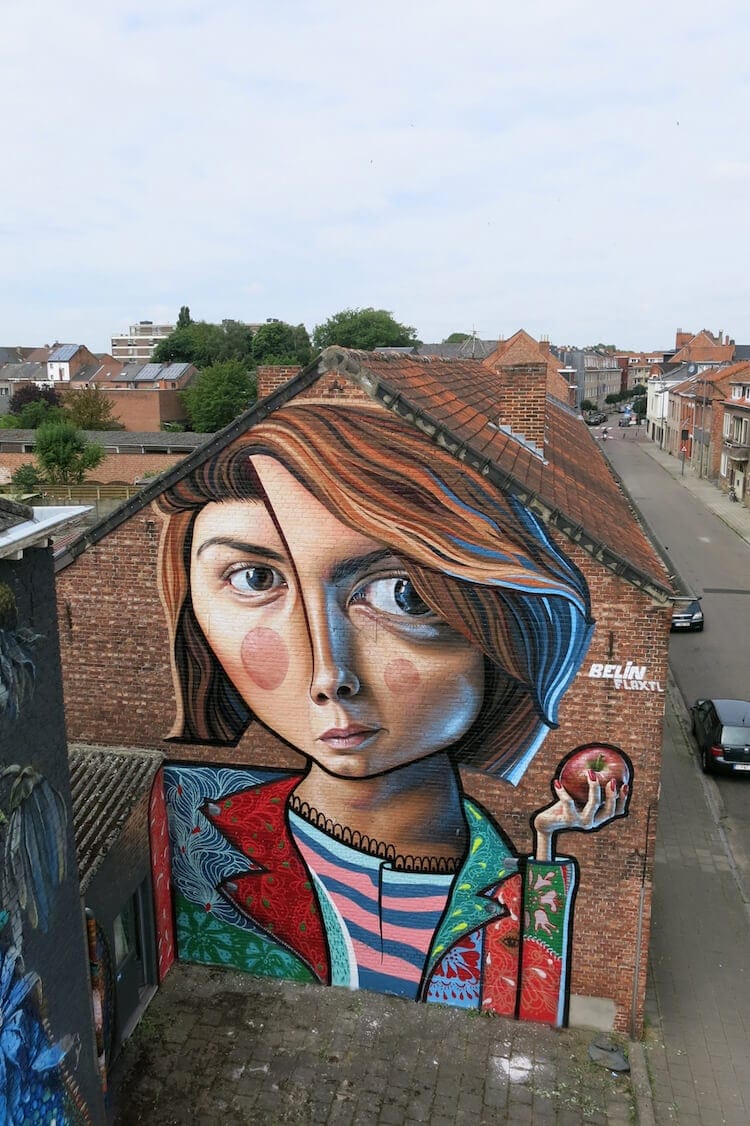
About Belin
| Field | Street art, mural painting |
|---|---|
| Origin | Spain |
| Known for | Cubist and hyperrealist portrait murals |
| Working method | Spray paint, paint, and large-format wall painting |
| Typical subject | Human figures, especially faces and heads |
Read the full overviewWhat makes Belin’s work distinct?, Where did his style come from?, How does he paint these murals?, Why does Belin matter in street art?
What makes Belin’s work distinct?
Belin’s murals are built from a tension between breakage and precision. He often treats the face as a structure to be dismantled and reassembled, using cubist faceting to split a portrait into multiple viewpoints at once. Against that fragmentation, he places highly realistic skin tones, eyes, lips, and shadows, so the image reads both as an abstract composition and as a convincing likeness.
That combination gives his work a particular kind of energy. The cubist sections can feel mechanical or architectural, while the hyperreal passages keep the subject emotionally present. The result is not pure abstraction and not straightforward portraiture, but a hybrid language that depends on the scale of the wall and the clarity of his draftsmanship.
Where did his style come from?
Belin’s visual language draws on modernist painting, especially Cubism, and on the technical demands of mural painting. Cubism supplies the idea of multiple perspectives and fractured form; street art supplies scale, speed, and direct public visibility. Hyperrealism enters as a corrective, giving the image detail, volume, and surface realism even when the overall composition is unstable.
That mix also reflects how contemporary muralism has developed. Many street artists move freely between fine art traditions and public-wall practice, borrowing from easel painting, illustration, photography, and graphic design. Belin’s work sits in that crossover space, where a wall can carry both a painterly argument about form and a recognizable human subject.
How does he paint these murals?
Belin’s murals typically depend on careful underdrawing, controlled color gradients, and precise spray-paint handling. The fractured planes need clean edges and confident tonal shifts, because the composition can collapse if the geometry becomes muddy. At the same time, the realistic sections require soft transitions, reflected light, and minute changes in facial structure.
That means his process is not just gestural street painting. It involves planning, layering, and a strong sense of volume. The wall becomes a site for both design and rendering: design in the way the image is broken into facets, rendering in the way the flesh, hair, and shadows are built up to create convincing depth.
Why does Belin matter in street art?
Belin matters because he shows how mural painting can hold two visual logics at once. The work is immediately legible from a distance, which suits public space, but it also rewards close looking through its technical detail and structural complexity. That balance has made his portraits useful as examples of how contemporary street art can borrow from art history without losing its public-facing force.
He is also part of a broader shift in mural culture toward highly finished, image-driven work. Rather than relying on tags, symbols, or rough expression alone, artists like Belin produce walls that behave almost like monumental paintings. In practice, that means the mural becomes both image and object: something seen in passing and something studied for its craft.
Frequently Asked Questions
Is Belin a traditional graffiti writer?
No. His work belongs more clearly to muralism and street art than to classic graffiti writing. The focus is not on lettering, tags, or name repetition, but on painted figures and portraits developed through layered image-making.
Why do his faces look broken apart?
The fragmentation comes from Cubism, which treats an object as something that can be seen from multiple angles at once. Belin uses that idea to split faces into planes, which creates movement and tension without making the subject disappear.
Does he paint only portraits?
Portraits are his best-known subject, especially heads and faces. Those subjects suit his style because the human face can carry both realism and distortion at the same time, which is central to his approach.