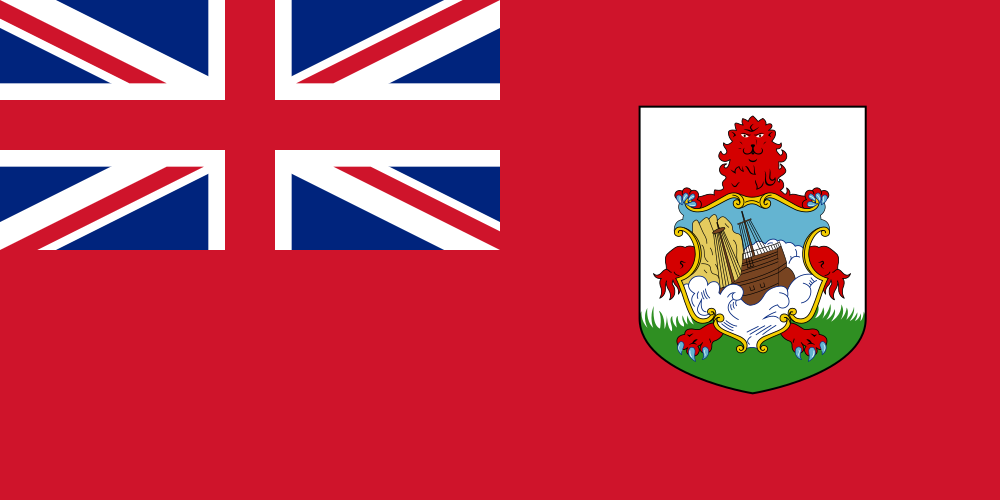
Bermuda is a British overseas territory in the North Atlantic, a small volcanic island group best known for its pink-sand beaches, pastel towns, and long association with maritime travel. Its capital is Hamilton. The territory sits far from mainland North America, which has shaped its history as a naval stop, a trade point, and later a place of tourism, finance, and marine research.
| Fact | Detail |
|---|---|
| Type | British overseas territory |
| Location | North Atlantic Ocean, east of the United States |
| Capital | Hamilton |
| Nearest major landmass | Cape Hatteras, North Carolina |
| Common alias | Bermudian, Bermudas, Somers Isles |
Where is Bermuda, and what is it like?
Bermuda lies in the western Atlantic, isolated from the continental mainland and formed from volcanic seamounts. The islands have a subtropical climate, with mild winters, humid summers, and a landscape marked by low hills, limestone caves, sheltered coves, and reefs. That geography has mattered as much as the politics: reefs made entry difficult for large ships, while the surrounding waters supported fishing, diving, and a dense visual culture of sailing and coastal life.
The island chain is compact, so towns, harbours, beaches, and administrative centres sit close together. St. George’s, one of the oldest English-settled towns in the region, preserves narrow streets and fortified waterfronts. Hamilton, by contrast, is the modern administrative and commercial centre, with offices, shops, and harbour traffic concentrated around a small downtown grid.
How did Bermuda develop?
Europeans first established permanent settlement there in the early 17th century after a shipwreck led to English occupation. Over time the islands became tied to imperial shipping routes, naval strategy, and Atlantic trade. Britain formally retained control, and Bermuda remains a self-governing territory under British sovereignty rather than an independent state.
That history shaped its built environment. Defence works, harbours, churches, dockyards, and town plans reflect the needs of a small island colony that depended on sea access. Many buildings use local limestone, which gives Bermudian towns their pale colour and keeps the architectural palette distinct. The result is a place where military, mercantile, and domestic architecture sit very close together.
Why does Bermuda matter in visual culture?
Bermuda appears often in photography, illustration, and travel imagery because it compresses several strong visual cues into a small area: turquoise water, white roofs, coral and limestone textures, and strong daylight. In underwater photography, the surrounding reefs and clear water make the island an attractive site for marine images, wreck photography, and shots that compare surface life with underwater ecologies. The sea is not just backdrop there; it is part of the subject.
The island also carries a recognisable style of vernacular design. White stepped roofs collect rainwater, pastel walls soften the sun, and narrow lanes frame views of harbours and cottages. These practical forms are easy to read visually, which is one reason Bermuda often appears in editorial and commercial imagery as a shorthand for orderly tropical modernity rather than rough coastal scenery.
What does Bermudian life and place look like in practice?
Daily life in Bermuda is shaped by limited land, imported goods, and intensive use of the coastline. Most movement happens within a tightly managed island system, and the harbour, ferries, roads, and small businesses reflect that constraint. Clothing and transport habits also mark the place: formal and semi-formal dress appears in public life more often than in many warm-climate settings, and scooter use remains common because of narrow roads and compact distances.
For makers, photographers, and designers, Bermuda offers a clear example of how environment dictates form. Materials are chosen for salt air, storms, and limited freshwater; architecture manages heat and rain; and images often emphasise the contrast between built order and open sea. That interplay gives the islands a distinct identity that is both highly local and widely legible.
Frequently Asked Questions
Is Bermuda a country?
No. Bermuda is a British overseas territory, which means it has internal self-government but remains under British sovereignty. It has its own local institutions, while the United Kingdom handles certain external and constitutional matters.
Why is Bermuda so often associated with the sea?
Because the sea has always governed its history, economy, and appearance. Bermuda depends on harbours, ferries, reefs, fishing, tourism, and marine travel, so water is present in both daily life and public image. That makes it especially visible in underwater and coastal photography.
What makes Bermudian architecture distinctive?
Its most recognisable feature is the white stepped roof, built to collect rainwater and painted to reflect heat. Buildings often use local limestone and pastel finishes, with forms shaped by climate, salt, and the need for self-sufficiency. The result is architecture that looks decorative but is deeply practical.
At a glance
- Address
- British Overseas Territories, United Kingdom
- Coordinates
- 32.3, -64.78333
Articles mentioning Bermuda