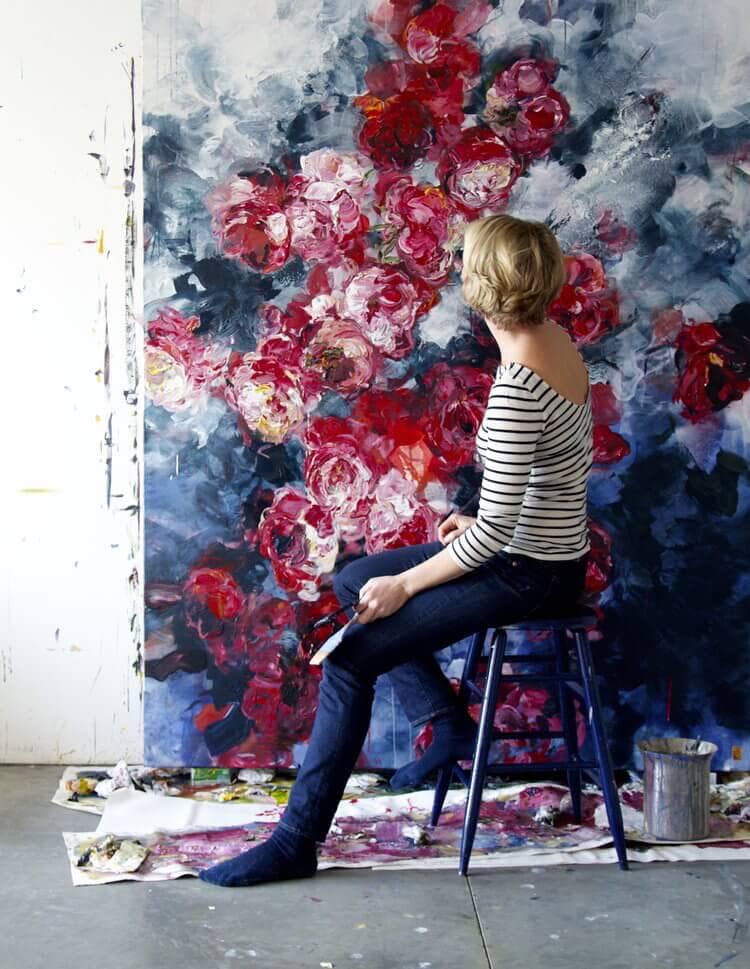
Bobbie Burgers is a Canadian painter known for large abstract floral canvases built from layers of acrylic paint, ink, collage, and thick gestural marks. Her work treats flowers less as botanical subjects than as a way to study colour, movement, and the push-pull between control and spontaneity.
| Field | Painting |
|---|---|
| Known for | Abstract floral works on large-scale canvases |
| Materials | Acrylic paint, ink, collage elements, mixed media |
| Style | Loose, expressive, saturated, often botanical in origin but non-literal |
| Origin | Canada |
What makes her paintings recognizable?
Burgers works at a scale that gives her brushwork room to behave like weather. Petal forms bloom, break apart, and overlap in dense clusters, often against pale grounds or fields of saturated colour. The flowers are rarely rendered with strict botanical accuracy; instead, they appear as fragments, bursts, and traces, built from quick strokes, smears, drips, and compressed layers.
That looseness is part of the subject. Her paintings use floral imagery to hold tension between order and collapse, abundance and restraint. A single canvas may combine crisp edges with rough scraping, translucent washes with opaque blocks, and areas that look heavily worked with places that seem barely touched. The result is decorative in the broad sense, but never merely ornamental.
How does she make the work?
Burgers typically builds her paintings through accumulation. Acrylic paint provides the main structure, while ink, collage, and other mixed-media interventions add variation in texture and density. She often works in layers, allowing forms to be covered, altered, or partially erased so earlier decisions remain visible beneath the final image.
This process gives her paintings a sense of movement that feels recorded rather than staged. Brushmarks stay visible. Edges bleed into each other. Colour is mixed, pushed, and interrupted instead of smoothed into a polished finish. The technique matters because it keeps the paintings alive to process; viewers can read how the image was made, even when its surface feels exuberant and complete.
Why flowers?
Flowers offer Burgers a subject with immediate visual appeal and a strong history in painting. They can signal beauty, fragility, excess, mourning, or celebration, and they carry centuries of association in still life and decorative arts. Burgers uses that familiar vocabulary but strips away the expectation that a flower painting must describe a real bouquet or a specific species.
That shift gives her work its contemporary force. The flower becomes a flexible form for abstraction, one that can hold colour theory, gesture, and scale without losing its emotional pull. In practice, the subject lets her make paintings that feel accessible at first glance and more complex on sustained viewing.
Where does her work sit in contemporary painting?
Burgers belongs to a strain of contemporary painting that reclaims decoration, pattern, and recognisable imagery without returning to realism. Her canvases sit near abstraction, but they keep enough reference to the natural world that they can be read immediately. That position matters in a field where painters often choose between pure abstraction and representation; Burgers moves between the two.
Her work also reflects a broader interest in material visibility. Rather than hiding the marks of making, she foregrounds them. The canvas becomes a site of decisions, revisions, and physical contact, which gives the finished image a sense of labour and immediacy. For readers interested in how paintings are made, that visible process is as important as the final floral image.
Frequently Asked Questions
Is Bobbie Burgers a realist painter?
No. Her paintings begin with flowers, but they do not aim to describe plants accurately. Forms are simplified, enlarged, and often broken into abstract passages of colour and gesture.
What materials does she use?
Her work commonly uses acrylic paint, ink, collage, and other mixed-media elements. These materials let her layer translucent and opaque surfaces, build texture, and keep the painting responsive to revision.
Why are her paintings often so large?
Large scale suits her energetic brushwork and dense layering. It also lets the floral imagery expand into something immersive, so colour and gesture dominate the viewer’s field rather than reading as small, contained motifs.
Articles mentioning Bobbie Burgers