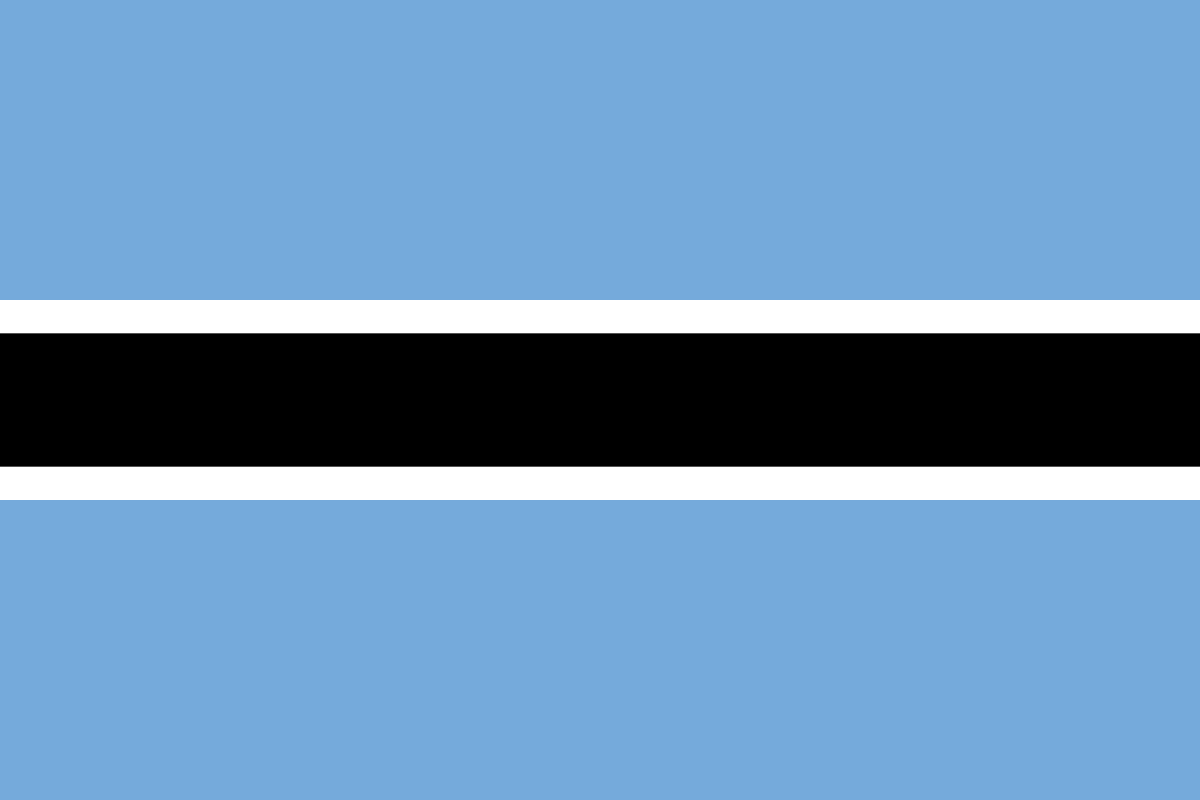
Botswana is a landlocked country in Southern Africa, known for its stable democracy, large protected landscapes, and central role in the modern diamond trade. It became independent from Britain in 1966 after a period as the Bechuanaland Protectorate, and since then it has maintained regular free and fair elections. The country’s name refers to the territory itself; its citizens are called Batswana, though English-language writing often uses Botswanan.
- Former British protectorate known as Bechuanaland before independence in 1966.
- Landlocked state in Southern Africa with borders that shape trade and transport.
- Best known internationally for democracy, wildlife conservation, and diamonds.
- Home to major desert and wetland environments, including the Kalahari and the Okavango Delta.
- “Batswana” names the people of Botswana; “Botswanan” is a common English adjective.
Where is Botswana, and what kind of place is it?
Botswana sits in Southern Africa and has no coastline. That geography matters: goods move by road and rail through neighboring states, and the country’s public life has long been shaped by the need to manage water, land, and mineral wealth carefully. Its terrain ranges from the arid Kalahari region to seasonally flooded wetlands in the north-west, giving it a strong contrast between dry open country and lush floodplain.
For a visual culture publication, Botswana often appears through its landscape as much as through its politics. Photographers and designers are drawn to the clarity of its light, the wide horizons, and the strong graphic forms of sand, grassland, and water channels. These settings also frame tourism, conservation work, and luxury travel narratives that frequently use the country as shorthand for remoteness, space, and ecological richness.
How did Botswana become independent?
Before independence, Botswana was the British protectorate of Bechuanaland. The transition to sovereignty came on 30 September 1966, when the new state adopted the name Botswana and remained within the Commonwealth. That change was not just administrative. It marked a shift from colonial rule to a government led by local institutions, with a national identity built around citizenship rather than empire.
Since independence, Botswana has been widely noted for competitive elections and political continuity. In African postcolonial history, that record makes it stand out. It has helped the country build a reputation for relative institutional stability, which in turn has influenced investment, diplomacy, and the way outside writers describe it: often as orderly, cautious, and well governed.
Why does Botswana matter in design and visual culture?
Botswana matters because it sits at the intersection of extraction, craft, conservation, and image-making. Diamonds are central to its economy, and the country’s mineral wealth shapes not only national finances but also the visual language around luxury jewelry, sourcing, and ethical supply chains. When a ring, stone, or brand story mentions Botswana, it may point to the origin of rough diamonds, the politics of extraction, or the prestige attached to a source associated with high-value stones.
At the same time, Botswana is strongly associated with wildlife tourism and conservation photography. The country’s parks and deltas appear in editorial and commercial imagery that uses emptiness, scale, and animal life to sell adventure or exclusivity. In that sense, Botswana is not just a location on a map; it is also a visual setting whose landscapes help structure how nature, travel, and luxury are presented.
What does Botswana look like in practice?
In practical terms, Botswana is a country where design and production often respond to scarcity and distance. Water management, transport, and conservation all require careful planning in a landlocked environment with large dry areas. That has influenced settlement patterns, infrastructure, and the look of built environments, which tend to be relatively low-rise and functional rather than dense or monumental.
In media and commercial imagery, Botswana commonly appears in two distinct registers. One is the polished world of diamond provenance, where the country names a source of value, trust, and traceability. The other is the open landscape of safari and conservation, where photographers use dust, reed beds, sunlight, and animal movement to create scenes of expansiveness. Both versions are real, but they tell different stories about the same place.
Frequently Asked Questions
Is Botswana the same as Bechuanaland?
No. Bechuanaland was the colonial name used under British rule, while Botswana is the independent state that replaced it in 1966. The new name reflects post-independence nationhood and a break from the colonial administrative label.
What do people from Botswana call themselves?
The citizens of Botswana are called Batswana in Setswana, the national language. In English, Botswanan is also used as an adjective or demonym, though it is less common in everyday speech than the country name itself.
Why does Botswana come up in articles about diamonds and luxury goods?
Botswana is one of the best-known diamond-producing countries in the world, and that status affects branding, sourcing language, and provenance stories. In jewelry writing, the country can signal origin, supply-chain transparency, or a connection to stones associated with high quality and significant value.